At the Heart of Learning


 images

The Endless Immensity of the Sea

 Once we get past the outmoded ideas of school – there’s only one answer, in the back of the book, take the test, and don’t look that’s cheating – we begin to see that learning and collaboration is an art and a science. We know more today about the science than ever before. We still tend to overlook the art.

A few weeks ago, my nephew asked me what the words “Subject Matter Expert” means. I told him it was all about learning. The expert was a team of people who each learned a lot about something, and learned more every day, until people agreed that team was The Subject Matter Expert. He listened carefully, then nodded and asked, “So, are Tommy and I the Subject Matter Experts about superheroes yet?” It made me pause and think about how that question would translate in the companies I consult with and what it meant for building successful collaborative teams who learn as they go.

Joi Ito, Director of the MIT Media Lab, writes about “neoteny,” the retention of childlike attributes in adulthood. This ability to learn is like the compounding interest on an investment; after two or three years, a relentless learner stands head and shoulders above his peers. It stands to reason that a team of relentless learners is optimized for successful collaboration.

So, why then are so many teams of smart people so stupid?

The answer has nothing to do with their collective IQ. I think the answer can be found in an obscure quote I pinned years ago on my actual pre-Pinterest cork board. It was written by Antoine de Saint-Exupéry, best known for his work The Little Prince. Here is the quote:

If you want to build a ship, don’t drum up people to collect wood and don’t assign them tasks and work, but rather teach them to long for the endless immensity of the sea.

The quote focuses on the art of collaboration. And it has a direct bearing on learning, lighting a fire instead of filling a bucket.

Amazing how some people knew so much about learning and collaboration before it became the business word du jour. The key to a great collaborative team is their ability to look outward in the same direction, to share a deeply felt goal or, as Saint-Exupéry wrote, “[…] to long for the endless immensity of the sea.”

Seems almost too simple to repeat. Yet I cannot tell you the number of times I listened to team members who had no idea what it felt like to long for the “endless immensity of the sea.” When we build teams to collaborate, we need to make sure that the first item on the punch list is to build a deeply felt desire, a “longing” if you will.

The next time you bring a team together, ask yourself a question: What is the longing — the deeply felt longing — which will drive the team to learn and perform, even if they do not have all the tools and knowledge to “build a ship”? What will wake them up every day and make them want to go wherever they dream of going? When you can articulate that longing, then you are on your way to a great collaboration and learning that will just happen.

Here are some examples that punctuate this idea:

We want to be the ones to really feel what it is like to step onto the surface of the moon.

The team will take the very first pictures of life on the bottom of the ocean.

We will actually see the proof of the ‘god particle’ that started all creation.

In the beginning, it is not all about the wood and the work. It’s about the art of collaboration, describing that longing that drives learning and collaboration forward. I spend a lot of time researching and studying, thinking and writing about the science of collaboration as a crucial part of learning. I just want to make sure I never lose sight of the art, of that longing for “the endless immensity of the sea.”
Using Your LCMS to Save Kirkpatrick


kirkpatrick

Forget About Level 4? Never!

Not too many years ago I remember the words of an L&D VP to whom I reported. We were talking about measuring the effectiveness of a very expensive training program we just delivered.

“Just focus on the first three. Forget about this Kirkpatrick level four,” he said. “It’s too hard and too expensive to figure out.”

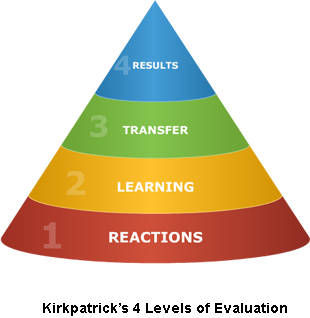
As a refresher, here are the four levels of Kirkpatrick’s evaluation model (I’m avoiding the argument about Level 5 on purpose):

  1. Reaction – what the learners thought about the course
  2. Learning – what the learners remember as well as any new skills and attitudes.
  3. Behavior – How much the learners transfer knowledge, skills, and attitudes from the schoolplace to the workplace
  4. Results – the final outcome, months down the road from the event, which was initiated by the course.

The first 3 levels are relatively easy to measure. They include the smile sheets (Level 1), demonstrations of what was learned (Level 2) and improvements in performance back at work (Level 3). The first two can happen during the training event; the third can be reviewed and assessed by a learner’s manager.

It’s Level 4 that’s more difficult, even though it’s the level that measures real learning. Let me back up a bit. Rote learning is what ‘skill and drill’ teaching gets you. It’s perfect for a Level 1 and 2 evaluations. You can even get by if the Level 3 evaluation is done soon enough after the course is finished.

If no one checks in after that you will probably not get a “Pass” on Level 4, unless you have adopted what you do every day and adapt it under a constantly changing set of circumstances. Level 4 is gated by the idea that “Practice Makes Perfect”. So it’s the down the road assessment that really tells you if the learning has become a new part of the learner’s way of doing their job.

Level 4 is a longitudinal study or assessment. It can be done at intervals that range up to one year from the learning event. It’s usually not done at all because it is the most costly and time consuming of the four. What’s changed is that new technology can make it easy.

LCMS Learning Objects to the Rescue.

The LCMS is usually thought of in terms of their ability to author learning objects. These objects can be stored in a repository and used to deliver a custom learning program. The learning objects are assembled by an individual learner who can tailor them into a personal learning path. On the other hand, a course that is SCORMed and developed as one-size-fits-many can be seen as one big learning object fixed in space.

When people are done with either a course or their personal learning path, it looks like the pellets flying out of a shotgun. All the learners go off in their own direction, and have separate and individual experiences. In short, they learn to adapt the knowledge and know-how they acquire in a multitude of different ways.

The course object can only measure the mean or average since it was designed for many people. Most Level 4 measures I’ve seen look at corporate data as if it was functionally related to what the learner knows or has learned to do. For example, an increase in employee retention can be the result of wage increases or an improved management style. Reduced waste is an old manufacturing metric that has little validity in today’s manufacturing processes. Increased customer satisfaction results from a constellation of factors. Fewer staff complaints in a tough economy are to be expected (add in increased retention as well). So the standard measures used at Level 4 are virtually useless in today’s workplace and economic environment.

Learning objects on the other hand can be turned around as a one-to-one assessment down the road because they were assembled by each learner who proscribed their own learning path. Learning objects that state “What I need to learn” can be flipped to ask “Did you learn what you needed?” Turn a learning object around, add a question mark, and you have a Level 4 assessment. If the learner six months later has really learned a new skill or behavior, you can easily find out by assessing them on what they decided to learn. If the learner is struggling with what they tried to learn, you can determine that as well and provide whatever support is required.

Learning technology changes the equation. In the same way that elearning removed the barriers of time, space and the four walls of the traditional classroom, LCMS can provide an assessment of a learning event ‘down the road’, and really start get to that formerly unobtainable Level 4. It can measure the degree to which the learning has been adopted and is being adapted.