Apply the “WHY” to Learning


If you want someone to remember and forget keep on doing what you’ve always done as an teacher or professor or instructor. Talk about the WHAT and HOW of whatever you’re trying to get your students to learn. If you really want them to give you some of their  precious brainspace to really know about or know-how to something then please pay attention because I’m about to tell you why you need to know this and practice it every time you transfer knowledge from your brain into another…

It all about starting with the “WHY”.

Create a Soundtrack that Captures What You Learned in 2011 So Far


I’m working on mine and looking forward to yours. Mine includes the following sounds:

  • New Years Cheers
  • Wine corks pulling and popping
  • Kids yelling
  • Gunshots
  •  Rachel Maddow
  • Lots of NPR bits

… and MUCH more.

Let’s literally HEAR from you!

My Latest Learning Obsession


I’m at the point where I’m beginning to think that we’ve come full circle. 350 years ago, before “education” became formal and public, we had spent hundred’s of thousands years learning stuff. We sat around fires and listened to stories. The best place at the fire was kept for the Shaman who was usually the storyteller. It was social. It went on all your life. It was all about continuous learning.

We moved to an apprentice model. Apprentices learned by watching, asking, making mistakes, and just doing. Their learning was a continuous experience from the day they started until the day they died. Experience did prove to be their best teacher.

So we move from that and more to the formal class and public schooling, corporate training events and then (drum roll please) informal, blended, social, virtual, simulated, digital games and … Did I miss anything?

Seems to me that, when you put it all back together, we’re back to the Continuous Learning Experience. So that’s what I’m going to focus on.

  • Are we back at the Continuous Learning Experience?
  • How do you disable the Continuous Learning Experience?
  • How do you enable the Continuous Learning Experience?
  • What does a Continuous Learning Experience design look like?
  • What does a Continuous Learning “Teacher” “Instructor” “Facilitator” do?
  • What are students expected to do during a Continuous Learning Experience?
  • Does it work?
  • Is it worth doing?
  • Can you measure the ROI?

… and more.

I want to hear from you since this blog gets between 3,000 and 12,000 hits per blog. What do you think?

How-To Learn by Trial and Error


This post should not need to be written …

Everytime, and I mean every time, you learn to do anything, you have done so by trial and error. Genius short circuits the process. Talent gets it quicker, but the process of learning is the same. Trial. and. error.

The latest findings from the neurosciences show that the brain aggregates memory and builds trial and error into the way to do something. Seems like the trial and error cells are held back while the successful trial and no error cells are moved to the front of the line. Then the old trial and error cells get recycled.

There are a number of things that either enable or disable this process.

Anxiety can work to help if it is aimed at the thing you are trying to do instead of at you focused on yourself failing. “I just can’t do this!” is anxiety talking, and disabling the trial and error process (hereinafter known as T&E). Someone outside your self talk can override your negative emotion with an enabling “Yes you can do it!” if they are an authority figure.

Which brings me to elbows in the mud at Boot Camp. Sargent Major SCREAMING “Whatisyourproblemgetourasupthatwallandoverthe toporIwillpersonallykickyour butttheremyself!!!” That is not a positive override, yet it sure as hell enables your body to get up and over the wall. How does that work?

Seems like the brain has a stronger need to win approval from authority figures than fail. So we do it for the Sarge. Or the Teacher. The Boy or Girl Friend. Or our Moms. Or Dads. Or our kids…

Or whomever we want to impress.

Regardless it’s T&E, the only way to effectively learn and the one way that is most overlooked by the industry from K – Corporate who purports to educate. The problem seems to be the E. You need to not fail. So no T&E only Just Do It. Nothing succeeds like success. [Add your own …].

It makes me crazy, not only because it disables the T&E process from Pre-K onward, it disables the process for all time. So we have a nation of people who no longer TRY because they are afraid to make an ERROR and FAIL. So we have a culture, a whole country of people who, for the most part, do not innovate, create, disrupt, do anything new and go from “Trial and Error” to “Tried and True”.

You want to learn or do something new and different and maybe better, faster and richer? Fail you ass off and count your errors as a plus rather than a minus.

Quick story to make a point. Thomas Edison was interviewed after he got the first light bulb to work (i.e. stay lit for more than a minute) and was asked “How did you manage to keep trying since you tried and failed over 1,000 times to get it right?”. He told the reporter “Those 1,000 times it didn’t work were all lessons that got me that much closer to the one that works.”

Now that’s T&E X 1,000. When it comes to learning, perseverance and persistence count …

At The Brain Gym


Today over 14 million people in 180 countries either subscribe to Lumosity’s website or have downloaded one of its iPhone apps. And revenues have grown 25% every quarter since its launch.

Never heard of it? Never worked out in one of their Brain Gyms? Here’s the story and it tells us a good deal about the future of learning since that grey matter in tour head that’s deciphering these words right now – actually a few nanoseconds before you get the message – will grow old.

Back up to 2007 …

Lumosity was a scrappy startup looking for seed money. Today, the San Francisco-based company that creates games to make your brain work better is announcing it’s landed over $32 million in new funding. 1,2,3,4 years and counting from $0 to $32M.

Quite the ride. But why you ask …

Tim Chang of Norwest Venture Partners recently told Fast Company the investment story. “When we first invested, we were concerned this was just a niche area for people with Alzheimer’s or other cognitive problems. But Lumosity has proved there’s universal demand for this among all demographics.”

A universal demand. That means you, me and a lot of other brains. Sharp Brains, a market research firm tracking the brain fitness space, estimates that the size of the market for digital products was just under $300 million in 2009.

And they estimate that it will grow to at least $2 billion by 2015. That US$2B.

When you sigh up at Lumosity’s website,  it starts a process in which go through a series of questions to figure out whether you want to improve your ability to remember names, get better at problem solving, or perhaps develop better concentration. Luminosity then designs a series of “courses” tailored to your particular interests.

The “courses” consist of 40 games designed to sharpen a wide range of cognitive skills.

For example, one game is about numbers. Arithmetic problems appear in bubbles, and you need to solve them before the bubble bursts. In a word game, you and several other players are given a three-letter prefix like “pre”.  You must come up with as many words as possible while a clock counts down. The clock is counting how many can you come up with?

(Hint: prescient, preface, presence, prefix, pre-test, preview, pre, you get the idea.

Lumosity CEO Kunal Sarkar believes that brain fitness is the latest wave in the trend of healthy living. For the last 25 years people have been running to the gym, running at the gym, trying to bend over backwards for a yoga class, filling up the parking lots at Whole Foods and organic Farmer’s Markets. So think of it as a gym membership for brain. A subscription costs $14.95 a month or $80.00 a year.

Okay, 10 seconds starts now, how much does a yearly subscription save you, do the math …

This is not really out there anymore. The neuroscience research coming out of universities in the past 20 years has proven that cognitive abilities – your ability to think, reason, concentrate and more – are not fixed. Just as you can pump up by pumping iron , the games that Lumosity lets you play really can make your brain stronger, faster, better and smarter.

Let’s face it. More and more who work in this new Digital Economy rely on how well the grey matter between our ears between our ears functions. Smarter at work is better at work. Lumosity users include traders in Chicago who use the tools as a brain warm up before charging onto the fast-paced trading floor, actors in Los Angeles who need to memorize a script before an audition, even pilots who want to improve their spatial abilities, their reaction times and quick thinking skills before wheels up.

And here’s the kicker that started this whole post. Again from Lumosity CEO Kunal Sarkar. “We don’t necessarily teach you anything but we make it easier for you to learn new things, which is more and more important.” Holy Brain Gym Batperson! Imagine a company that not only provides a gym gym for your body but adds in a Brain Gym for you brain…

Like I said, in this new global hyper-competitive digital economy, only the companies with the highest Corporate IQ will win. A Brain Gym might just be the new espresso maker of the next decade.

Bye-Bye Trainers!


How Mint Exec’s New Company Will Teach All Employees To Teach Others

Training has traditionally been part of centralized departments—and the bane of everyone else. MindFlash is about to change that.

Whether you’re a seasoned executive or new to the workforce, the idea of spending an hour in a training class is enough to make you long for a dental appointment. Online training, which emerged about a decade ago, hasn’t improved the experience much, even if it has allowed companies to save money on travel costs.

We can’t promise that MindFlash, a new cloud-based service led by former Mint CMO Donna Wells, is going to make the average employee jump for joy. But we do think it will have a profound impact on how organizations share knowledge–including eventually making trainers out of all of us.

Traditional online training tools consist of software systems that organizations have to install and manage on local computers or servers. That’s expensive. MindFlash, like just about every other work productivity tool released in the last few years, is based in the cloud. That makes it a lot cheaper. Which means more organizations can afford it.

Add to that the service’s killer ease of use. Mint, which earned itself a $170 million exit in 2009, did the impossible: Get 20-somethings hooked on personal finance, in large part by making the service drop-dead easy to use. MindFlash, which launched last September, has to be just as simple, Wells tells Fast Company. Though the service has a slew of features–the ability to add quizes, embed video, and track who’s taken a course–the standard they’re aiming for is to enable to new user to sign up, configure a course, and invite their first student in 15 minutes or less.

It seems reasonable to predict, then, that if you’ve got more organizations using online training tools, and more people capable of using the tool, training is quickly going to seep out of centralized training departments and become the responsibility of all employees.

And that’s what MindFlash is already seeing among customers, Wells says. As organizations need to move more quickly, it’s often faster to have the person with the expertise to prepare the presentation than waiting on a training department to get up-to-speed on the subject matter. Just as more and more employees are expected to have basic multi-media skills–the ability to blog, for example, or to shoot images or videos on their smartphones–so will they be expected to have the basic ability to share knowledge with their peers.

Perfection, says Wells, won’t matter as much as speed. “The most forward thinking are recognizing that the traditional approach to centralized content development results in content that takes so long to develop that it’s obsolete by the time it’s ready.”

As it becomes easier for workers to toss together presentations for their colleagues, “training” will probably come just as often in the form of 10-minute “classes”–to transmit bits and pieces of knowledge that need to be shared quickly–as the lumbering hour-long courses we’re more familiar with.

“Training just becomes a seamless part of the employee’s day,” Wells says. “It allows you to get better information into the hands of the people who need it, at the right time, increasing the speed and nimbleness of the organization.”

[Image: Flickr user Michael 1952]

E.B. Boyd is FastCompany.com’s Silicon Valley writer. Twitter. Email.

Changing VILT One Student @ A Time


Here’s the press release from Cisco and a video of Jeanne Beliveau-Dunn explaining the importance of the new certification:

Cisco Introduces The New Virtual Classroom Instruction Specialist Certification

Vendor-Neutral Training and Certification Helps Instructors Make

The New Virtual Classrooms Engaging and Improves Student Outcomes

SAN DIEGO, CA and SAN JOSE, CA — (MARKET WIRE) — 02/07/11 — Training 2011, Booth 416 — With more educators using technology to advance the classroom experience, Cisco (NASDAQ: CSCO) today announced the Cisco® Leading Virtual Classroom Instruction certification, developed to build and validate the skills that educators and instructors need to effectively teach in virtual classroom environments.

Key Facts

  • According to the American Society for Training & Development, 37 percent of training in 2009 involved electronic technology, up from 15 percent in 2002, while face-to-face instruction fell to 59 percent.
  • The Cisco Leading Virtual Classroom Instruction (LVCI) course teaches participants how to prepare and manage a virtual classroom, effectively deliver material online, and use collaboration tools to maximize student participation and comprehension.
  • LVCI goes beyond tool usage and teaches instructors how to improve learner outcomes through more effective classroom collaboration. They learn how to become Facilitators and work collaboratively with their learners
  • LVCI is delivered virtually using Cisco WebEx™; however, the skills are readily transferable to other conferencing and collaboration tools.
  • LVCI consists of 17.5 hours of live virtual instruction and six hours of participant presentations, delivered over five consecutive days.
  • LVCI is designed and led by experienced WebEx University instructors, who have delivered more than 40,000 hours of virtual training sessions.
  • Certification will be based on a proctored multiple-choice exam (642-132 LVCI) and a practical demonstration (642-133 LVCIP), in which the candidate uses the best practices of virtual classroom delivery.

Supporting Quotes:

  • Jeanne Beliveau-Dunn, vice president and general manager, Learning@Cisco, said: “As the paradigm of education continues to evolve to meet new institutional and business requirements, developing instructional strategies for new virtual education environments is becoming key to improving student results. The Virtual Classroom Instruction Specialist training and certification help ensure that instructors have the most comprehensive understanding of the latest technologies and effective classroom collaboration strategies. Cisco’seducational offerings provide the skills and depth of knowledge required for educators to differentiate themselves in today’s job market and enable a competitive advantage for their employers.”
  • Kathy Cooper, senior product trainer, WebEx University, said: “Cisco Virtual Classroom Instruction Specialist certification not only covers the skills and techniques instructors need to prepare and manage a virtual classroom, but also shows how instructors can engage learners in the educational process and increase their participation and comprehension.”
  • David Mallon, principal analyst, Bersin & Associates, said: “Our Virtual Classroom research shows that learning in an online environment is both less expensive and can be more instructionally rich than physical in-class experiences. Our research also demonstrates that what makes a great instructor effective online is the skillful use of collaboration tools. As job training and education continue to move online, this type of certification is an important offering.”
  • David Grebow, Instructional Designer, KnowledgeStar said: “This course is a game changer and will make the virtual classrooms the choice for learning in the 21st century. I had the privilege of working with some of the most forward-thinking and smart people at Cisco and WebEx, and we produced a certification program that will turn instructors into facilitators and students into adult learners collaborating with each other and taking the learning beyond the virtual classroom. It’s a new model for making online education really work.”

Ready Or Not …


Help! Not again! I was finally ready to do the old thing and now, here’s the new thing right on its heels. Something we’ve all felt. Newness. It seems to be the driving force in this new economy. And it requires more innovative approaches to learning than “training,” as an extension of our formal education. Why? Because it’s no longer a question of “What did you learn in school today?” but “Are you ready to do it, use it, sell it, make it happen?”

Let’s face it. In most corporations, we are lifelong survivors NOT lifelong learners. Performance is what counts. Short term memory wins. Defining strategies for enabling short-term memory is the future of learning in the new economy.

If you want a glimpse of that future, download Microsoft’s new online book reader. Welcome to hypertext, the book that does the work for you. Want a definition of a word? Highlight the word and click the mouse. Want to add a note? Click the mouse and type it. No need to take the time to find a post-it or get the dictionary. Certainly no need to remember the definition.

Who remembers anything any more anyway? Who needs to really remember with all the “remembering” tools at our disposal? And who has the time?

As lifelong survivors, we turn on our brains and learn when we need to get ready to do something. The rest of the time we get by with what we know. Learning is becoming synonymous with ‘being ready fast.” Ready for your next assignment? Your new job? That next sales call with a new customer? Or servicing that new widget? Readiness has become the true test of learning.

In the new knowledge economy, readiness stands alongside competitiveness. Readiness equals success. Imagine intersecting lines of latitude and longitude. Latitude is you, working every day. Longitude is your intersection with the new. The new seems to happen more frequently. You need to be ready or you’ll be left behind—not just you, but your whole company.

So if readiness is the key to success, here’s the question: Does any form of training (from elearning to instructor-led classes) help you get ready to perform? I suspect you know the answer.

If training worked so well, why aren’t we all performing like top guns? After taking all that costly and time-consuming training, why aren’t we all ready to sell that new and exciting product, or deliver that value-adding service, install and use that cool new upgrade? Why aren’t we ready?

Here’s the reason. Training is not focused on getting us ready to reach that exalted “State of Readiness.” Instead, training treats us as if we were still in school. The difference is that instead of a test and a grade, it’s our performance being graded. Instead of moving from grade school to high school, it’s our promotion or pay increase that’s at stake. In the corporate world, especially in the new knowledge economy, it’s all about Readiness: being ready to do something, not just learning about doing. I’ve never yet had anyone come into my office and ask me to “go learn something just to learn it.” You?

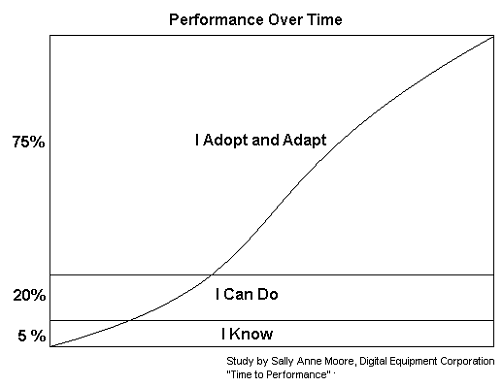
Here’s a bold assertion: Training does not make us ready to do anything. Here’s an interesting chart that explains why.

Training in the corporate world, where doing is everything, can only take you at best 25% of the way towards readiness. Usually you’re lucky if you get to the 5% mark. The other 75% or more is up to you.

Take the game of golf. You can go to a seminar or read a book about the History and Etiquette of Golf, watch a videotape of Great Golfing Moments, attend an Introduction to Golf seminar and you can say you know something about golf. But are you ready to play? You can then buy and enjoy a great computer eGolf game, find a golf pro, take lessons, learn to simulate the swing, practice putting, slice and dice balls at the driving range all weekend, and think youcan do it, but are you ready to play golf?

From your first tee shot on your first hole, it takes hours of adopting and adapting what you know and can do, swinging all the clubs, in all sorts of weather and conditions, failing and succeeding, practicing and more practicing, before you are ready to really play golf.

Readiness, then, is the state of being able to creatively adopt and adapt what you know and can do under a varying set of circumstances. You may not win the game, but at least you’re ready to play.

Can you say as much for your players? Is training making them ready? Are they getting the right support to help them get ready? Are they really discovering what they will need to be able to do and know in order to get ready? Are they at least getting that 25% of knowing and doing? Do they have enough time to practice, to fail and succeed, to adopt and adapt, and really get ready? Or do you expect them to do it on the job, fail at the customer’s expense, and practice on the customer’s dime?

The best example I’ve seen of a program that helps people get ready was recently created by a company called SkillScape. They created The Readiness Assessment Program (RAP)™ to help customers implement software upgrades. The RAP first helps you see how ready you are, then points you towards the learning you need as part of your Individual Learning Plan. After you cover your learning plan, you can assess yourself again and see where you stand. It’s focused, it’s targeted, and it’s designed to do one thing only: Get you ready for a specific new job.

Readiness? That is the question that no one seems to be asking. Content. Tools. Technology. Methodology. If it doesn’t help me or my organization get ready the next time something new crosses my path, then who cares?

The Future of the Book


“We find when writing moves online, the connections between ideas and people are much more apparent than they are in the context of a printed book.”

Bob Stein, Institute for the Future of the Book

This post comes, in part, from Spotlight on Digital Media

Bob Stein is founder and co-director of the MacArthur-funded Institute for the Future of the Book, an organization premised on the idea that “the written page is giving way to the networked screen.”

Stein agrees with many others that our definition of writing must change to include audio, visual and graphical components. Take a moment to digest that, because it’s actually the easy part. What Stein is working on at the Institute is something deeper than just the idea of books and other kinds of writing becoming multimedia. He’s encouraging a complete transformation of the notion of ownership of writing altogether.

“The age of the know-it-all author who went into her room for three months and figured something out that no one figured out, and had a whole idea that was hers alone – it’s over.”

The keys to understanding this new perspective on writing and reading lie in notions of collaboration and being social. More specifically, it’s believing that collaboration and increased socialization around activities like reading and writing is a good idea.

“You and I grew up with the notion of the little girl curled up in her chair reading, or the writer in her garret, right?” Stein said. “But what we’ve discovered is that when you move the function of reading and writing online, the social aspect comes forward.”

According to Stein, the idea of the author as someone who works alone to produce something that is hers comes from the Enlightenment—and from then until now is only a “blip in time.” This notion, he adds, is “only part of the picture.” The other part is facilitated by our increasingly networked world—reading other books, collaborating, sharing ideas, chatting with colleagues.

“We find when writing moves online, the connections between ideas and people are much more apparent than they are in the context of a printed book,” Stein said.

Essentially, the writer is a synthesizer of the information and ideas.

One of the Institute’s projects is CommentPress, an open-source plug-in for WordPress that aims to turn a document into a conversation (view examples here). Readers can comment on, say, an academic paper before it has gone to press and add insights and questions in the margins of the text.

It’s an idea very much in the air. The MIT Media Lab tagged collaboration as one of the key literacies of the 21st century, and it’s now so much a part of the digital learning conversation as to be nearly rote. In his new book, “Where Good Ideas Come From,” Stephen Johnson argues that ideas get better the more they’re exposed to outside influences.

It is not only the act of writing that is changing. It’s reading, too. Stein points to a 10-year-old he met in London recently. The boy reads for a bit, goes to Google when he wants to learn more about a particular topic, chats online with his friend who are reading the same book, and then goes back to reading.

“What I’m arguing is that we should say reading equals all of these behaviors,” Stein said. “Not just when you’re looking at the book, but also when you’re talking to people about the book or when you’re Googling things that occur to you as you read the book.”

The implications for learning are huge. In a recent experiment by the Institute, professors at the University of North Carolina used CommentPress when assigning the story “An Occurrence at Owl Creek Bridge” by Ambrose Bierce in a first year seminar course. The story was posted online along with clips from the 1962 film adaptation. Students engaged with the text not only in the classroom, but also while they were at the library after class and at home after the library. (Learn more about the project in this video.)

“They come back to class the next day still talking to each other,” Stein said, “because the conversation continued in the margins.”

Laura Flemming is an elementary school library media specialist in River Edge, N.J. About three years ago, she came across a hybrid book—half digital, half traditional—called “Skeleton Creek” by Patrick Carmen.

“The 6th graders were running down to library class, banging down the door to get in, which you don’t often see,” Flemming said.

Indeed, she was so struck not only by her students’ enthusiasm, but also by the way they were picking up themes of character, setting and mood that she started researching the subject in her spare time. Now she writes the blog edtechinsight.blogspot.com, where she discusses digital reading and writing.

Flemming’s favorite transmedia work is “Inanimate Alice,” a remarkably evocative and compelling multimedia book from the BradField Company. Alice is an 8-year-old girl in China searching for her missing father in episode one. Music plays; images float by; text rolls across the screen.

“We tell our kids we want them to know what it’s like to walk in the shoes of the main character,” Flemming said. “I’ve had more than one child tell me that before they read ‘Inanimate Alice,’ they didn’t know what that felt like.”

Flemming believes that digital storytelling, done right, can increase children’s ability to empathize. It is also about teaching kids interactive communication skills, because, says Flemming, “this is the world they’re growing up in.”

That is an answer you’ll hear a lot in the world of digital media and learning. But Stein says that’s not good enough. We must be sure we’re driving the horse, he argues.

Stein says it’s better to take advantage of new technologies to push the culture in the direction you want it to go. Stein is fully aware of the political and cultural implications of his vision of the future of reading and writing, which shifts the emphasis away from the individual and onto the community. It’s asking people to understand that authored works are part of a larger flow of ideas and information.

“We’ve grown up in a world where all great ideas are pretty much ascribed to a single individual,” Stein said. “What we’re not particularly good at is understanding what the origins of that idea were or seeing the continuous flow of ideas.”

Such a redrawing of the boundaries of authorship, of course, undermines our system of intellectual property and copyright laws. If the creation of a book is a collaborative process, who owns it in the end?

“The writer gets the marquee billing,” Stein said, but is this really appropriate? Consider a party, he says. A guy named Bob may have hosted, but if there weren’t any guests, the party wouldn’t exist. We call it Bob’s party, but is it really his?

“As for what a new “progressive system” of copyright law might look like, Stein doesn’t have a prescription. He just knows that what we do have isn’t working.

Stein was recently in San Paulo giving a talk. While there he found himself deep in discussion with a filmmaker, a colleague of Jean-Luc Godard.

“He was arguing the auteur version of filmmaking,” Stein said, still going over the conversation in his mind. “And I understand why that worked for the first hundred years. But it’s not the future. The future is the collaborative effort.””

Industrial Age Education is DEAD


Industrial Age education is dead … but not buried … that was the full title of this blog.

and I have nothing to add except watch and listen to Sir Ken Robinsons spot on understanding of the current AND future problems with education around the world. If enough people listened to him then The Future might have a chance …

It’s hopeful, and at the same time frightening, since we seem to cling to the old model of education like a life raft in bloody shark infested waters. And we drag that same stupid raft into the workplace even though it never worked in the schoolplace.

(… and thanks as always to RSA Animate for the amazing and brilliant job the UK team did on Sir Ken’s presentation.)