Welcome to Learning 3.0


(Please HELP! I’ve been looking for a GREAT representative image that captures Learning 3.0 and becomes iconic for the next wave of learning experiences … I’m hoping that you can help me find one. Thanks)

I usually ignore the labels…

Lately I’m beginning to see that they serve  a purpose. They delineate the evolutionary stages of our profession. They also coincide with the evolution of technology that to date has brought us to Social Media and Social Networking.

Let me take a crack at defining the ones I’ve heard so far.

Learning 1.0: The emphasis was on the blending of the Industrial Economy learning methods (Kirkpatrick, Gagne et al.) that were essentially non-scientific observations with  the newly emerging computer tools such as elearning on disc. We were still the Gatekeepers of Knowledge (or at least we thought we were). Programs were developed from theories and intuition and “training” was basically a craft. Students were students, the classroom was the default environment, and you were a meaning taker (sponge) as Ruth Clark so aptly called it.

We were beginning to be enamored with technology for learning and attended conference called “TechLearn”. We could finally put the teacher in the box.

Learning 2.0: The emphasis was on the tools and technology that had rapidly evolved and could now deliver learning programs to more people anytime and anywhere. We still acted like the Gatekeepers, and we learned a lot about the new (and newer) technology and tools (Authorware software programs, LMS, Virtual Instruction, et al.) to put the teacher (us) in the box. We delivered training on CD’s, over slow computers, creatively and artfully blended technology and people.  We were still in the bookish mindset, creating what were referred to as “page turners” on screen.

Programs were still based on a best guess, supported by assessments, pre-existing theories and/or committee agreements about what the people needed to learn. Period.

Learning 3.0: The latest evolution that places the emphasis back on people and takes us out of the role of Gatekeeper. Blame it on the newest technology that puts the learner in the driver’s seat. Now ‘the people’ decided what they need to learn and, guess what, if we cannot come up with it then they will go wherever they need to learn what they want to know and know how to do. If we stay in the Learning 1.0 or 2.0 mode we’re toast, we have become irrelevant.

Our job is to take the role of Enabler, Mentor, Tutor etc. We can no longer manage knowledge. All we can hope to do is manage the environment in which knowledge can be “…created, discovered, captured, shared, distilled, validated, transferred, adopted, adapted and applied.” [Chris Collison and Geoff Parcell, “Learning to Fly” January 2005, Capstone]. Scientific research into how the brain works and how we really learn, has replaced sociological and psychological observation that generated the theories about learning.

Learning 3.0 is another BIG change. And it comes too soon, way too soon for many in our industry. They have made a name for themselves during the previous phases. Can they change and evolve?

Meaning takers now become meaning makers. Collaboration is the essential key to learning. Learning and Social Media and Social Networking are all mashing up. Having a group working together to learn with and from one another is the quest. And it is a quest.

We need to drop all the stuff we learned during the previous phases. We need to adopt new roles as Mentors and Guide and even Entertainers and Storytellers.

All the stuff about informal and blended and everything else that’s “teacher-centric” or “content-centric” needs to be abandoned. It all needs to be focused as “Learner-centric”. And that means Wiki, Web Portals, Connecting people in the class … and anything else that does the following:

  • Builds that learning experience upon the solid foundation of science and the most current scientific research about the ways the brain learns, remembers, forgets, adopts and adapts. We need to learn to enable rather than disable the learning process with which we are all endowed from birth
  • Creates and delivers a compelling way of transferring the knowledge, transforming it into a learning experience
  • Be emotional, entertaining, full of stories, anecdotes, and anything else that touches the hearts and minds of the people experiencing the program. Put an end to death by PowerPoint
  • Takes full advantage of all the technology tools&toys we have now and will have in the future and uses them really well. This means well trained Virtual Instructors / Mentors / Guides who really know what their about.
  • Connects the people before, during and after that learning experience so they can learn from one another and continue to learn from one another

Okay, so you heard it here first. What do you think about Learning 3.0?

A Tool for Learning 3.0


How many times when you’ve been watching a movie have you just wanted to reach out and poke an annoying character? Maybe help a fleeing victim by making them run just a little bit faster? A new interactive experience by production company Tool of North America uses the capabilities of the iPad to allow viewers to do just that as they interact with–and seemingly change the outcome of–live-action video. Part video game, part immersive entertainment, Touching Stories is available today as a free, downloadable app, and we’ve got an exclusive behind-the-scenes video that gives a peek into the process of making it.

Tool, who create ads and interactive work for brands like MTV and Bud Light, had been tossing around ideas for creating such an experience for the iPhone, but as soon as the iPad was announced they realized the device was made for their concept, says Tool’s digital executive producer Dustin Callif. “Immediately as visual storytellers we got excited because the iPad is such a better device for consuming media than the iPhone–I mean just look at the difference in size with the screen,” he says. “We’ve been looking for the right opportunity to really create customized stories.”

Five of Tool’s directors–Geordie Stephens, Jason Zada and Erich Joiner, Sean Ehringer and Tom Routson–shot four films with interactive points that call for touching, shaking or turning the iPad built into the plots. A partnership with Domani Studios provided the technology to connect the film process with the iPad’s multi-touch and accelerometer features, as well as the ability to load videos or visit Web pages. The result goes far beyond special effects–the team rebuilt each film’s story within the context of the iPad experience.

Last week, Tool used the convergence of advertising’s top players at the Cannes Lions festival to create major buzz around Touching Stories: They delivered iPads pre-loaded with the apps to at least 10 chief creative officers at blue-chip agencies. A smart move, since the experience feels like it’s made for delivering a brand’s hands-on experience to consumers. But the implications for more narrative filmmaking are also important–how will this technology change the face of storytelling?

This week, we’ll have an in-depth look at each film and see how Tool worked closely with Domani Studios to collaborate on this new experience. If you want to try it for yourself, Touching Stories is available in the App Store today. Be careful, though, if you mess with the fate of those characters: Sometimes they strike back.

From Fast Company

How to Make Corporate Training Rock


By: Dan Heath & Chip Heath

How one team transformed a training binder into must-see TV.

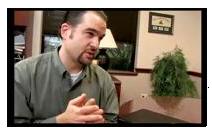
WORLD’S SLEAZIEST BOSS BearingPoint’s ethics videos deftly mimic The Office’s mockumentary style, even starring a Michael Scott-esque leader.


Russ Berland’s first assignment at BearingPoint was a doozy. He was asked to redesign the company’s ethics-and-compliance training program. If simply reading the phrase “compliance training” sapped a little of your will to live, perhaps you can empathize with Berland.

Most companies — including yours, probably — have an ethics program, and often the “program” looks uncannily like a three-ring binder. It may be sitting on your bookshelf right now, between What Color Is Your Parachute? and the 2003 Metro Area phone book. It’s filled with mimeographed, knuckle-rapping prose, just like the code of conduct Berland inherited, which, he said, appeared to have been repurposed from a law firm.

Yet compliance training was critical at BearingPoint, a management and technology consulting firm, because the company’s employees often spent more time on client sites than at home. So Berland, the chief compliance officer, had to influence the behavior of employees who were scattered across the country, operating in organizational cultures very different from BearingPoint’s. (BearingPoint filed for bankruptcy earlier this year, due to an excessive debt burden unrelated to an ethics issue.)

Berland and his colleagues began to interview some of the company’s associates, asking them about real-world “gray areas”: What situations make you feel squishy? What have you seen happen in the field that gave you pause? Soon, they’d uncovered stories of ethical quandaries and anxious situations and strained relationships. It was exactly the sort of drama that was absent from the three-ring binder.

Then came their epiphany: Let’s bring this drama to life. They hatched the idea to film a fictional series, modeled on The Office, that would highlight the activities of a single IT consulting engagement team. The team would work for a fictional company called Aggrieva, which was designed to be the evil doppelgänger of BearingPoint. (Motto: “Aggrieva says yes when everyone else says no.”)

Berland hired filmmaker Marc Havener to direct the series, and they shot an entire season of 10 short episodes in a weekend. The episodes deal with touchy areas such as bosses hitting on subordinates, teams misrepresenting their expertise, and managers trying to pass along inappropriate expenses to the client. In other words, comedy gold.

Here’s a scene where Kevin, the lovably oily boss, has proposed throwing a grandiose surprise party for Ricardo, a client, as a way to curry favor. Vanessa, a levelheaded analyst on Kevin’s team, objects:

VANESSA: Sir, how are we going to pay for this?

KEVIN: We’ll just work it into the bill somewhere.

VANESSA: We can’t bill a client for a birthday party.

KEVIN: [Exasperated] Okay, you know what? Fine. I tried. You know what, Vanessa? I want you to look Ricardo in the face and tell him that we don’t care enough to throw a party for him.

VANESSA: Wasn’t this party supposed to be a surprise? Why do I have to tell Ricardo that the party is off if he never even knew about it in the first place?

KEVIN: Well, now it’s “Surprise! There’s no party!” Tell him that.

The episodes were an immediate sensation. The emails poured in: “This is the best training I’ve ever had.” “I think that episode was based on my team.” “I’m cackling like a madman,” and so forth. Soon, the characters and situations became part of the company’s vocabulary. Many employees admitted to Berland that they had “worked for a Kevin.”

New episodes debuted each Monday, but employees were so ravenous for the next episode that they started tracking them down on the company’s staging server where the videos were posted on the preceding Friday. Thousands of employees watched the videos before they were released.

Note: When your company’s employees are madly searching for your compliance videos, you’ve done something right.

Great Way to Learn


It may seem like I’m sidestepping the issue of learning, but I learned SO much from the way this was done that I had to include it as an example of “way to go”.

Failure Is NOT An Option


Well, there you have it … as often is the case Dilbert sums up the mess we’ve gotten ourselves into … without failure there can be no real learning, since real learning requires practice over time to adopt and adapt what you know and can do … under an ever-changing variety of circumstances.

If experience is the best teacher, then corporations that do not reward real learning – trying , failing, succeeding – have fired the best teacher.

Actually she was never hired …

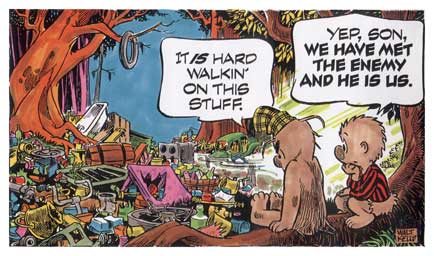
It’s like another great cartoon character, Pogo, told us years ago ,

“We have met the enemy … and he is us.”

The Real Meaning of mLearning


The mobile web has eradicated any wired person’s dilemma whether to be offline in the real world, or online and stuck in one location (an office cube, a living room, or worse, the basement).

Offline is now online, and online is offline.

mLearning will be the driver for Learning 2.0. Today’s smartphones and tablets – e.g. iPhones and iPads – are just the beginning. We now have real meaning when we say learning anytime anyplace. It first meant someplace other than the classroom. Now it means the freedom to learn when and where you need to know.

The implications for learning are as profound as the creation of the formal educational system. That system was created to support an Industrial Economy where mass production required mass consumption. Learning 1.0 was all about learning as an event, a beginning and an end, ADDIE, Kirkpatrick’s Levels, SCORM and ‘asses in classes”.

Learning 2.0 is all about performance, connection and conversation, mentoring and support, learning as a process that occurs over time and can now be supported with mlearning when and where you need to learn.

The implications for design and delivery are profound. Courselets. 10 minute time limits. Compelling emotional stories to pull a learner in and provide lessons from the real world …

… that’s only the beginning. There’s the added benefits of Social Media and Social Networking = Social Learning. The mind boggles …

Welcome to the new world of mLearning. Like my friend Marcia Connor says in one of her new Learnativity posts (which I recommend you RSS ASAP) “In Naming Elephants, Sue Hammond and Andrea Mayfield write, “Ignorance and knowledge grow at the same rate because the more you know, the more you know you don’t know.””

Get used to it … the more you can learn about mlearning, the more you know you don’t know. Like the unk-unk I use in groups to whom I speak. It means the unknown unknown. You can’t know what you don’t know. You can only keep learning, and discovering, and pushing the boundaries of your expectations aside.

Back to the Future


Sometimes I think we already knew then what we are learning today. Take a music break and learn a lesson:

Extraordinary App for Education


I’m not selling smartphones but you just have to look at this augmented reality app from the Museum of London called “Streetmuseum“. Talk about bringing history alive.

How would you use it to help learners learn?

I’ll start with one – a thriving small business that was a microloan start-up with an augmented reality picture of the gross empty lot that was there a year ago. Use it to motivate people who are learning how to write a simple business plan to get a microloan to start a small business. After seeing a number of augmented success stories, and then walking right into the business and talking with the owners about their experiences.

Out of the classroom and into the street, that’s where learning needs to go more often.

“It’s the brain, stupid!”


It seems a bit crazy to me that people who are responsible for creating educational programs for adults fail to listen and learn from the amazing work being done in the Neuroscientists and others who are discovering how we learn.

They are learning how we send ideas from our short-term to our long-term memories; why ten minutes is the maximum amount of time we can pay attention; when a lesson learned becomes part of one’s life.

… and so much more. I tried to capture some of it here. Hopefully it will shake you out of the Industrial Economy box in which all of the educational theories you hold so dear were created. To be replaced by a real understanding (and the principles, rules, methods and approaches that follow) of the miraculous ability of our brains to learn.

Here’s the link:

http://www.slideshare.net/KnowledgeStar/how-adults-learn

We Are No Longer the Gatekeepers of Knowledge


Chris Collison and Geoff Parcell, in their recently updated book and CD, “Learning to Fly”, have what I believe is a paradigm shifting insight into our professional lives:

“You can’t manage knowledge. Nobody can. What you can do is to manage the environment in which knowledge can be created, discovered, captured, shared, distilled, validated, transferred, adopted, adapted and applied.”

What do you think? Can we still manage knowledge, or has technology stripped the power out of our hands and given it to anyone, anytime and anywhere? And if they’re right, what new role should we take?

I’ve been giving this a lot of thought and have come to the conclusion that we need to become any or all of the following:

  • Knowledge Traffic Cops
  • Translators of Techspeak into (whatever language the non-technical folks in your country speak)
  • eKnowledge Librarians
  • Mentors
  • Coaches
  • Tutors

We are no longer the gatekeepers of knowledge.

If anything, we are the bottlenecks, the place where all the people who need to learn and to know how to do, get put into line and told when and where and how they can access what they need today, right now.

I remember Instructor Led Training programs that had waiting lists of hundreds of people who needed a certification course but had to hold off on their careers until there was an opening for them to get to the knowledge.

I think we had the impression that we ‘owned’ the knowledge … back then perhaps we did.  But that’s no longer true …

What do you think?