Digital Immigrants Zero, Digital Natives Won
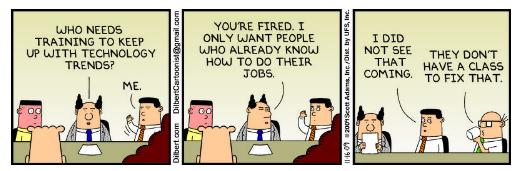

dilbert on training

I recently read this and had an epiphany about why older workers over 40 are becoming an endangered species, not only in the high tech industry but in companies worldwide.

“Besides the problem of “older engineers who face rapid skill obsolescence and deteriorating job opportunities,” they wrote, there’s a switch in how U.S. companies regard their employees – from a “high commitment system,” which puts a premium on long-term employment and on-the-job training, to a “high innovation system.” “Engineers are typically hired because their skills and knowledge are required for a specific technology or product being developed,” they wrote. “This system is seen as cost effective, since the company can hire required skills and does not have to retrain experienced workers, who usually command higher wages than new graduates. Of course, this puts engineers, who are no longer retrained by their companies, at a disadvantage as they age.” From SFGate.

I come from a generation of continuing education – workers who were tagged to go from event to event to learn new skills and improve or update old ones. I wondered why there were so many older (read post-40) workers being counted as part of the ‘long-term unemployed’. The answer is that “learning” has been replaced by “knowing”. If a company can find a worker with a specific skill to fill a job that requires that skill, then there’s no need to spend the time and money training someone to learn it. In today’s flat and hypercompetitve world, it’s the equivalent to trying to teach a square peg ‘roundness’ when simply finding a round peg will do.

It’s the difference between the “high-commitment system” in which employees expect to be taught and learn and improve skills while they are working in order to perform, and the “high innovation system” in which people only become employees when they can already perform the skills that are required. How they learned them is not important. Being able to prove they can do them is all that counts.

In the industrial economy where change happened more slowly there was time and money to train someone in a new skill. In today’s Digital economy, there is more talent out there than time or money, training as we knew it is becoming irrelevant. Let me repeat myself; training as we knew it is becoming irrelevant. If that scares you then you are a Digital Immigrant and should be scared. The digital revolution has happened so fast that an entire segment of the workforce now has an expired ‘use by’ date stamped on their foreheads.  Digital Natives today and in the future will always trump a Digital Immigrant in the job market. What a Digital Native has already learned will always be in higher demand than what a Digital Immigrant can learn. The younger Digital Native must be continuous learners who learn on their own dime and in their own time. What they know comes prepackaged, not as a SCORM-wrapped course, but as who they are. The Digital Immigrants are still waiting around for the class to begin.

So the next time you see a picture of an employment fair or a long-term unemployed 41-year old engineer, the knee-jerk response about “all they need is more training” is not the answer. I’m not sure what is, but the epiphany is that retraining older workers no longer works. Like they say on Wall Street, “Past performance is no longer an indicator of future returns”.
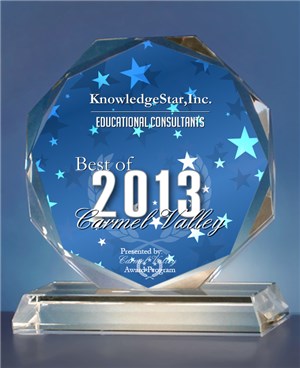
Tooting Our Horn


Sometimes we just need a pat on the back …

C13DB9C-PBAX-BGVV

Learning Wisdom


I keep wondering where is the wisdom…

I’ve spent a lot of time over the last few years trying to discover how we learn wisdom. I see a continuum that goes like this:

Image


OVER TIME

Data is raw stats that over time becomes a fact. That fact is tested (or should be) and turns into more useful information. That information in turn is used by a number of people and becomes knowledge. Knowledge that can be shared by anyone anywhere. Time tests the knowledge as it is used to produce know-how. All the usual suspects are included in the process – content, context, communication, collaboration, connection. That know-how is then tested over a longer period of time by lots of people and becomes wisdom.

So wisdom is borne by many and stands the test of time. The flame is hot do not touch. A penny saved is a penny earned. Time heals all wounds. The statements of wisdom abound. Yet they all seem old and tired. Where is the new wisdom? 

It matters to me because we seem to have stopped learning at know-how. Here’s a quote that kicked-off this post:

“You’ve been thinking about intelligence the wrong way. Almost everyone assumes that intelligence is a genetically programmed trait like eye color—set from birth and unalterable. Yet the extensive body of research on human intelligence demonstrates that this assumption is false. Our best data show that IQ, the most common measure of intelligence, fluctuates within a person’s lifetime as well as from generation to generation. This is our conceptual starting point: IQ scores are changeable. With the right environment, intelligence levels can be increased intentionally. This possibility holds implications for you and for the world around you.”—Michael E. Martinez, Future Bright: A Transforming Vision of Human Intelligence

We apparently become smarter and stupider at the same time. There is wisdom in not killing one another yet we seem to stop at knowing-how to develop better weapons. There is wisdom in learning how to love one another on this insanely impossible human journey yet hate is on the curriculum in schools worldwide. We have been visited by great teachers – Abraham, Buddha,Deganawidah James the Baptist, Jesus, Moses, Muhammad, The Saptarshi, and many others – yet we seem to not only ignore the wisdom they taught, we often turn it upside down and use their teachings to support what (never who) we hate and want to kill or eradicate. 

The point is who cares how much we learn or even how we learn if wisdom is not one of the goals. Can elearning help teach wisdom? The Kahn Academy model? A flipped wisdom classroom? Wisdom games? 

Without wisdom we will destroy one another and the world that is Gaia to us. Learning needs to grow over time and become wisdom. We should be wise enough by now to have learned that we must stop wrecking the earth, work to disable countries from fighting civil wars, have religions teach tolerance instead of hate, pay attention to the growing divide between rich and poor, practice forgiveness and support the least among us and more. So much more. We have the hubris to call ourselves Homo Sapiens ” in Latin meaning Wise Man”.

Yet I keep wondering, after all this education and learning, where is the wisdom?

How to Get a Head


I’m not sure what this has to do with education, learning, knowledge transfer, or anything else I usually write about. It just struck me as … relevant? You decide.

A leading neurosurgeon has revealed a project to carry out the first human head transplantation with spinal linkage with the next two years. The project is code-named HEAVEN / GEMINI. Read more here … Is this immortality? Can we finally forget about uploading what we know into the cloud? Could Stephen Hawkins head be put onto a healthy body? Does anyone reading this doubt it is a possibility?

262948-head-and-neck


Create Your Own Education


Image

Ditch the Lectures, Save Tens of Thousands, and Learn More Than Your Peers Ever Will

The cost of college can range from $60,000 for a state university to four times as much at some private colleges. The total student debt in the U.S. now tops credit card debt. So a lot of people are asking: Is college really worth it?

There are several famous and staggeringly successful college dropouts, including Mark Zuckerberg, Bill Gates and Larry Ellison. You may not end up with fat wallets like them, but Dale Stephens says you can find a different education path.

Dale Stephens, founder of UnCollege.org and author of a new book,Hacking Your Education, challenges people to learn differently, away from a school campus.

“When you think about education as an investment, you have to think about what the return is going to be.”

Stephens points to an alternative self-education system by taking responsibility for learning on your own and using networking to your advantage. He also says school just isn’t for everyone.

“I left school because I didn’t feel like school was an environment that left me free to learn,” says Stephens, who dropped out of college. In his interview he makes it clear that college will always be there in one form or another. These days, with MOOCs and other online learning programs, building your own curriculum is easier than ever. Plus schools still have not adapted to the need for a real-world performance -based educational model. Perhaps the better path for some is the educational road less taken.

Image

Tyler Driscoll/Courtesy of Perigee


Interview Highlights

On what “hacking your education” means, and how people learn

“Hacking your education is about figuring out how to create an education for yourself. There are all these different parts of an education that are currently just given to us. And hacking your education is figuring out how to find the mentors, how to build the network, how to find the content and put those together in a package that works for you. One of the great myths of the school system is that we tell people that everyone should learn exactly the same thing and exactly the same way, at roughly exactly the same speed. And that’s just not true. People learn in different ways, at different speeds, at different times. And so hacking your education allows you to learn what, when, how and where you want.”

On leaving the college experience behind

“For anyone in college today, just going to college is not going to be enough, right? The competition for a job is insanely furious. We keep hearing about the extent to which there’s a gap in skills between what people learn and what companies are actually hiring for. And whether you go to college or not, it’s your responsibility to figure out what it is that you need to learn, and how you can learn those things so that you can get a job after school.”

On figuring out whether or not to go to college

“It’s an even bigger gamble to … commit to four years into an institution, when the average student graduates with $27,000 in debt, which is an astronomical amount of debt to be saddled with, as you’re coming out and trying to find an entry-level job and being forced to pay off that debt. If college were free, this would be an entirely different question, right? But when you’re faced with the economic reality of how much college costs and how little self-directed learning costs, I think the cost is fairly low. College is not going away anytime soon. If you want to go back, it will always be there. But the cost of taking a year to learn for yourself is nothing.”

A Basic Primer on MOOCs


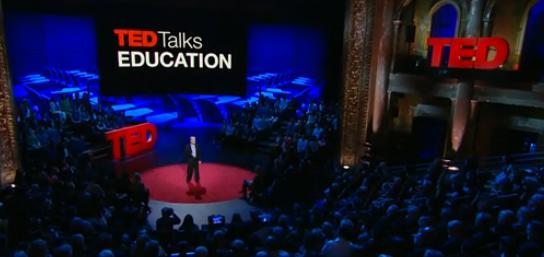
I’ve been posting about MOOCs since they first appeared. Easy to get lost in the trees and forget to see the forest. So I look at this TED presentation about once a month to get a refresh on the basic reasons why MOOCs are so important. The message gets lost too often in the static of the various media pundits and education gurus who, having very little if anything to do creating and developing MOOCs, still feel obliged to weigh in on them.

Daphne Koller is one of the original and most articulate visionaries behind MOOCs. Every time I watch this I pick up a new idea as well as remembering some of the basic reasons why MOOCs are important and are here to stay.

MOOCs are a work-in-progress. How they end up looking and working is To Be Determined. Like anything new with education they are still in the early stages of their evolution. I recently heard a mother tell her son that a MOOC was not worth taking since they were “… still experimental”. A MOOC is no more experimental than a college lecture hall presentation by professor. And that may be the sticking point … but don’t worry it’s covered by the presentation.

Inside the Crystal Ball: Education and the Future


Untitled

Children are the future, and their education needs to be part of that future, woven into the web of the digital world, not stuck in the rut of the industrial economy we are leaving behind. This really summed it up for me ….

“We’re still teaching our kids using a 20th-century paradigm, but many visionaries–like the ones in this video–have plans to take our advances in computing and technology and use them to explode the idea of what education can be.”

http://www.fastcoexist.com/node/1680776


Content as a Service (CaaS)


Image

The etextbook in 2018 will be dramatically different than the etextbook of today. It will be coupled to an app that will provide you with Content as a Service (CaaS). CaaS will include many of the following features (and more that have yet to be imagined):

  • Multimedia
  • Simulations
  • Educational Games
  • Animations
  • Pre- and post-tests
  • Formative and Summative Quizzes
  • Adaptive testing
  • Networked Social Learning
  • Study groups
  • Analytic Datasets 
  • Virtual and Flipped classes
  • Communities of Learning and Practice
  • Virtual classes.

It will be designed to make learning easier and more effective. It will replace the old print (and even current online) early prototype etextbook that still uses content as the product. By 2018, you will be purchasing the services which the CaaS app will provide. Dream with me a moment …

I am sitting at my desk in the near future, the year 2018. My Ecology etextbook is on my tablet and my elearning app helping me take notes. I read the following: “The biosphere is interconnected with three other spheres of the physical environment: the lithosphere, the hydrosphere, and the atmosphere.” I press the ASK THE EXPERT button and an email form pops up. “What” I write “does the term Gaia have to do with all the spheres?” The answer will probably be in my inbox before I go to sleep. I watch the animation of clouds forming and rain falling and plants growing. I skip the I Dig the Earth game and decide to test myself to see if I’m getting it.

Principles-of-Biology-digital-textbook-by-Nature-Publishing-Group-pop_10779

So I touch the TEST ME button and a menu comes down asking what kind of test do I want? I say Chapter, and a test of the chapter appears. I could have asked for Page, Chapters or Book. I answer the questions, get most right, and the ones I missed are automatically turned into flashcards. I skim all the sentences I highlighted when I was reading, check the notes my friends sent about the book, answer a few questions they asked, and bookmark my place. I remember to place a yellow sticky note on the front to find my reading glasses although enlarging the type was no problem. I check the times of my remaining biology courses that week, and make sure there are no tests coming up. Taking a break from studying, I switch from the etextbook to an old Big Bang Theory TV episode I missed.

Nice fantasy? Not at all. The etextbook of the future is all about the idea of Content as a Service (CaaS). Textbooks in the not-too-distant past were a product. You wrote them, packaged them, and sold them. Period. They were a product, often a commodity that had many versions from many authors on the same topic. As textbooks moved from analog print to digital online something amazing started to happen.

They were free. Not free as in no cost although they are cheaper (and lighter). They were let out of the analog prison. Think about it for a second, even though it’s such an embedded part of our lives we take it for granted. You print and bind a textbook and that’s it. You can write in the margins or highlight a passage and that’s about it. Now take that same book and put it online. Suddenly the constraints of print are gone. You can use your tablet to enlarge the print, highlight the text, and even take notes. Okay so aside from making the font bigger it’s about the same.

Now here’s the big deal. Add an app that has been developed to help you learn. eBooks are great when you’re reading for pleasure. Reading for learning, or RFL, is an entirely different process. And the app is there to make your day. It almost magically knows you. You are connected to you to your fellow students and even students that have already passed the course. Your notes, highlights, questions and more are all collected in one place. You can ask to be tested, and what you have not yet learned is instantly turned into flashcards for later studying. The etextbook is there to serve you. To help you learn. The app transforms the etextbook of tomorrow into Content as a Service (CaaS).

Content as a Service will be the marketing and sales differentiator for the etextbook of the future. The services that you can will be able to purchase will be THE deciding factor in what publisher and/or CaaS app provider offers you the best learning services. And that is a gamechanger. The current established publishers may disappear as new digital publishers, especially those with great CaaS apps, disrupt the print textbook publishing market that has been around for hundreds of years. The printing press invention spun off the invention of the analog textbook. The perfect storm of digital etext, mobile technology, and tablets,  is at the heart of the reinvention of the new CaaS etextbook.

I recently had the opportunity to review a number of these apps. They are designed to work with students who are learning from etextbooks. Developed in response to the needs of people who read etextbooks for learning.  They’re real and they are here. And they will change the way we teach and learn. Not only for students but for authors, teachers, instructors and administrators as well. Content as a Service (CaaS) is a new paradigm for putting the “e” into the etextbook. Only this time it will mean enhanced and enabled instead of merely electronic.

For more information take a look at Brandon Hall Group Executive Summary on CaaS.

Here’s the final word on the future of the textbook as we know it today:

The “4th Annual eBook Survey of Publishers” was completed in April, 2012, and in remarks addressed to the National Press Club, Education Secretary Arne Duncan said, “Over the next few years, textbooks should be obsolete,” citing a need to not only keep up with the times but also with other countries such as South Korea, whose students outperform those of the U.S. and which has set a goal to make all of its textbooks digital by 2015, excluding some grades and to allowing paper textbooks to be used alongside digital etextbooks while paper books are phased out.  “The world is changing,” Duncan said. “This has to be where we go as a country.”[1]

Planet Earth: The Community of Learners


ME2

I’ve been writing and talking about the idea of a Community of Learners for several years now and I just wanted to bring you up-to-date. It’s a reality, it’s huge, as big as the Earth itself and getting bigger …

WhooHoo! as my friend Sue likes to say … here are some quotes from two New York Times articles I just read:

First from Alison Smale, New York Times

 “We don’t know where the next Albert Einstein is,” said Daphne Koller, a computer science professor at Stanford who, with a colleague, Andrew Ng, introduced Coursera last spring. “Maybe she lives in a small village in Africa.”

“The Community of Learners from around the world is proof that the Internet as worldbrain is a reality. There really are no borders for learning anymore.

Sebastian Thrun, another Stanford computer science professor who introduced Udacity after seeing more than 160,000 students sign up for an online class on artificial intelligence in the fall of 2011, predicted that this kind of learning would eventually upend American and perhaps other Western academic institutions.

Enterprising academic institutions have taken the lead in online learning. Harvard and M.I.T., for instance, worked together to introduce EdX, which offers free online courses from each university, last year. About 753,000 students have enrolled, with India, Brazil, Pakistan and Russia among the top 10 countries from which people are participating.

Dr. Koller said the value of a postgraduate education, no matter where it was gained, was shifting fast. “We have passed the stage in history,” she said, “where what you learn in college can last you for a lifetime.” After 15 years, she added, that learning is “obsolete.””

And this is from Thomas L. Friedman also NYT

“Last May I wrote about Coursera — co-founded by the Stanford computer scientists Daphne Koller and Andrew Ng — just after it opened. Two weeks ago, I went back out to Palo Alto to check in on them. When I visited last May, about 300,000 people were taking 38 courses taught by Stanford professors and a few other elite universities. Today, they have 2.4 million students, taking 214 courses from 33 universities, including eight international ones.

Anant Agarwal, the former director of M.I.T.’s artificial intelligence lab, is now president of edX, a nonprofit MOOC that M.I.T. and Harvard are jointly building. Agarwal told me that since May, some 155,000 students from around the world have taken edX’s first course: an M.I.T. intro class on circuits. “That is greater than the total number of M.I.T. alumni in its 150-year history,” he said.

One member of the Coursera team who recently took a Coursera course on sustainability told me that it was so much more interesting than a similar course he had taken as an undergrad. The online course included students from all over the world, from different climates, incomes levels and geographies, and, as a result, “the discussions that happened in that course were so much more valuable and interesting than with people of similar geography and income level” in a typical American college.

Mitch Duneier, a Princeton sociology professor, wrote an essay in The Chronicle of Higher Education in the fall about his experience teaching a class through Coursera: “A few months ago, just as the campus of Princeton University had grown nearly silent after commencement, 40,000 students from 113 countries arrived here via the Internet to take a free course in introductory sociology. … My opening discussion of C. Wright Mills’s classic 1959 book, ‘The Sociological Imagination,’ was a close reading of the text, in which I reviewed a key chapter line by line. I asked students to follow along in their own copies, as I do in the lecture hall. When I give this lecture on the Princeton campus, I usually receive a few penetrating questions. In this case, however, within a few hours of posting the online version, the course forums came alive with hundreds of comments and questions. Several days later there were thousands. … Within three weeks I had received more feedback on my sociological ideas than I had in a career of teaching, which significantly influenced each of my subsequent lectures and seminars.”

As we look to the future of higher education, said the M.I.T. president, L. Rafael Reif, something that we now call a “degree” will be a concept “connected with bricks and mortar” — and traditional on-campus experiences that will increasingly leverage technology and the Internet to enhance classroom and laboratory work. Alongside that, though, said Reif, many universities will offer online courses to students anywhere in the world, in which they will earn “credentials” — certificates that testify that they have done the work and passed all the exams. The process of developing credible credentials that verify that the student has adequately mastered the subject — and did not cheat — and can be counted on by employers is still being perfected by all the MOOCs. But once it is, this phenomenon will really scale.

I can see a day soon where you’ll create your own college degree by taking the best online courses from the best professors from around the world — some computing from Stanford, some entrepreneurship from Wharton, some ethics from Brandeis, some literature from Edinburgh — paying only the nominal fee for the certificates of completion. It will change teaching, learning and the pathway to employment. “There is a new world unfolding,” said Reif, “and everyone will have to adapt.”

What can I add except “WhooHoo!”

Too Many Children Left Behind


tedtalk

This is a wonderful talk by Sir Ken Robinson at TED. In a most delightful and engaging way he rips the current educational system to small shreds. Especially the fact that the system is missing the 3 most vital parts that drive any real learning – individuality, curiosity and creativity.

“Why don’t we get the best out of people? Sir Ken Robinson argues that it’s because we’ve been educated to become good workers, rather than creative thinkers. Students with restless minds and bodies — far from being cultivated for their energy and curiosity — are ignored or even stigmatized, with terrible consequences. “We are educating people out of their creativity,” Robinson says. It’s a message with deep resonance.”

And if you have the time and want to ‘go to school’ on what Sir Ken has to say here are a few more gems to watch: