This Says It All …
In the future all learning experiences will be flipped …
“Will the teacher please step to the front of the room.”
In the future all learning experiences will be flipped …
“Will the teacher please step to the front of the room.”
Jane Hart is one of my great “go-to” resources for all things learning. Every year she posts a great review of the Top 100 Tools. Here it is and Thanks, Jane!
“Yesterday, I finalised the Top 100 Tools for Learning 2011 list. In the last few days of voting there was a surge of contributions (both online and by email) that brought the number of contributions to 531. Many thanks to everyone who took the time to share their Top 10 Tools and help me compile this, the 5th annual survey of learning tools.” Jane Hart
This is a MUST WATCH for anyone interested in the future of what we today call the K-12 grades. And if the past gives us any signage on the road to the future, it also is about the way we will learn in colleges, universities, corporations and other organizations.
There are not many people today who have a clear crytal ball on the future of education. Not surprising since the past has become something of a mashup of approaches, methods and ideas. The majority of which do not work if you know the stats.
I believe Tom Vander Ark is the exception. He is the leading education futurist and chair of the International Association for K-12 Online Learning. If you want more than you’ll get from this great video – and I know you will – you can read his new book Getting Smart: How Personal Digital Learning is Changing the World. Tom is also investor in General Assembly (see this month’s Fast Company Life in Beta) through his education-focused venture fund Learn Capital. I also recommend the Fast Company article.

It takes more than a village: It also takes a hotspot. TeachAClass.org is bringing wireless routers pre-loaded with online education content to provide lessons to rural communities.
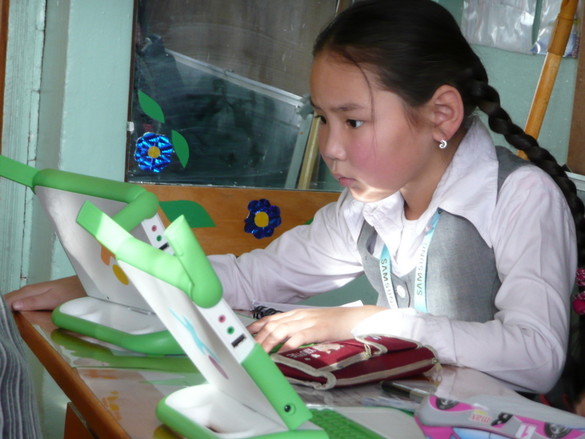
One Laptop per Child
As a turbulent snowstorm whips across the vast, desolate Mongolian grasslands, a group of schoolchildren huddle over laptops, their eyes transfixed as the sagacious Sal Khan works through Newtonian physics.
But Khan is only reaching these kids because of a bold initiative from another creative edupreneur: Neil Dsouza, age 27, cofounder of TeachAClass.org, a San Francisco-based nonprofit dedicated to enabling access to education in developing countries. Dsouza was previously an engineer at Cisco, where he helped develop the first 4G core routers for AT&T and eventually Verizon’s mobile network.
Technology is starting to become a waste in developing countries.
Plenty of people have tried to tackle education in remote areas. The One Laptop Per Child (OLPC) project, for instance, has shipped millions of laptops to impoverished corners of the world. The impact has been faint, however, leading OLPC founder Nicholas Negroponte to recently propose a more radical approach: dropping tablets from helicopters to remote villages, “then go[ing] back a year later to see if the kids can read,” he has declared.
But to those already on the ground, the idea of indiscriminately flinging equipment from the air and hoping for a positive educational outcome seems like a recipe for waste. OLPC has already donated over 7,000 laptops to Mongolia. When Dsouza arrived, he found many collecting dust on shelves. Some have not even seen the light of day, still unopened in shrink-wrapped boxes.
“Technology is starting to become a waste in developing countries,” notes Dsouza. He points to startling findings from the World Bank’s very own Independent Evaluation Group that “only 30 percent [of its projects worldwide] have achieved their objectives of implementing universal assess policies or increasing ICT [information and communications technologies] access for the poor or underserved areas.”
It’s not just due to misguided strategies like airlifting hardware, either, Dsouza says. Too many Western-driven programs have neglected to take into account geographical limitations and cultural differences—whether it’s failing to realize the lack of basic IT infrastructure in developing countries, or assuming that everyone naturally understands the potential and use of computing devices.
Haunted by memories of piles of unused laptops, Dsouza devised an ingenious plan: Bring a chunk of the Internet’s offerings to Mongolia. He packages content from Khan Academy, MIT open courseware, and other resources into portable, self-contained servers that can be wirelessly accessed by laptops and computers. These servers, which cost roughly $350 apiece, are small enough to fit in a backpack and need only a power outlet to boot up. Other laptops need only wireless capability and a browser that supports Flash to log on. What this creates, in essence, is a local intranet network—what Dsouza has dubbed an “Education Hotspot”—that allows users to access materials hosted on the server, even in areas so remote that Internet is either outrageously expensive or non-existent.
Here’s how Dsouza is distributing his technology: TeachAClass.org has a tiny team of three in San Francisco that collects free content from the web, then taps volunteers around the world to translate the material into local languages. These materials are then copied onto the backpack servers, which get delivered to local coordinators in developing countries. These coordinators—so far 12 Peace Corps volunteers in remote regions—work with teachers in schools and orphanages to set up the “Hotspots.” Content on the servers can be regularly updated via CDs or USB sticks.
The project is still very much in its infancy. So far Dsouza has deployed three Hotspots in Ulaanbaatar, two in the Uvurkhangai province of Mongolia, and one in Takengon, Indonesia—all together serving orphanages that house around 300 children. He plans to set up six more in schools in Mongolia’s Hovd province in the next few months. Next year, Dsouza also hopes to get pilot programs established elsewhere, too, including Sri Lanka, Bangladesh, and Egypt. In India, Dsouza also has plans underway to see how well the Hotspots work with the much-publicized $35 Aakash tablets, which the government has promised to provide to rural schools.
Considerable obstacles exist. Getting buy-in from local officials and educators is not always easy; some can be outright hostile to outsider advisers. But Dsouza has made sure to involve local teachers at every step of his project, providing them with the training required to effectively harness the potential of the Hotspots. It’s opened their eyes and given them a stake, he says, to the point where local teachers are taking ownership of the projects.
And then there’s the matter of funding. So far, Dsouza been bootstrapping this venture largely on his own, something he admits is unsustainable. He has considered returning to a day job to resuscitate his finances or reaching out to investors and VCs to turn the Hotspots into a viable business, despite his initial intentions to make this a nonprofit project.
But buzz around these Hotspots is—excuse the pun—starting to heat up. Dsouza has given talks at TEDxUlaanbaatar and the Global Education Conference. Earlier this year, he was awarded runner-up at the Houghton Mifflin Harcourt Global Education Challenge. Even the World Bank sees potential, having allocated a small sum ($3,200) to pilot this project—not for orphans and students, but nomads and herders, who will use the Hotspots to access information relevant to their day-to-day activities and improve their knowledge on production and supply.
Dsouza remains humble about his work, framing it in terms of making the best use of existing technologies rather than creating something radically new. “We’re not trying to reinvent the wheel, but rather focus on finding ways to recycle technology and resources—the hardware, content, and networks—that are already in place.”
By Tony Wan, Associate Editor, EdSurge
(From NPR Sunday November 27, 2011)
The typical college student today isn’t “typical” anymore: Only 1 in 4 lives on campus and studies full time.
But part-timers and commuter students are much less likely to finish — most part-time students are still without a degree or a certificate after eight years. Higher education is desperately looking for strategies that improve those numbers. There might be one in Tennessee.
Many higher-ed institutions brag about all the choices they offer: lots of courses and majors to choose from, pick your own schedule. But for some students, choice can be the enemy, says James King, vice chancellor of the Tennessee Technology Centers, a state-supported career-training program with 27 locations strung across the state.
“We do not use the Burger King Approach — ‘Have it your way’ — because, most of the time, employers do not have that approach,” he said. “You work according to a schedule they set.”
‘Scared To Death’
Carol Puryear is the director (and den mother, you might say) of the Murfreesboro Center, not far from Nashville. She and the other staff do a lot of hand-holding to make sure students get to their goal — a certificate and a job. Many community college programs let students pick and choose classes, but once they sign up at a Technology Center their class schedule is decided for them.
“They decide on the program and they decide if they want to be full time or part time and that’s pretty much it,” Puryear said.
Students don’t have to worry that their schedule might change from semester to semester. For the 16 months she’s enrolled, student Heidi Khanna knows exactly when she has to show up for her drafting courses: 7:45 to 2:30 Monday through Friday.
Attendance is taken and makes up about a third of your grade. It’s a lot more like high school than the typical on-again-off-again schedule of many college students.
Khanna is working on a computer-aided design program. Yes, architecture is in a slump, but she’s also getting the skills to move into mechanical drawing. The Technology Centers work closely with advisers from local businesses to keep their programs in sync with economic reality. That’s one reason why around 8 in 10 students finish and get a job in their field — amazing statistics for any higher-ed institution. But it’s still scary leaving the nest.
“I’m scared to death,” Khanna says laughing. “I don’t know, scared of change, you know, just getting back out into the workforce.”
– James King, Tennessee Technology Centers
Khanna already has a degree — but her associate of arts in liberal studies wasn’t getting her the work she wanted, so she’s starting over at age 39. Other students plan to use their certificates to get a job to pay for more schooling.
Working With Industry
Jeremy Miller, 23, already has an offer to be a surgical technician. His earnings will rise to around $40,000 a year.
“That’ll do for me,” he said. “That’s better than what I’m making now.”
He laughed when asked how much that is. “Nothing,” he said.
“Next August I plan on starting where I left off the first time I went to school with my prerequisites, to start my bachelor’s degree in biology and then hopefully off to med school after that,” he said.
Transferring to a new school is a big challenge for many students, but the Technology Centers have good arrangements with other colleges so students can continue without losing credits.
The centers have followed much the same program for more than 40 years, and it’s actually pretty old school: create a closely knit program, like a small Ivy League college. Now, as more schools realize just how bad college completion rates are, they’re looking in this direction.
Next September, the City University of New York will open a brand new school called The New Community College, with Scott Evenbeck as president.
“We’ve designed a curriculum and core curriculum that everyone will go through together,” Evenbeck said. “And the students will all be, at least in the first year, enrolled full time.”
These schools are building on evidence that shows many students simply take the wrong classes or they can’t get into the right ones; either way, they waste time and money. The longer they take, the more likely they are to drop out. The New Community College will start with a summer program that introduces students to the school and one another.
“Then when they come in the fall, they’ll have an intact schedule where a cohort of students will take everything together,” Evenbeck said.
There are signs this approach has promise for one- and two-year students. The question is whether these tightly focused programs have something to teach bigger four-year schools, where graduation rates are also pretty low.

Let’s have a little exercise. Walk me through this school you’d create. What do the classrooms look like? What are the class sizes? What are the hours?
It’s open 24 hours a day. Different kids arrive at different times. They don’t all come at the same time, like an army. They don’t just ring the bells at the same time. They’re different kids. They have different potentials. Now, in practice, we’re not going to be able to get down to the micro level with all of this, I grant you, but in fact, I would be running a twenty-four-hour school, I would have non-teachers working with teachers in that school, I would have the kids coming and going at different times that make sense for them.
The schools of today are essentially custodial: They’re taking care of kids in work hours that are essentially nine to five — when the whole society was assumed to work. Clearly, that’s changing in our society. So should the timing. We’re individualizing time; we’re personalizing time. We’re not having everyone arrive at the same time, leave at the same time. Why should kids arrive at the same time and leave at the same time?
Alvin Tofflers “The Third Wave” at Edutopia
Earlier this year I wrote a blog that discussed the ways that the Internet is revolutionizing education. The post featured several companies and organizations that are disrupting the online education space including Open Yale, Open Culture, Khan Academy, Academic Earth, P2PU, Skillshare, Scitable and Skype in the Classroom. The Internet has changed how we interact with Time and Space. We can be learning all the time now, whenever we want, and wherever we want. And because of that, we’re seeing explosive growth in online education.
In October, Knewton, an education technology startup, raised $33 million in its 4th round of funding to roll out its adaptive online learning platform. In early November, Khan Academy, an online collection featuring over 2,100 educational videos ranging in intensity from 1+1=2 to college level calculus and physics, snagged $5 million in funding to add two new faculty members that will create lectures for humanities and art-intensive classes.
According to the 2010 Sloan Survey of Online Learning, approximately 5.6 million students took at least one web-based class during the fall 2009 semester, which marked a 21% growth from the previous year. The Harvard Business School Review points out that this figure is up from 45,000 in 2000 and experts predict that online education could reach 14 million in 2014.
But with its tremendous growth, online education has brought up much debate between deans, provosts and faculty. Teachers worry that online education is going to take their jobs away. There’s fear on all sides about maintaining quality control. And how do you know that the student at the other end of the computer is really doing what they’re supposed to be doing?

Dr. Clayton Christensen At The
At The Future of State Universities conference last month, which was sponsored by Academic Partnership , Dr. Clayton Christensen spoke in front of 250 of the nation’s state university deans, provosts, presidents and faculty about the challenges universities face scaling their education models and how online education can serve students potentially better than brick and mortar classrooms.
Christensen is well-known for his academic work on disruptive innovations. And recently, he’s become a key figure in the online learning community with his new book: Disrupting Class: How Disruptive Innovation Will Change the Way the World Learns that he co-authored with Michael Horn. The two also co-founded Innosight Institute, a nonprofit think tank that studies education and innovation. This week, Dr. Christensen was asked him, “Do you think education is finally ready for the Internet?”
“I absolutely do. I think that not only are we ready but adoption is occurring at a faster rate than we had thought… We believe that by the year 2019 half of all classes for grades K-12 will be taught online… The rise of online learning carries with it an unprecedented opportunity to transform the schooling system into a student-centric one that can affordably customize for different student needs by allowing all students to learn at their appropriate pace and path, thereby allowing each student to realize his or her fullest potential….”
In a Washington Post column, titled “The Rise of Online Education”, Christensen and Horn explain how online education will disrupt traditional educational models. Looking at how the Los Altos School District in California uses Khan Academy to teach its students mathematics by having them watch lectures at home and participate in classroom workshops (see the post on flipping elearning) , the authors highlight the importance of a blended-learning environment, which is a model that includes both online and offline learning. Dr. Christensen explained why we’re starting to see this model be so effective. He said:
“The transition by which a new technology transforms the old, or takes it away, is a process, not an event, so almost always you have a hybrid in the middle just like the transition to electronic cars. It’s not unusual…
What’s exciting to me as a teacher is that this presents an opportunity to break down the departments that characterize higher education. For example, God did not dictate from heaven that literature and history are two different fields, but somebody decided they were. He never said calculus needs to be taught independently from chemistry. But someone decided they were different fields. And we teach these things as if they are indeed different from each other. But since I graduated from college I have never used calculus once on its own. I always use it in conjunction with something from another field. We graduate students with the belief that every field is a different one and the day after they graduate they realize oh my god, I can’t use any of these things independently. Online education gives us a clean slate so we can teach calculus in the context of chemistry, music in the context of history, and so on.”
Christensen explained how the University of Phoenix is spending about $200 million every year on making their teaching better. “That’s $200 million every year just on making their teaching better,” he repeats. “Do you know how much money Harvard spends every year to make its teaching better? Zero.” The reason is that Harvard defines research as creating new knowledge, while The University of Phoenix defines it as finding new ways to provide knowledge. “It blows the socks off of us in their ability to teach so well,” he says.
Rather than teachers fearing for their jobs, they should see online education as liberating. Teachers no longer need to just stand up and lecture when students can absorb the content at home. And when a teacher doesn’t have to be consumed with delivering content they can become a coach and a tutor to the students and help them on an individual basis. “Rather than it being a threat, it makes it a much more interesting profession,” says Christensen. “It’s really exciting because teachers can have deeper relationships with their students and not be so detached from them.”
Christensen talks about a man named Norman Nemrow who teaches accounting at BYU. His online accounting course is being taken by several hundred thousand students in America right now. Harvard Business School has stopped teaching accounting and instead makes their students take his course online. And then there’s Walter Lewin at MIT, whose Intro to Physics course has been taken by over 5 million people. “They are the best teachers in the world in their field,” says Christensen. “And now rather than everybody having to put up with crummy teachers, everyone can learn from the best.”
So, realistically, online learning IS disrupting the teaching profession. We will still need teachers but the skills necessary for success as a teacher will be very different in the classroom that Christensen envisions than in the one the teachers’ unions are comfortable with. In the early 19th century, British textile artisans protested the Industrial Revolution with the anti-technology “Luddite movement.” They believed mechanized looms would replace them and make their jobs obsolete. They were right.

Automation in the 19th century was the disruptive equivalent of high-speed digital technology in today’s KnowledgeEcomony, which is replacing jobs in the entertainment, manufacturing and service sectors at astonishing speeds. Self-checkout counters at the grocery store, complete with laser scanners to read bar codes, are starting to replace human cashiers. On the road, the advent of EZPass and other computerized toll machines are replacing human tollbooth collectors. The rise of online education could effectively render terrible teachers redundant, while bolstering the careers of talented educators. There’s a word for this; it’s progress in the Knowledge Economy.
In his Washington Post article, Christensen concludes that perhaps what is most critical now is to “move beyond today’s time-based rules—those policies, regulations and arrangements that hold time as a constant and learning as the variable, which inhibits the ability to move to a competency-based learning system.”
With the rise of online education, the future of learning will be a student-paced culture as opposed to our current forms of custodial education, which are teacher-based. Students can hold down a job while working on their Masters. Children in unstable homes can ask for help online instead of working it out on their own. Anyone can “go back to school” without having to really go anywhere. With online education, learning never has to end. And certain online education models actually have the potential to reduce the costs of both delivering education for the university and the cost of tuition for the student.
Human beings with the best education tend to do the best in the marketplace. “I think it will not be long before people will see that those who took their education online will have learned it better than people who got it in the classroom, and that’s exciting,” says Christensen.
The dogmas of the quiet past, are inadequate to the stormy present. The occasion is piled high with difficulty, and we must rise — with the occasion.
–Abraham Lincoln, December 1, 1862
Found this article on Fast Company. Since Education has completely intersected with Technology, it’s not a surprise anymore to find education-related material in technology-oriented magazines. This is SO amazing that when you start to read back in these posts and look at the inevitable way forward you will be blown away by the possibilities.
I’m focused on developing Continuous Leaning Theory and working on a book called Continuous Learning and this was one of the more fantastic ideas that are already happening to bring continuous learning experiences to everyone everywhere every time.
BY Gregory FerensteinSun Oct 30, 2011

Since the launch of the iPad, colledge educators have been seeking an inexpensive alternative to paper textbooks that could leverage the collective knowledge of teachers and students. With a $249,000 grant from the Gates Foundation’s Next Generation Learning Challenge, Dr. Daniel Johnson of Wake Forest University and education technology firm Odigia might have found it. Their BioBook, an iPad and web-enabled interactive biology textbook, creates a fully customizable experience for both students and educators.
For educators, the BioBook allows professors to track individual student progress and develop their own textbooks from a national database of professor-generated, mix-and-match chapters. On the student side, linear chapters are remixed into “branches and leaves,” where students explore concepts as interlinked ideas, moving from fundamental facts to an array of detailed chapters, which students can explore in their own way.
Threaded Learning
“Every learner brings unique prior knowledge, misconceptions, and pre-existing mental models to the process of learning a new concept,” Dr. Johnson tells Fast Company. “These pre-existing elements mean that two learners may need to follow very different pathways to achieve deep, functional understanding of a concept.”
Instead of reading like storybook, chapters are reformed into a branch/leaf relationship; all students start with the same fundamentals and explore details as their curiosity guides them.

“Each newly acquired piece of knowledge in turn raises additional questions that encourage exploration of other previously unknown concepts, theories, or facts.” writes Dr. Johnson. Put another way, expert learners construct their understanding by following what seems to be a logical path to them, not a pre-defined path.” In other words, traditional textbooks assume that students all the learn the same way, but the BioBook allows students to seek different learning paths as they encounter questions and points of curiosity.
Along the way, students are given self-assessment quizzes and pose questions to the class, with comment boxes and annotations appearing next to the text for a more social experience.
A National Database
Eventually, BioBook plans to allow university partners throughout the world to create their own chapters and upload them into a national database that can be mixed and matched into a customized textbook, built on top of the widely used open-source education platform, Moodle.
Dr. Johnson and his team will curate and produce an official BioBook, using contributions from the academic community to revise and update chapters. “We expect parallel review and analytics data will drive most of the routine correction, revision, and page adoption decisions,” he says. Since the BioBook collects data from students on the fly, knowing what students like–and don’t like–should automatically inform the decision-making process on which chapters ultimately end up in the official book.
“Data analytics will be collected on standard and alternative versions that let us determine if students (or specific subgroups) learn better from a particular version,” Dr. Johnson continues. “If an alternative version proves more effective over time, we will ask the originating author for permission to make their page our new “standard” version; the prior version will be retained as an alternative as long as other instructors continue using it.” Professors are then free to swap out official chapters for alternative versions, or create their own.
All professors retain some intellectual property rights under a Creative Commons License but are encouraged to contribute their ideas to the community–a community that could give standard textbooks a run for their money.
Follow Greg Ferenstein on Twitter, Google+, or Facebook. Also, follow Fast Company on Twitter.
It used to take years and now it seems that as soon as I write a blog post about what might happen I read an article or hear a story a few weeks later and it IS happening. The pace of change has surely changed! Here’s another example:
Are iPads on their way to replacing computers in K-12 schools? It sure looks that way. A recent survey of district tech directors found that all were testing or deploying tablet devices—and they expect them to outnumber computers by 2016.
Piper Jaffray analyst Gene Munster questioned 25 educational IT directors at a conference on the integration of technology in the classroom, and his small survey, “Tablets in the Classroom,” reveals that all were using Apple’s iPad in schools, while none were testing or deploying Android-based tablets.
Munster explained that the trend in education may be due to a familiarity with Apple devices among students and school employees.
The IT directors polled indicated that within the next five years, they expect to have more tablets per student than they currently have computers. Since iPads represent most of the tablets seen in schools, Munster said the word “tablet” is basically synonymous with “iPad.”
“Within the next five years, our respondents expect to have more tablets per student than they currently have computers” Munster said. The school districts represented in the poll have about 10 students per computer, but in the next five years, IT directors for school districts say they expect it to drop to about six students per iPad. Devices like the iPad are preferred over computers in the classroom because they provide more individualized learning than a traditional computer.
Earlier this year, Apple Chief Executive Tim Cook indicated that demand for the iPad is strong among education customers. In February, Georgia Senate President pro tem Tommie Williams (R-Lyons) proposed a plan to replace conventional textbooks in middle schools with the iPad. Williams met with Apple to discuss a plan to make the iPad a central component in the state’s education system.
“[Apple] has a really promising program where they come in and their recommending to middle schools—for $500 per child per year, they will furnish every child with an iPad, wifi the system, provide all the books on the system, all the upgrades, all the teacher training—and the results they’re getting from these kids is phenomenal,” Williams said at the time. “We’re currently spending about $40 million a year on books. And they last about seven years. We have books that don’t even have 9/11. This is the way kids are learning, and we need to be willing to move in that direction.”
This article originally appeared in the newsletter Extra Helping. Go here to subscribe.
I am always looking for new and potentially useful technologies that I might transfer to improve the learning experience. Here’s another I found today. Soundtracks for books …
The questions, to which books or textbooks would you add a soundtrack to enhance the learning experience and further enable the learning process?
Since I’ve never had a soundtrack added to a book, I’m starting to wonder if I supply my own. Listening to a soundtracks book starts to feel like a ken Burns documentary. Personally I think that’s a good thing.
Before the talkies, theater owners found that adding live music to the silent films added a giant dimension to the experience of watching the movie. More cues. Think of the scene in Jaws at the buoy when the shark attacks the swimmer. Or the musical communication between the humans and the aliens at the end of Close Encounters. Soundtracks enhance movies and have become an inextricable part of the experience.
Would a soundtrack do the same for a book or textbook that was used as part of the learning experience? Is this the next logical step in the world of digital publishing? You heard it here first …
So here’s the challenge: What book or textbook do you think
would be greatly enhanced by the addition of a soundtrack?
Read on for the details …
Booktrack matches synchronized music, sound effects and ambient sound to the text of e-books in a way that’s automatically paced to the reading speed of the user.

Filmmakers have long been aware of the power of sound to enhance a story, but now a New York-based startup aims to bring a similar experience to e-books. Booktrack matches synchronized music, sound effects and ambient sound to the text of e-books in a way that’s automatically paced to the reading speed of the user.
Working in collaboration with Sony/ATV Music Publishing, Park Road Post and Full Fathom Five, Booktrack offers users a new way to experience the stories they’re reading. Readers begin by downloading the Booktrack edition of the book they want to read from Apple’s App Store. Pricing ranges from free to USD 4, depending on the title. Booktrack e-books can currently be enjoyed on iPad, iPhone or iPod Touch, but versions for Android and other devices are coming soon, Booktrack says. Either way, as the reader progresses through the story, the soundtrack keeps pace, with the ability to pause and resume whenever needed. Separately controlled music, sound effects and ambient soundtracks, meanwhile, can be turned off, lowered or raised individually, depending on the reader’s personal preference. The video below demonstrates Booktrack in action:
If you’re interested in more. check out Push Pop Press and its efforts to bring multitouch capabilities to digital books; now, Booktrack’s focus on sound is equally compelling.
Publishers around the globe: you’d better be paying attention!
Website: www.booktrack.com
Contact: info@booktrack.com

 David Grebow KnowledgeStar