There is a lot of advice, information and great books (I personally have always referred to my old marked-up copy of Roger Schank’s Tell Me a Story) about the art of storytelling. We always find a way to use them in our programs, since I think they are among the most powerful and hardwired ways to teach. Stories are important tools for learning for a lot of reasons, this one from Roger Schank’s book in particular:
“We would like to imagine that we learn from the stories of others, but we really only do so when the stories we hear relate to beliefs that we feel rather unsure of, ones that we are flirting with at the moment, so to speak. When we are wondering, consciously or unconsciously, about the truth, about how to act or understand some aspect of the world, then the evidence provided by others can be of some use.” (P.78)
The NPR short video is all about how to capture and keep the learner’s – or listener’s – attention. The focus is on rhythm and how to ‘breath’ your story.
If you use stories in your learning experiences, it’s worth your time.
I asked my techno-savvy friends this questions recently and for the most part received blank stares.
The answer was obvious to me. They are both products of The Digital Revolution. Both of them have taken an analog “thing” and turned it into an instantly downloadable immediately gratifying product-of-your-choice. I want a single tune from a new CD. There’s the “i” and the “Tune” and it’s mine for 99¢. Same for an ebook only more money.
So ebooks have become the iTunes of the publishing world … and like iTunes the ebooks have quickly established a dominance in the marketplace that was totally unpredicted as little as three years ago.
Amazon predicts that it will sell more e-books than paperbacks by the end of next year, and that they will eclipse both paperback and hardcover sales combined shortly thereafter.
“I predict we will surpass paperback sales sometime in the next nine to 12 months. Sometime after that, we’ll surpass the combination of paperback and hardcover,” Amazon CEO Jeff Bezos told USA Today.
Kindle books have already eclipsed hardcover sales. Amazon recently said it sells 180 e-books for every 100 hardcovers, with the ratio constantly shifting in e-books’ favor. And that’s only on the Kindle. There are currently at least 5 ebook readers (not counting your PCs and other mobile computing devices) with more to come.
Many readers still favor the good old printed book. In a recent poll, most Mashable readers cited a preference for physical books over e-books. However, with the e-reader cum tablet battle heating up – the iPad is selling so amazingly well that Amazon recently launched a new version of the Kindle for the iPad – paperbacks and hardcovers may soon become an artifact of the analog world.
The analog was inherently isolating and we needed to create environments, for example schools, where text could be shared and discussed. The digital model is basically social and enables connections and conversations. I predict that it’s only a matter of time before the ebook finds a social connection like Ping for iTunes.
There’s already been an interesting experiment that I just finished … reading? linking from? booting up?
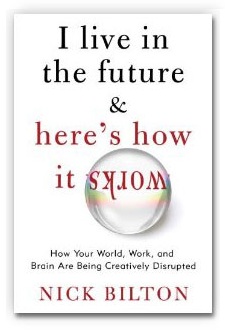
It’s from author Nick Bilton’s new book, “I Live in the Future and Here’s How it Works.”. One of the key points of the book is what Bilton calls “Me Economics”, what I have been referring to as “meconomics”. It explains an increasing consumer trend in which the buyer will increasingly seek out products and services that have personal relevance, and provide highly engaging personal experiences. Products and services in the Digital Revolution are all about 1:1 customization and personalization.
As the music industry and now the book publishing industry are learning, they need to adopt and adapt in order to survive and then thrive. My tunes, iTunes. Me book, ebook. Get it?
Lots of discussion lately about the iPad for textbooks. I find it a bit premature since I only bought mine today, the first day of it’s release. Since the experiments are about to commence throughout Appleville, I thought I’d add some grist to the knowledge mill.
Here are two examples of what print might look like when it is creatively moved from analog to digital. The purpose is to thrill your imagination, help you see ways that ‘print’ can become something totally new when it morphs from it’s traditional and historical analog state to a new, multimedia digital world. The change to the digital mindset will give reading and learning a whole new meaning, and like iTunes, once again change the business model for an industry.
I especially like the Sports Illustrated model that incorporates an easy to use ‘social media wheel’ that enables you to instantly connect and converse with your social network. It highlights what I think is one of the key differentiators between the analog and the digital versions. The analog was inherently isolating and we needed to create environments, for example schools, where text could be shared and discussed. The digital model is basically social and enables connections and conversations.
These are the 10 most important lessons I learned in 2010.
What’s on your list?
1.The brain is hardwired by evolution for learning.
2. We spend a lot of time and money disabling the hardwired learning process.
3. Learning is a social experience – We learn the best when we learn with a group of people who also need to learn what we need to learn.
4. Online learning is inherently an anti-social experience.
5. Social Media (SoMe) and Social Networking (SoNe) can help enrich and enable the online learning experience .
6. Learning in a business environment in the 21st Century needs to focus on know-how more than knowledge.
7. We need to flip online learning – especially virtual classes – upside down so they focus on performance, instead of a passing score.
8. Need to know (cognitive information) is best transferred using asynchronous learning technology.
9. Need to know-how (behavioral information) is best transferred using synchronous and social learning technology.
10. We ignore most of what we have learned about how we learn. We let habit rule, instead of adopting and adapting what we now know about enabling the learning process.
For those of you wrapping up the year, spending time thinking and reading about 2010 in preparation for 2011, I highly recommend Jane Hart’s annual 2010 Review : Jane Hart’s Top 100 articles from 2010 as a place for your mind to visit. As interesting as the list of Top 100 for 2010 is a quick review of the same Top 100 for 2009 and 2008. It’s a fabulous roadmap to show you the way learning is evolving.
I’ve had these words to the wise pinned above my desk for awhile. I can’t remember where they were discovered. I’m not even sure who “Schuster” is. I just know he is a very wise human being.
I wanted to share them since I think they have a lot to do with learning. And time. That seems to be my definition of wisdom. Learning about life that lasts more than one lifetime for more than one person. Perhaps that’s why I like cliches so much. They capture wisdom in a few easy-to-remember words. Apple juice made from the Tree of Knowledge.
Hopefully there’s a space above your desk for these words.
May 2011 be an AMAZING year for you, filled with laughter, learning and love.
Become the world’s supreme expert in something – Schuster advises to “begin at once, at this precise moment to choose some subject, some concept, some great name or idea or event in history on which you can eventually make yourself the world’s supreme expert.”
He urges us to start a crash program immediately using the three R’s of modern education, reading, research and reflection – with the goal of establishing yourself as “one who has the most knowledge, the deepest insight and the most audacious willingness to break new ground by defining your terms and actually examining all the alternatives and consequences.”
Master the art and technique not merely of rapid reading, but creative reading and creative research – Schuster says it’s important to “learn how to use a library and how to build a home library of your own.”
He reflects how “back in 1913, high school graduates were singing the old refrain: “No more pencils, no more books, no more teacher’s saucy looks.” He points out that they were throwing away their books and saving their diplomas. He urges us to do the opposite, “Forget your diploma, or throw it away, but save your books and use them day and night.”
Learn the supreme art of getting sixty seconds out of a minute, sixty minutes out of an hour, twenty four out of a day – He reminds us that we have as much time as everyone else our age. He says to “Save it, hoard it, plug up all the leaks. If necessary, stand on the street corner, cap in hand like a mendicant, and beg all the passers-by for the seconds and minutes and hours and days they waste.”
Master the art of preparation – Do your homework (especially after your formal education). Remember the words of French chemist Louis Pasteur (1822 – 1895) who said “Chance favors the prepared mind.”
Begin now to learn the art and science of preventative medicine – In other words, take care of yourself. Exercise and eat healthy. He says we should prepare now to out-perform and outlive our doctors. He says Ralph Waldo Emerson said it best: “Give me health and a day, and I will make the pomp of emperors ridiculous.”
Work hard, think big, and always have a dream beginning with a detailed blueprint and plan for your agenda, your priorities, your first things first – Schuster encourages us to put a firm foundation under our “castles in Spain, in the form of these step-by-step, play-by-play specifics and make your dream come true.”
Remember the following three questions: “If I am not for myself, who will be? If I am not for others, what am ‘I’? And if not now, when?” These three questions were first asked by renowned Jewish religious leader Hillel the Elder.
Work hard and opportunities will come – Schuster advises us to remember the words of noted American journalist H.L. Mencken (1880 – 1956) who said, “Most people don’t recognize opportunity when it comes along, because usually it is disguised as hard work.”
Don’t try to please everyone – Schuster counsels us to always keep in mind the maxim of U.S. editor and journalist (and the first recipient of the Pulitzer Prize for reporting), Herbert Bayard Swope (1882-1958) who said, “I can’t give you any formula for success, but I can give you a sure formula for failure – try to please everybody.”
Always remember, the time to be happy is now – The place to be happy is here. The way to be happy is to make others so.
Remember what people really want – Schuster’s last point is extremely applicable to writers who promote products and services. He says to “never forget that people never buy things or services … they buy solutions, for their problems. Your job is to help them find solutions.”
According to a recent statement by Bing, Microsoft’s search engine answer to Google, search is no longer about looking for knowledge about something. It’s about getting something done. It’s all about know-how.
According to a recent Fast Company article, “The idea behind features like this, say Bing executives, is that search is no longer simply about looking for information. It’s about getting things done: Booking reservations, buying plane tickets, researching consumer products. And Microsoft is trying to help its users get those things done as quickly as possible. It’s trying, simply put, to make search results less like a list of links and more like an app.”
So before we say goodbye to 2010, let’s say “Adieu” to The Knowledge Age and shake hands with The Know-How Era!
So what’s the problem? Well it’s kind of simple. All the tools and technology we have for learning is all still focused on knowledge, learning about something NOT learning how to do something. There’s very little built into these learning tools – from LMS to Virtual Live Classrooms – that enable practice, practice and more practice.
Everything that neuroscience and psychology, and any of the fields related to learning how we learn, all understand that to learn how to do something involves the following key elements;
Time
Practice
Failure (In a safe environment)
More Practice
And More Practice.
Learning how to actually do something means that we have adopted what we know and can do and learned enough to adapt it in a variety of real world situations. That’s what being an Expert instead of a Beginner really means.
Here’s a great and recent example: When Captain Chesley Sullenberger – called just “Sully” – rescued those 155 people on board his plane, landing it safely and improbably in the Hudson River, everyone agreed Sully was a hero. Everyone that is except Captain Sully. In his mind, he was just doing what he spent 30 years training how to do. On his own, he would often take simulator training that focused on emergencies, water landing among them.
So he was all about learning how to do something.
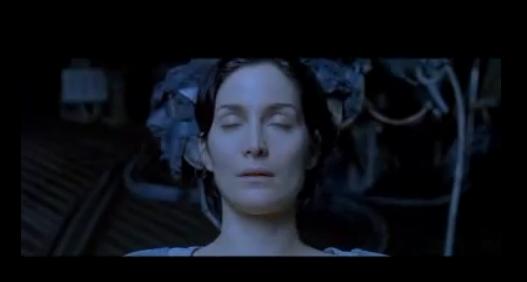
It calls to my mind that scene from The Matrix in which Trinity is on the roof with Morpheus and Neo. She gets programmed to expertly fly a helicopter in a matter of seconds by “jacking-in” to the database of know-how. These days acquiring that level of know-how would take years.
You can watch that scene here if you need to recall the technology. It’s very cool and I look forward to the day …
The question is how to shorten the time on that continuum between jacking-in seconds and the years of actual simulated and actual flying. And that gets us back to the initial question. If the current learning tools and technology are ‘artifacts’ from the Knowledge Age when we were all learning about something, what tools and technology can we adapt or create to really enable learning how-to do something? How do we truncate the time-to-performance between the Beginner and the Expert?
I have some ideas but I’d really like to hear yours first.



 David Grebow KnowledgeStar