The Dangers of “Push” Training: A True Story


old-typewriter-with-mouse-thumb3355

This post was written by Susan Fry, Vice President, Creative Strategy, KnowledgeStar.

A recent experience proved how dangerous adhering to the old “push” model can be. In consulting with one of the world’s best-known NGOs, I conducted an exhaustive series of interviews with Managers and Directors at different levels, located in countries around the globe.

This NGO is funded to do work throughout the world improving health — which also means working to eradicate deadly diseases or control outbreaks. The interviews quickly revealed that members of the NGO in one country were not sharing information that could be extremely beneficial to coworkers in other countries, even though doing so surely could have eliminated suffering and saved lives.

Deeper investigation revealed that the NGO had a long-established culture of “hoarding” learning and training and doling it out to those that the top management had decided they wanted to bring into “the fold.” When a favored few rose to the top in their own country, they were invited to the world headquarters located in a vibrant, wealthy city, where they were wined, dined and welcomed into the elite “inner circle.”

They then moved to the headquarters city to take their new positions, where they communicated information to the other “elites,” occasionally returning to their home countries. The pattern had been in place for years and there was little desire to change it — even though changing to a learning culture could clearly make them much more agile, effective and successful in meeting the stated goals of their organization.

This exposes one of the dangers of a “pull” learning culture as well, where inputting knowledge is power. If I go to my PC, it is KIKO (Knowledge In, Knowledge Out). The technology systems that enable the learners are only as good as the information they contain. If the underlying culture is still embedded in the old command-and-control hierarchy in which knowledge is power, then selectively sharing knowledge will become power.

The culture is the bedrock upon which leaders, learners and the enabling technology is built. In a true learning culture people instinctively believe that sharing knowledge is empowering and automatically act on that belief.

This is yet one more reason to build a real learning culture and not just erect a facade that might be able to pass for one.

Only Smart Companies Will Win


The Inevitable Future of Learning

images3

As recently as eight or ten years ago, transforming your organization’s culture from a teacher-led training culture to a learning culture, driven by digital technology, may have been a matter of managerial preference.  Today, it’s an absolute necessity.

The change to digital technology is so profound, so dramatic that it can be compared to the invention of the printing press in 1450 or Edison’s success in making electric lighting commercially viable in the 1880s. We are only now beginning to see the changes.

Digital communication is changing everything about learning. In a recent report on global human capital trends, Bersin by Deloitte advised organizations to look at the ways people learn in their organization and “Prepare for a revolution.”

With all due respect to Bersin by Deloitte, we think their timing is a bit off. The revolution isn’t coming, it is here. In our kids’ K-12 classrooms, changing the ways they learn. Anyone can now be a publisher or a video producer and provide news channels for knowledge. Performance support systems, virtual classes, video conferences and more are finding their way into individual departments and divisions of many companies. Yet the technology is not significantly changing the way we learn in our organizations.

ATD’s 2014 State of the Industry Report confirms that instructors still reign supreme in workplace learning, with 70% of formal training hours delivered by an instructor in a classroom.

While we’ve eagerly adopted digital technology and the changes it has brought to our personal lives, the vast majority of organizations have not seemed to grasp the need to adapt our organizational lives so they embrace the possibilities presented by the digital world. Either they are resistant to the change or simply don’t know how to go about making the change.

In fact, relatively few leaders have fully grasped what enormous benefits there can be in transitioning their training culture to a learning culture and changing the way their employees learn. This is true despite evidence showing that significant value accrues to organizations that make the transformation from one culture to the other.

I have an spent my entire career defining, designing, developing, delivering, and evaluating corporate education programs around the world. When I started, the model was all “push.”  Now it’s becoming “pull”.  About creating an organizational culture that supports people in automatically finding what they need to learn, when they need it, anytime and anywhere. Learning at the point of need.

Susan Fry, Stephen Gill and I have written a whitepaper to answer questions about what we believe is the inevitable future of learning:

  • What is a “learning culture”?
  • Why is creating a learning culture is critical to my organization’s future success?
  • How can I assess progress toward changing my organization’s culture?
  • What are the key elements of a roadmap that I can follow to get started?

If you’re interested in receiving a free copy, leave a comment.

What do you think about the idea of the learning culture?

dilbert on training

The Learning Culture: A Report from the Hub


LC1

It’s been awhile …. I’m back from what became a long journey, working with a number of leading research and consulting firms on what they defined as “corporate education”. Our little secret … it was all about the money.

I spent hours every day focusing on developing paid for webinars that were thinly disguised marketing messages for the sponsor’s products. Writing white papers that were paid for by companies looking to justify their approach or methodology to corporate education. Developing charts, diagrams, infographics and more that proved the current prescribed vendor approaches to learning were absolutely correct.

So the assumption that I’ve heard many times – corporate education analysts are too often paid lobbyists for vendors – turned out to be true. I was living on the wheel, climbing up and sliding down the spokes, avoiding the hub of things. This is a report from that hub.

The key message is simple. Change or die. Corporations that do not “get it” will go out of business and be replaced by those that understand the following:

  • The research tells us that high performing organizations, the type many aspire to become, are driven by a learning culture.
  • Enabling and empowering everyone so they can find what they need to know, whenever and wherever they need it, is critical to the success of a company
  • Becoming a learning culture is the only way a corporation can succeed every day and win in a highly competitive almost Darwinian global marketplace.
  • Finally, if you’re not scared, you’re not listening, and if you are not building a learning culture, you’re falling further behind every day in terms of sales, profits, customer satisfaction levels, innovations, service, and everything else that comprises your business.

lc2

So from this point forward this blog will be about  building a learning culture. We’ll define what it is, help you assess where you are (pdf), and recommend changes you might need to make. We will explore the relationship between leaders, learners and technology. And provide examples of learning cultures in action, from exciting new companies like Tesla and established organizations like the WD-40 Company, to not-for-profit organizations like Doctors Without Borders.

In addition, since we don’t have all the answers, we will be sure to add any links to books (Creating a learning Culture), other posts, whitepapers (At the Water Cooler of Learning),workshops, webinars and other resources that might help. As a starter. here’s one from my friend and colleague Stephen Gills 16 Signs of a Learning Culture and another great resource from Marcia Conner Introduction to a Learning Culture.

I will be working with many of the most experienced and brightest minds in our field, and the areas of learning psychology, neurosciences, sociology, learning theory and more. People who have come to the same conclusion. We need to stop looking at the pieces – the spokes – and start to focus on the real problem at the hub. We can no longer spend ridiculous amounts of money and time on point solutions, and not try and solve the real problem – how to create learning cultures.

Looking forward to learning together.

signature 1

3052879559_c8b6a11a8d_z

At the Heart of Learning


 images

The Endless Immensity of the Sea

 Once we get past the outmoded ideas of school – there’s only one answer, in the back of the book, take the test, and don’t look that’s cheating – we begin to see that learning and collaboration is an art and a science. We know more today about the science than ever before. We still tend to overlook the art.

A few weeks ago, my nephew asked me what the words “Subject Matter Expert” means. I told him it was all about learning. The expert was a team of people who each learned a lot about something, and learned more every day, until people agreed that team was The Subject Matter Expert. He listened carefully, then nodded and asked, “So, are Tommy and I the Subject Matter Experts about superheroes yet?” It made me pause and think about how that question would translate in the companies I consult with and what it meant for building successful collaborative teams who learn as they go.

Joi Ito, Director of the MIT Media Lab, writes about “neoteny,” the retention of childlike attributes in adulthood. This ability to learn is like the compounding interest on an investment; after two or three years, a relentless learner stands head and shoulders above his peers. It stands to reason that a team of relentless learners is optimized for successful collaboration.

So, why then are so many teams of smart people so stupid?

The answer has nothing to do with their collective IQ. I think the answer can be found in an obscure quote I pinned years ago on my actual pre-Pinterest cork board. It was written by Antoine de Saint-Exupéry, best known for his work The Little Prince. Here is the quote:

If you want to build a ship, don’t drum up people to collect wood and don’t assign them tasks and work, but rather teach them to long for the endless immensity of the sea.

The quote focuses on the art of collaboration. And it has a direct bearing on learning, lighting a fire instead of filling a bucket.

Amazing how some people knew so much about learning and collaboration before it became the business word du jour. The key to a great collaborative team is their ability to look outward in the same direction, to share a deeply felt goal or, as Saint-Exupéry wrote, “[…] to long for the endless immensity of the sea.”

Seems almost too simple to repeat. Yet I cannot tell you the number of times I listened to team members who had no idea what it felt like to long for the “endless immensity of the sea.” When we build teams to collaborate, we need to make sure that the first item on the punch list is to build a deeply felt desire, a “longing” if you will.

The next time you bring a team together, ask yourself a question: What is the longing — the deeply felt longing — which will drive the team to learn and perform, even if they do not have all the tools and knowledge to “build a ship”? What will wake them up every day and make them want to go wherever they dream of going? When you can articulate that longing, then you are on your way to a great collaboration and learning that will just happen.

Here are some examples that punctuate this idea:

We want to be the ones to really feel what it is like to step onto the surface of the moon.

The team will take the very first pictures of life on the bottom of the ocean.

We will actually see the proof of the ‘god particle’ that started all creation.

In the beginning, it is not all about the wood and the work. It’s about the art of collaboration, describing that longing that drives learning and collaboration forward. I spend a lot of time researching and studying, thinking and writing about the science of collaboration as a crucial part of learning. I just want to make sure I never lose sight of the art, of that longing for “the endless immensity of the sea.”

Using Your LCMS to Save Kirkpatrick


kirkpatrick

Forget About Level 4? Never!

Not too many years ago I remember the words of an L&D VP to whom I reported. We were talking about measuring the effectiveness of a very expensive training program we just delivered.

“Just focus on the first three. Forget about this Kirkpatrick level four,” he said. “It’s too hard and too expensive to figure out.”

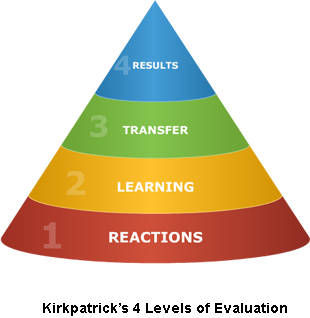
As a refresher, here are the four levels of Kirkpatrick’s evaluation model (I’m avoiding the argument about Level 5 on purpose):

  1. Reaction – what the learners thought about the course
  2. Learning – what the learners remember as well as any new skills and attitudes.
  3. Behavior – How much the learners transfer knowledge, skills, and attitudes from the schoolplace to the workplace
  4. Results – the final outcome, months down the road from the event, which was initiated by the course.

The first 3 levels are relatively easy to measure. They include the smile sheets (Level 1), demonstrations of what was learned (Level 2) and improvements in performance back at work (Level 3). The first two can happen during the training event; the third can be reviewed and assessed by a learner’s manager.

It’s Level 4 that’s more difficult, even though it’s the level that measures real learning. Let me back up a bit. Rote learning is what ‘skill and drill’ teaching gets you. It’s perfect for a Level 1 and 2 evaluations. You can even get by if the Level 3 evaluation is done soon enough after the course is finished.

If no one checks in after that you will probably not get a “Pass” on Level 4, unless you have adopted what you do every day and adapt it under a constantly changing set of circumstances. Level 4 is gated by the idea that “Practice Makes Perfect”. So it’s the down the road assessment that really tells you if the learning has become a new part of the learner’s way of doing their job.

Level 4 is a longitudinal study or assessment. It can be done at intervals that range up to one year from the learning event. It’s usually not done at all because it is the most costly and time consuming of the four. What’s changed is that new technology can make it easy.

LCMS Learning Objects to the Rescue.

The LCMS is usually thought of in terms of their ability to author learning objects. These objects can be stored in a repository and used to deliver a custom learning program. The learning objects are assembled by an individual learner who can tailor them into a personal learning path. On the other hand, a course that is SCORMed and developed as one-size-fits-many can be seen as one big learning object fixed in space.

When people are done with either a course or their personal learning path, it looks like the pellets flying out of a shotgun. All the learners go off in their own direction, and have separate and individual experiences. In short, they learn to adapt the knowledge and know-how they acquire in a multitude of different ways.

The course object can only measure the mean or average since it was designed for many people. Most Level 4 measures I’ve seen look at corporate data as if it was functionally related to what the learner knows or has learned to do. For example, an increase in employee retention can be the result of wage increases or an improved management style. Reduced waste is an old manufacturing metric that has little validity in today’s manufacturing processes. Increased customer satisfaction results from a constellation of factors. Fewer staff complaints in a tough economy are to be expected (add in increased retention as well). So the standard measures used at Level 4 are virtually useless in today’s workplace and economic environment.

Learning objects on the other hand can be turned around as a one-to-one assessment down the road because they were assembled by each learner who proscribed their own learning path. Learning objects that state “What I need to learn” can be flipped to ask “Did you learn what you needed?” Turn a learning object around, add a question mark, and you have a Level 4 assessment. If the learner six months later has really learned a new skill or behavior, you can easily find out by assessing them on what they decided to learn. If the learner is struggling with what they tried to learn, you can determine that as well and provide whatever support is required.

Learning technology changes the equation. In the same way that elearning removed the barriers of time, space and the four walls of the traditional classroom, LCMS can provide an assessment of a learning event ‘down the road’, and really start get to that formerly unobtainable Level 4. It can measure the degree to which the learning has been adopted and is being adapted.


Reflections on the “Why”


picq

They get lost too easily as the New Year rapidly progresses. The forests we each inhabit. We quickly find ourselves racing through the trees like Luke Skywalker on a speeder bike. This is a good time of the year to step back and reflect.

So before I plunge headfirst back into my forest, I want to remember to remember “Why” I do what I do, and what the Big Problem is that needs to be solved.

I started thinking about the “Why” a few weeks ago after watching a great TED presentation by Simon Sinek on “How Great Leaders Inspire Action”.

Then I happened to read a blog post by Kaihan Krippendorff about how “Great Companies Solve Problems That Matter” by focusing on the Big Problems. The two put my brain into overdrive. As I stepped further back from the trees, the forest I inhabit became even more distinct, and the “Why” of things and the Big Problem came into greater focus.

No one disagrees that we are all in an increasingly competitive global race. It’s an odd race in the sense that the finish lines keeps moving off into the future. I try and discover ways my clients can use learning and development to help their companies catch up, keep up and then lead the way. Find the best practices in learning from around the world, and then teach what I discover. Learning and Development in corporations is an ongoing and continuously changing process. Not the learning part, which happens in the brain and is unchanged for millions of years. But the most current methods of learning, new techniques, updated technology and continually improving best practices. Part of solving the Big Problem these days is keeping up with all that is changing and get out in front of the curve.

I used to hear Learning and Development referred to as the “800 pound Gorilla in the room.” These days it’s more like 1,000 nattering and chattering monkeys.

So “Why” and the Big Problem are connected: To make companies smarter and improve their performance. That’s the “Why” and the Big Problem all rolled up into one.

I just hope someone reminds me to read this next June while I’m thrashing about in the forest again.


Learning at the Speed of Now


I originally posted this as a Brandon Hall Group blog and kept thinking about it. If you have ever had an idea that seems to take seed in your synapses, and then germinate and sprouts, you’ll know what I mean. I came to a conclusion that startled me.  Here it is …

The Speed Limit of Now


I used this graphic recently in a Brandon Hall Group webinar. The idea was to show the underlying drivers of learning in organizations. It pointed out that in the 20th century there was time to learn. We measured the shelf life of knowledge in years. We had time to go to a course to learn something that you might need someday.

In Digital Economy of the 21st century, we quickly realized that everything was changing more rapidly, even the pace of change. The idea of learning something someday no longer worked. We based the new model on the idea of now, as in “I need to learn it now”, “Tell me how to do it now” and “I want that information now”. Now was also part of the learning DNA of the Millennials, raised with digital technology from the time they could walk, Googling replacing dictionaries, Facebook and Twitter replacing … well there was nothing to replace, it was all new.

The question that came up during the webinar was what is next, what does “???” mean for L&D professionals? How do we increase the speed of now? I thought about it and here is the answer to my answer.

Learning faster and faster has a top speed limit of now. Even ‘jacking in’ to their headjack for Neo and the others in The Matrix was all about now, only as direct and fast as you could imagine. So if now is the redline on the learning speedometer, what’s next?

The Slow Now and the Fast Now

The only thing gating the speed is connecting the person who needs to know with the person who has the answer. Taking the time to find the person who knows slows down the transfer. We already have the ability to jack in, only we rarely use it.

It’s called a Community of Practice (CoP). First, let me start with a new idea called the Community of Learners  (CoL). You can connect every class, or any learning event, where there are more than two people, into a  Community of Learners. That community enables the learners to network, start working together, get used to  the idea of a technology-mediated community in which learning something is the focus. They learn to learn as  a community.

When that Community of Learners graduates, they become part of a growing, active, worldwide, and always-  on Community of Practice. Learning continues. Continuously. Get enough people connected in that CoP, and  you will find that the community has encountered almost every problem, resolved almost any imaginable  issue, asked all the questions and most likely answered them. It not exactly the headjack but it’s as close as today’s technology enables.

I can connect to the CoP with any device, anytime and anywhere. I can read the answer in an email, listen to the answer on the smartphone, watch a video of the answer someone recently shot, or share a schematic as I get my answer. I can follow an answer step-by-step if I have a process or procedure question. I can even snap a pic and show the work I did to the person who is telling me what to do, so they can look at my work in real time and make sure that the red wire goes where the red wire needs to go. Learning, getting the answer now, is an extension of the experience of learning taken away from the Community of Learners. You want to learn about something. You learn how to ask the right question, you learn where to find the right person, and you learn to use the right community.

Some companies are getting it right. It was apparent in the winners of the Brandon Hall Group “The Award Winning Collection:  Best Use of Blended Learning”. These companies are finding out how to extend learning past an event, make it continuous and move the needle past the top speed of ‘now’, into the even faster speed of ‘community’. As I was thinking more about this answer, I wondered why an EPS (electronic performance system) is not faster than a CoP. The answer was, it may be faster, but it’s canned, formal. It cannot answer my now questions in the moment unless they are pre-programmed into the support system. You really need people to make now go faster. That was the startling revelation, especially since I tend to focus on educational technology. There is nothing faster than quickly being able to formulate the right question and find the right person who has the right answer. It no longer needs to be face-to-face, just brain-to-brain.

The blended programs I reviewed shortened the distance and increased the speed between the person with the right question and the person or persons with the right answer. Not all of the programs use the Community of Learners that graduate into the all-knowing, all-powerful Community of Practice. They will, because the faster now will always try to push past the speed limit of a slower now. Connecting the right question to the right person equals the fastest way to learn. And in a hyper-competitive world marketplace, to the fastest go the sales, services, innovations, collaborations and everything else.

Great Guest Blog on Flipping the Classroom


Wendy Roshan: With Flipped Classroom, ‘Old School’ No More

By taking advantage of technology, math teacher Wendy Roshan details how she has evolved her teaching using the ‘flipped classroom’ model.

by Wendy Roshan

I started teaching in the early 1970’s, when one of the most important resources teachers had was the mimeo machine.  All worksheets and tests had to be handwritten and run through a hand cranked copier, which would turn your hands blue from the ink. There weren’t computers in every classroom, we didn’t use SMART Boards (just chalk) and students came to class carrying pencils and notebooks, not smartphones and tablets.

Wendy Roshan

Yet, 40 years later, my computer, iPad, and trusty iPhone has revolutionized my life as a teacher. Today, there’s more information at my fingertips than ever before, literally. I can type up an assignment and email it to the whole class, or even have tests taken (and instantaneously graded) online.  Students can stay in touch with me, and I can communicate with parents 24/7 by email.  It’s a major change from the past, and has a lot of benefits for my students.

However, the biggest change for me occurred a few years ago when my daughter, Stacey Roshan, decided to follow in my footsteps and become a math teacher too. However, having grown up in a different generation, she became a different kind of teacher. While I continued to resist new technologies that were starting to be used in the classroom, these tools came easily and naturally to her. In 2009, Stacey attended the Building Learning Communities Conference and learned about Camtasia Studio, software that would allow her to literally flip her classroom. She began video recording her lectures, which students watched for homework, and during class she walked around the classroom and worked with students 1-on-1 when they needed help solving problems.

After much coercion, Stacey finally convinced me to give the flipped classroom a try, and just one year later my entire teaching life has been turned upside down. I began flipping my AP Calculus class last year, and as a result, 80% of my students scored a “4” or “5” on the AP exam, with half of the class earning a perfect score! Not only were my students thrilled at how high their scores were, I had one of the most enjoyable and rewarding years of my teaching career, as I was able to spend significantly more time working with students individually and in small groups, helping them solve problems, rather than lecturing – and that’s really my favorite part of teaching.

I had no idea how much technology could change the learning experience for me and my students, and I’m not sure I ever would have given into change if Stacey hadn’t practically forced me too. After such an exhilarating year, Stacey and I have been spending the summer preparing for the challenge of flipping our Algebra II classes, which we will both be teaching this coming school year.  We have been making videos together and are really excited to provide a new group of students with an entirely new learning experience then they’re used to.

While at one time, I was only looking forward to my retirement, I now am looking forward to the new and exciting year ahead.  Technology has made me feel young again, as the boredom and tedium of the mimeo machine is gone, and in its place is a whole new world!

Wendy Roshan started her career in Montgomery County public schools teaching Math.  She taught in Tehran, Iran at the Tehran American School for 3 years, was an Adjunct Professor at Montgomery College, and taught at the Langley School in McLean, Virginia. She is currently in a math teacher at the Madeira School in McLean, Virginia, where she serves as department chair.

Towards a Smarter Nation – Update


UPDATE: As bandwidth articles appear and the question start to gain traction, I will add the articles here for those of you who are interested in seeing if America catches up to the rest of the world or continues to fall behind. The article details the importance to the growth of our economy and the strength of our security. Bandwidth is as much a national issue as any other that has been raised, and is even overlooked more than climate change. Increased free or low cost high bandwidth will be the Great Divide between the nations that are pulling ahead and succeeding in the 21st century and those who are not. Today, compared to other countries that are providing the digital pipes for their citizens, we are falling further and further behind.  

This newest piece of the puzzle is from Huffington Post by Robert Pepper, Vice President, Global Technology Policy, Cisco. It supports and takes the premise many steps further.

Two Asian nations — Korea and Singapore — have managed to leapfrog multiple stages of economic development and have transformed into economic miracles. This comes as no accident, in part, because both have taken a planned approach to technological development, starting with national broadband plans, which has led to increased broadband adoption, and successive waves of economic growth.

A new report by the UN Broadband Commission and Cisco shows that Korea and Singapore are the most notable examples of a statistically significant trend; Countries that embrace national broadband plans have increased broadband adoption. The data show that the introduction of a broadband plan accounts for 2.5 percent higher fixed broadband penetration and 7.4 percent higher mobile broadband penetration. This is based on a thorough examination of broadband adoption data from 2001 through 2011.

For developing countries, 2.5 percent is nearly half of current fixed broadband penetration (6 percent). This is a significant impact and at the global level translates into over 175 million more broadband connections. In most cases, a single fixed connection serves multiple people, meaning more than half a billion more people onto broadband.
The report also demonstrates that a competitive market results in higher broadband penetration, with a particularly strong impact for mobile broadband. Competitive mobile broadband markets have 26.5 percent higher penetration on average.

Now why is this important?

Because, as we know, higher broadband penetration drives economic growth and helps nation achieve social goals, such as improved education and health care outcomes.

In the Republic of Korea, for example, the Government instituted a series of IT master plans since the mid-1990s, and the nation has since become a world leader in the utilization and production of IT. Over the last two decades, its nominal GDP per capita has more than doubled from under $12,000 in 1995 to over $25,000 in 2013 and the country consistently ranks in the top 10 countries in terms of average broadband speeds and adoption.

Similarly, in Singapore, the country has had national IT related plans in place since 1985 (starting with the National Computerisation Plan and most recently the iN2015). Over this period, the country has significantly advanced its IT environment. In 1980 Singapore was still at an early stage in IT development as it had only 22.2 fixed lines per 100 people, substantially below other countries such as Australia (32.3 fixed lines per 100 people) and New Zealand (36.1 fixed line per 100 people). But today, Singapore stands atop several measures of IT and broadband adoption, such as the 2013 Networked Readiness Index, where Singapore ranks second worldwide out of 144 countries.

And Korea and Singapore are just two examples; the same trend holds true for Chile, Spain, Latvia, Lithuania, and several other countries, including many on the African continent.
In Nyangwete, a remote Kenyan village of 20,000 people, Community Knowledge Centers are giving citizens Internet access and, with it, connections to language and technology training, health care information, and other resources. Local farmers connect with Kenya Seed Company to buy sorghum seeds then sell back the crops. In 2010, the village’s income from agriculture increased by 34 million Kenyan shillings (almost $400,000). Roughly 10 to 15 percent of the village population has branched out into new business after the influx of money in 2010. The number of women with personal businesses grew 20 to 30 percent since 2010, and the number of women receiving a secondary education has increased by roughly 20 percent since 2010.

Broadband deployment leads to more than economic opportunity; it can help create social progress and lead to healthier communities. In Kenya, Inveneo helped a nongovernmental organization called Organic Health Response (OHR) set up a 512kbps connection on Mfangano — an island in Lake Victoria with 26,000 inhabitants, dirt roads, and one of the highest HIV infection rates in the world. In exchange for having HIV tests every month, residents can access the Internet for free at an OHR training center. Once the broadband link was established, word spread quickly across the island, and within a few hours all 10 computers at the center were in use. As a result, more citizens are connected to the world outside Mfangano and 2,000 of them have enrolled in HIV/AIDS-related social services offered by OHR.

For policymakers thinking about how to jumpstart their economies, there are 5 basic takeaways.

  • Develop a national broadband plan to set a strategic vision for how information technology will drive your country’s knowledge economy;
  • Get buy in from both public and private constituencies;
  • Ensure the plan is balanced between the supply of high-speed Internet and demand driving adoption;
  • Implement rules and regulations that ensure a competitive broadband market;
  • Finally, regularly monitor progress toward broadband targets and ensure implementation and follow through.

To develop a national broadband plan and drive broadband adoption, the report identifies various forms of plans, critical elements of success and builds on the framework of broadband policies we identified in April in the World Economic Forum’s Global Information Technology Report.

The message to policymakers is clear: If you want to increase economic growth, focus on broadband. And to drive broadband, have an effective national broadband plan.

To read the report in full, click here.

Read More