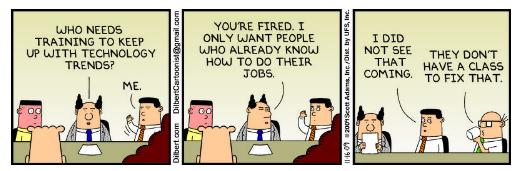
Unemployed? Forget Training.


I’m posting this for two reasons.

I initially thought it was funny. So haha …

Then I heard today about a job posting that said “Please do not apply if you are currently unemployed for more than one year.”

Please do not apply if you are currently unemployed … I am, as the Brits and others say, gobsmacked.

Here’s a quote from one of the stories:

“While refusal to consider the unemployed is sometimes overtly noted in ads, at NELP we also hear regularly from unemployed workers — mostly older workers — who, despite years in the labor force and significant directly relevant experience, are nevertheless told they will not be referred or considered for employment once recruiters or potential employers learn they are not currently working,” she told the commission.”

So where does that leave all the talk about training and retraining and more training and new skills training and …

When a cartoon, that in better times made me laugh as someone who valued and promoted education and training, becomes a reality for millions of people, I start to wonder.

Should anyone raise their hand when asked if they need more training? Or just go the informal route, and learn what they need to know and know-how to do as quietly and safely as possible?

A Piece of Cake!


I’ve been a long-time advocate for moving education out of the analog past into the digital future. And I’ve reported a lot of great changes that are happening in this blog. Well it’s my pleasure to introduce another that is not only a brilliant use of the internet but incredibly timely.

There’s a tremendous need in this country for education for school children with special needs. One of those special needs is in the area of speaking and communicating. There are now – and have been for several years – more kids who need help than there are Speech Language Pathologists (SLPs).

Enter the internet and the brilliant program put together by Presence TeleCare.

Watch the video by Dr. Shari Robertson, Professor of Speech/Language Pathology at Indiana University of Pennsylvania and then take a look at the Presence TeleCare site. Make sure to let people you know who work as SLPs, teachers, administer school systems or parents with children that the site is up and ready. Think about all the kids who need the help the site can provide, but are not getting it because of cutbacks in school funding across the country.

http://presencetelecare.com/

Changing VILT One Student @ A Time


Here’s the press release from Cisco and a video of Jeanne Beliveau-Dunn explaining the importance of the new certification:

Cisco Introduces The New Virtual Classroom Instruction Specialist Certification

Vendor-Neutral Training and Certification Helps Instructors Make

The New Virtual Classrooms Engaging and Improves Student Outcomes

SAN DIEGO, CA and SAN JOSE, CA — (MARKET WIRE) — 02/07/11 — Training 2011, Booth 416 — With more educators using technology to advance the classroom experience, Cisco (NASDAQ: CSCO) today announced the Cisco® Leading Virtual Classroom Instruction certification, developed to build and validate the skills that educators and instructors need to effectively teach in virtual classroom environments.

Key Facts

  • According to the American Society for Training & Development, 37 percent of training in 2009 involved electronic technology, up from 15 percent in 2002, while face-to-face instruction fell to 59 percent.
  • The Cisco Leading Virtual Classroom Instruction (LVCI) course teaches participants how to prepare and manage a virtual classroom, effectively deliver material online, and use collaboration tools to maximize student participation and comprehension.
  • LVCI goes beyond tool usage and teaches instructors how to improve learner outcomes through more effective classroom collaboration. They learn how to become Facilitators and work collaboratively with their learners
  • LVCI is delivered virtually using Cisco WebEx™; however, the skills are readily transferable to other conferencing and collaboration tools.
  • LVCI consists of 17.5 hours of live virtual instruction and six hours of participant presentations, delivered over five consecutive days.
  • LVCI is designed and led by experienced WebEx University instructors, who have delivered more than 40,000 hours of virtual training sessions.
  • Certification will be based on a proctored multiple-choice exam (642-132 LVCI) and a practical demonstration (642-133 LVCIP), in which the candidate uses the best practices of virtual classroom delivery.

Supporting Quotes:

  • Jeanne Beliveau-Dunn, vice president and general manager, Learning@Cisco, said: “As the paradigm of education continues to evolve to meet new institutional and business requirements, developing instructional strategies for new virtual education environments is becoming key to improving student results. The Virtual Classroom Instruction Specialist training and certification help ensure that instructors have the most comprehensive understanding of the latest technologies and effective classroom collaboration strategies. Cisco’seducational offerings provide the skills and depth of knowledge required for educators to differentiate themselves in today’s job market and enable a competitive advantage for their employers.”
  • Kathy Cooper, senior product trainer, WebEx University, said: “Cisco Virtual Classroom Instruction Specialist certification not only covers the skills and techniques instructors need to prepare and manage a virtual classroom, but also shows how instructors can engage learners in the educational process and increase their participation and comprehension.”
  • David Mallon, principal analyst, Bersin & Associates, said: “Our Virtual Classroom research shows that learning in an online environment is both less expensive and can be more instructionally rich than physical in-class experiences. Our research also demonstrates that what makes a great instructor effective online is the skillful use of collaboration tools. As job training and education continue to move online, this type of certification is an important offering.”
  • David Grebow, Instructional Designer, KnowledgeStar said: “This course is a game changer and will make the virtual classrooms the choice for learning in the 21st century. I had the privilege of working with some of the most forward-thinking and smart people at Cisco and WebEx, and we produced a certification program that will turn instructors into facilitators and students into adult learners collaborating with each other and taking the learning beyond the virtual classroom. It’s a new model for making online education really work.”

Wait a Minute I’ll Google It!


Google has become a digital extension of my memory. The older I get the more I use it. If I forget how to do something, or cannot remember a fact or name or place, I Google around for a bit and find it.

For example, this morning I was on the phone talking with a client. We started talking about a film and neither one of us could remember the name, only that Al Pacino was in it. So I Googled “Al Pacino Filmography”, and two clicks later, I ‘knew’ the name of the movie. Earlier in the week, I had moved all the livingroom furniture and, in the process, unhooked the VCR, DVD, and TV. When I went to plug in this Medusa’s Head of wires, I could not for the life of me remember how the VCR fit back into the scheme of things.

Right. I Googled “Mitsubishi DVD VCR Connections” and three clicks later had the operating manual that was lost in the same place that socks go to in the washing machine.

What does this have to do with learning? Everything. It points to the fact that I do not need to know something, or know how to do something, and I can still know it and do it. My performance is acceptable. It’s my memory that sucks. Google is my brain plugged into the internet, the largest repository of information ever created since they set fire to the the Library of Alexandria. Wait a minute, who was it who set that fire … hold on a sec … okay it was either Julius Caesar or Caliph Omar .

Yep, Googled.

So why are we spending untold amounts of time and money on learning programs that are not necessary? They could be effectively replaced by a computer on a fast WIFI connection to a knowledge repository. Does anyone assess what needs ‘real learning’ versus what only needs to be searched for, used, and then forgotten?  What is real learning anyway?

This is one place where some technology, beyond the flipchart, can come to the rescue and save us from painful, expensive and needless “training”. And it would be just in time …

Tony Carlson tells us that “We process more information in a 24-hour period, than the average person 500 years ago would come in contact with in a lifetime…” Are we part of the problem, or the solution?

Maybe I’ll ask Google … .


Ready Or Not …


Help! Not again! I was finally ready to do the old thing and now, here’s the new thing right on its heels. Something we’ve all felt. Newness. It seems to be the driving force in this new economy. And it requires more innovative approaches to learning than “training,” as an extension of our formal education. Why? Because it’s no longer a question of “What did you learn in school today?” but “Are you ready to do it, use it, sell it, make it happen?”

Let’s face it. In most corporations, we are lifelong survivors NOT lifelong learners. Performance is what counts. Short term memory wins. Defining strategies for enabling short-term memory is the future of learning in the new economy.

If you want a glimpse of that future, download Microsoft’s new online book reader. Welcome to hypertext, the book that does the work for you. Want a definition of a word? Highlight the word and click the mouse. Want to add a note? Click the mouse and type it. No need to take the time to find a post-it or get the dictionary. Certainly no need to remember the definition.

Who remembers anything any more anyway? Who needs to really remember with all the “remembering” tools at our disposal? And who has the time?

As lifelong survivors, we turn on our brains and learn when we need to get ready to do something. The rest of the time we get by with what we know. Learning is becoming synonymous with ‘being ready fast.” Ready for your next assignment? Your new job? That next sales call with a new customer? Or servicing that new widget? Readiness has become the true test of learning.

In the new knowledge economy, readiness stands alongside competitiveness. Readiness equals success. Imagine intersecting lines of latitude and longitude. Latitude is you, working every day. Longitude is your intersection with the new. The new seems to happen more frequently. You need to be ready or you’ll be left behind—not just you, but your whole company.

So if readiness is the key to success, here’s the question: Does any form of training (from elearning to instructor-led classes) help you get ready to perform? I suspect you know the answer.

If training worked so well, why aren’t we all performing like top guns? After taking all that costly and time-consuming training, why aren’t we all ready to sell that new and exciting product, or deliver that value-adding service, install and use that cool new upgrade? Why aren’t we ready?

Here’s the reason. Training is not focused on getting us ready to reach that exalted “State of Readiness.” Instead, training treats us as if we were still in school. The difference is that instead of a test and a grade, it’s our performance being graded. Instead of moving from grade school to high school, it’s our promotion or pay increase that’s at stake. In the corporate world, especially in the new knowledge economy, it’s all about Readiness: being ready to do something, not just learning about doing. I’ve never yet had anyone come into my office and ask me to “go learn something just to learn it.” You?

Here’s a bold assertion: Training does not make us ready to do anything. Here’s an interesting chart that explains why.
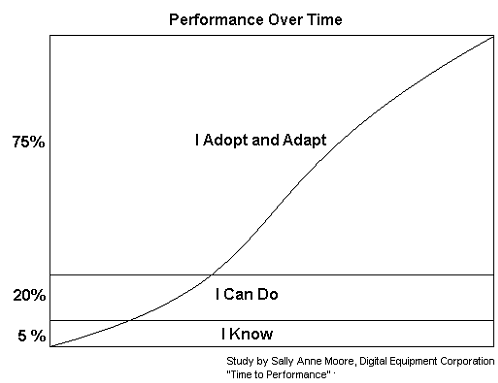
Training in the corporate world, where doing is everything, can only take you at best 25% of the way towards readiness. Usually you’re lucky if you get to the 5% mark. The other 75% or more is up to you.

Take the game of golf. You can go to a seminar or read a book about the History and Etiquette of Golf, watch a videotape of Great Golfing Moments, attend an Introduction to Golf seminar and you can say you know something about golf. But are you ready to play? You can then buy and enjoy a great computer eGolf game, find a golf pro, take lessons, learn to simulate the swing, practice putting, slice and dice balls at the driving range all weekend, and think youcan do it, but are you ready to play golf?

From your first tee shot on your first hole, it takes hours of adopting and adapting what you know and can do, swinging all the clubs, in all sorts of weather and conditions, failing and succeeding, practicing and more practicing, before you are ready to really play golf.

Readiness, then, is the state of being able to creatively adopt and adapt what you know and can do under a varying set of circumstances. You may not win the game, but at least you’re ready to play.

Can you say as much for your players? Is training making them ready? Are they getting the right support to help them get ready? Are they really discovering what they will need to be able to do and know in order to get ready? Are they at least getting that 25% of knowing and doing? Do they have enough time to practice, to fail and succeed, to adopt and adapt, and really get ready? Or do you expect them to do it on the job, fail at the customer’s expense, and practice on the customer’s dime?

The best example I’ve seen of a program that helps people get ready was recently created by a company called SkillScape. They created The Readiness Assessment Program (RAP)™ to help customers implement software upgrades. The RAP first helps you see how ready you are, then points you towards the learning you need as part of your Individual Learning Plan. After you cover your learning plan, you can assess yourself again and see where you stand. It’s focused, it’s targeted, and it’s designed to do one thing only: Get you ready for a specific new job.

Readiness? That is the question that no one seems to be asking. Content. Tools. Technology. Methodology. If it doesn’t help me or my organization get ready the next time something new crosses my path, then who cares?