121 Blogs About Learning


Here’s my daily reading list from which I pick and chose every day. The represent the best minds in the area of learning and learning technology. Enjoy!

Aaron Silvers

Adventures in Corporate Education

aLearning

Allison Rossett

Assets

B Online Learning

Blogger in Middle-earth

Bottom-Line Performance

Bozarthzone

brave new org

Brian Dusablon

Challenge to Learn

Clark Quinn

Clive on Learning

Connect Thinking

Courseware Development

Daretoshare

Dawn of Learning

Designed for Learning

Designing Impact

Developer on Duty

Discovery Through eLearning

Dont Waste Your Time

e-bites

e-Learning Academy

E-Learning Provocateur

E-learning Uncovered

easygenerator

eCampus Blog

eLearning 24-7

eLearning Acupuncture

eLearning Blender

eLearning Brothers

eLearning Cyclops

eLearning TV

Electronic Papyrus

Element K Blog

Engaged Learning

Enspire Learning

Experiencing eLearning

Getting Down to Business

Good To Great

I Came, I Saw, I Learned

ICS Learning Group

ID Reflections

IDiot

Ignatia Webs

In the Middle of the Curve

Integrated Learnings

Interactyx Social Learning

Jay Cross

Jay Cross’s Informal Learning

Joitske Hulsebosch eLearning

Jonathan’s ID

Kapp Notes

KnowledgeStar

Lars is Learning

Latitude Learning Blog

Learn and Lead

Learnability Matters

Learnadoodledastic

Learnforever

Learning and Technology

Learning Cafe

Learning Conversations

Learning Developments

Learning in a Sandbox

Learning Journeys

Learning Next

Learning Putty

Learning Rocks

Learning Technology Learning

Learning Unbound Blog

Learning Visions

LearnNuggets

Leveraging Learning

Living in Learning

Managing eLearning

mLearning Trends

Moodle Journal

onehundredfortywords

Ontuitive

OutStart Knowledge Solutions

Performance Learning Productivity

Pragmatic eLearning

QuickThoughts

Rapid Intake

Redtray

Road to Learning

Rob Hubbard

SharePoint and Assessment

Simply Speaking

Skilful Minds

Social Enterprise Blog

Social Learning Blog

Spark Your Interest

Speak Out

Spicy Learning

Sticky Learning

Stoatly Different

Sudden Insight

Take an e-Learning Break

Tayloring it

The E-Learning Curve

The eLearning Coach

The Learned Man

The Learning Circuits Blog

The Learning Generalist

The Peformance Improvement Blog

The Writers Gateway

Thinking Cloud

Tony Karrer

Trina Rimmer

Twitterpated with Learning

Upside Learning Blog

Vikas Joshi on Interactive Learning

Web 2.0 and Learning

Wonderful Brain

Work 2.0 Blog

ZaidLearn

Asleep at Midnight


Image

Wisdom about education comes at us from many sources these days. I found this on TED (no surprise there). What is a surprise is that the presenter is a former teacher, and what he learned about “smart failure” is a lesson that is not only relevant for education, it is relevant for everyone everywhere who was, as he says, “…asleep at midnight when all the rules changed.”

The implications are profound. Eddie Obeng is one of the few on this planet who can see the forest and the trees, who gets it – that we have moved from one paradigm to another and most of us still operate in the old one. To move forward – in the classroom, in the workplace, in our own lives – we need to accept that fact and begin to fail smartly if we are ever to succeed.

The world is changing much more rapidly than most people realize, says business educator Eddie Obeng — and creative output cannot keep up. In this spirited talk, he highlights three important changes we should understand for better productivity, and calls for a stronger culture of “smart failure.”

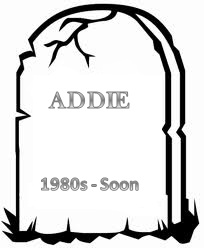
ADDIE Must Die!


NOTE (October, 2012): I first posted this piece in 2004. At the time I was looking at educational theories and methods that had been developed in the early 1970’s and that rather mysteriously became the de facto standard for developing educational programs.

I saw two major problems with ADDIE.

The first is obvious. The way we learned back then was simple and singular. Classroom, teacher, facing front in rows, be quiet, raise hands, take tests and more tests then PASS or FAIL. The ADDIE model worked and perhaps that is why is was adopted as THE standard even though there was no standards body that developed and accepted ADDIE. Thanks to Don Clark‘s research into ADDIE (which I recommend), it was developed by the US Army in 1975, and then copied by corporations, presumably by people who heard about it and experienced it in that environment. The problem is that today – and into the future if the past is any guide – we learn and will learn in dramatically different ways. Ways that ADDIE cannot support as a developmental model.

Second, either explicitly or implicitly ADDIE still is the default for defining, designing, developing, delivering, managing and measuring education. That means – and I still experience this – whenever educational programs are being created, the underlying thinking is A – D – D- I -E. This not only limits the way new educational programs are developed, it hamstrings the creative use of new learning technologies. Technologies that were not even dreamed of when ADDIE became the accepted guideline for development. It precludes many, if not all, of the powerful capabilities technology promises . Learning that is blended, mobile, flipped, social and more. So my conclusion then and now is that ADDIE must die. 

The Premise

ADDIE is the illegitimate child of the Industrial Age, and using it is an addiction that almost always leads to formal training programs that are, in these digital days of rapidly advancing Blended,Mobile, Flipped and Social Learning, close to worthless if not actually counterproductive.

The good news? There is a better alternative …

Note: This is Part One of a two part series.
The future is a foreign country where

they do things differently than we do today…

Preface

I never minded school that much. It was the place where my friends hung-out and occasionally suffered through a class with me. I’m not sure what I learned or if it was of any use, but it was at least social. Learning in the workplace was the same until the computer started to pop-up everywhere. Then learning became lonely, it became anti-social.

Those of us who are trying t put the social back into the learning too often focus on the forest. The Big Enterprise 2.0 picture. This is a look at one of the trees – ADDIE – and it’s contribution to ongoing tradition of cranking out ineffective Enterprise 1.0 formal learning programs.

Change is Hard

Change is the most difficult yet desired state to which people want to move. Yet we live in the past in which habits rule and rules become habits. They don’t even need to be good habits or intelligent rules. Just habits and rules.

You’ve probably heard that expressions “If every problem is a nail, then every solution is a hammer”?

With ADDIE, if every problem is a lack of knowledge or know-how, then every solution is a formal training program …

Now I already know that you are falling into one of several categories of readers.

  • You are so hooked on ADDIE that anyone who tries to show you that ADDIE has no clothes is an instant turnoff, and you are in the process of clicking away as fast as your finger can find your  mouse
  • You think ADDIE is okay, agnostic and can be used ‘back then’ as well as ‘moving forward’ and might consider reading what I have to say
  • You develop really compelling and exciting social learning experiences and have no idea what ADDIE means … you can go.

Hopefully those of you in the first two groups will read on …

The ADDIE Habit

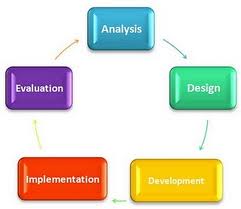
ADDIE.  As you may (or may not) know, it stands for the five linear phases or guidelines for building effective training:

  • Analysis
  • Design
  • Development
  • Implementation,
  • Evaluation.

ADDIE evolved into a more circular model in the late 1990’s and looked like this:
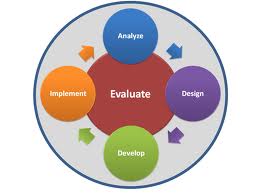
Evaluation became embedded in every part of the model. The variation was often called “Rapid Prototyping” which simply meant you ‘evaluated’ how well it was working at each A-D-D-I step.

There’s only one problem.

It no longer works.

Background Check

Here’s some ADDIE history. After doing an extensive search for the origin of ADDIE¹, I came to the conclusion that no one created the model. It was not the outcome of years of research, or a brilliant point of insight at the intersection of the disciplines that explore how we learn.

This idea is not new. It was, for example, originally published in an article by Michael Molenda of Indiana University, In Search of the Elusive ADDIE Model(Performance Improvement, May/June 2003).

During my halcyon ISD days, I didn’t really care who built the model, or that it was merely “… a colloquial term used to describe a systematic approach to instructional development, virtually synonymous with instructional systems development (ISD).”

Happy New Year 2005 (2013).  Now I do.

When Learning Was a Noun

It was around the late 1970’s when ADDIE suddenly became the de facto standard for developing training programs for the US government and everyone else. ADDIE seems to have been adopted as an acronym in all the RFP’s that were issued by TWLA (Those Who Love Acronyms).

That meant that ADDIE had its roots in the Industrial Economy.  A time when we managed hands and produced things. ADDIE was useful for helping people develop formal education programs in which knowledge was transferred and tests proved that it was ‘learned’.

ADDIE became the cutout you traced, the “paint by numbers” approach to developing and delivering programs that were the formal start – and too often the end – of your education. ADDIE was popular when organizations were bricks and mortar, development of programs was top down, and performance with regard to training was about getting a passing grade not adopting and adapting what you learned and transferring it back into the workplace.

When it came to really learning how to do anything, ADDIE led to the place where, if you were lucky, your informal education began. That was when you really started to learn how to do something².

Learning is Now a Verb

Times change. Take a look at the following chart to see how different the world of work is today:
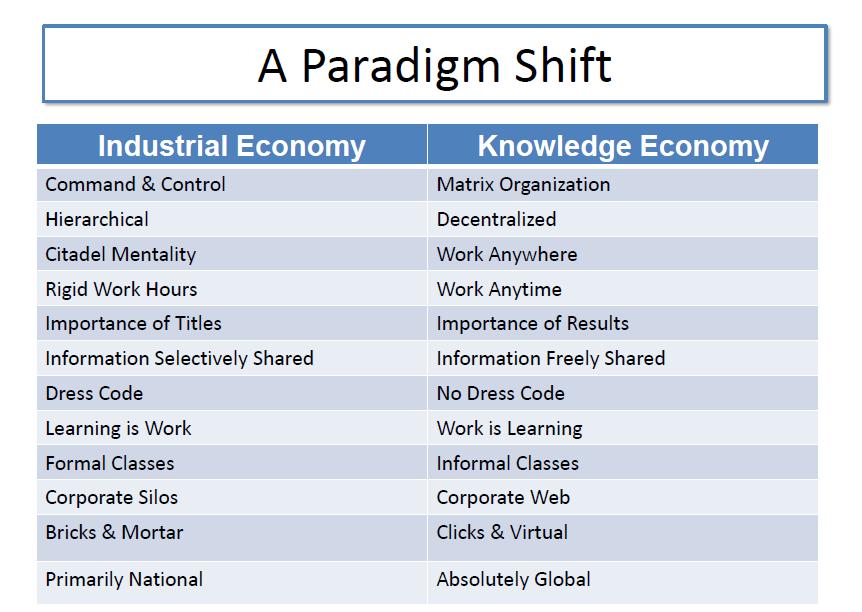
Shift Happens

Performance, Performance and Performance

Today it’s all about performance. What can you do for me?  How can you do it faster and better? We’re well into the Knowledge Economy (aka Idea Economy), in which we manage minds and produce ideas. We no longer need to focus primarily on knowledge. We need to refocus on know-how and develop a model that supports learning how-to do something. Fix a thing. Make a thing. Come up with a solution. Steps to meet a challenge.

We need to focus on a developmental model that is more than just a “colloquial term”, one that helps incorporate new technologies and new ways of learning. One that enables rather than disables what we now understand as the learning process. A new model that provides knowledge AND  is the launching pad for know-how and real learning in the future.

A model that drives a Social Leaning program.

From this perspective, let’s take a closer look at ADDIE and judge how relevant it is today. In Part Two of this blog, we’ll look at replacement model that enables Social Learning.

WARNING: Boring details and research up next!

Read More

¿Su LMS habla español?


Why build a Spanish LMS?

First, more and more of the schools with whom I’ve spoken this past year, individually and at conferences and meetings, have told me they need one and need one now. So I did some research and that brings us to the second point. The surprising facts: 

Spanish is spoken by almost 400 million people worldwide. Even more compelling, when you realize that about half of the population in the Western Hemisphere speaks Spanish, it becomes the primary language for as many people as English in this region of the world.

Within the United States, Spanish is the second most widely spoken language after English, by a very wide margin, and the Spanish-speaking population within the U.S. is growing as a percentage of the total U.S. population every year.

· According to the U.S. Census, the number of Hispanics in the U.S. grew by 57.9% between 1990 and 2000 – from a total of 22.4 million people to a total of 35.3 million people. This figure means the United States has the fifth largest Hispanic population worldwide (trailing Mexico, Colombia, Spain and Argentina – just barely behind Spain and Argentina).

· Of this group of over 35 million people, well over 3 out of 4 say that Spanish is their primary language.

· Within the United States, a total of over 28 million people speak Spanish at some degree of fluency. A few states have a large percentage of these Spanish speakers – California has 5.5 million, Texas has 3.4 million, New York has 1.8 million, and Florida has 1.5 million.

· In the U.S., the 28 million people who speak Spanish at home is well over half of the approximately 47 million people who speak a language other than English at home. That means that Spanish is spoken by more people than all other languages combined within the U.S.

· The 35 million Hispanics in the U.S. as of 2000 was projected to be close to 40 million people as of 2003. Moreover, by 2050, the number of Hispanics in the U.S is projected to grow exponentially to over 100 million people. At that point Hispanics will be about one quarter of the total U.S. population. That’s over triple the 2000 figure in a 50-year span.

· In the New York City area, the newscast on the Spanish-language Noticias 41 and Noticiero Univision, often have higher ratings than ‘the big three’ network news shows on CBS, NBC and ABC.

· Approximately 5.8 percent of Internet users speak Spanish, making it the 4th most common language among the Internet community, trailing only English (about 50%), Japanese (about 8%), and German (about 6%).

· A recent study of 25 metro markets in the U.S. found that Spanish-language programming was the sixth most popular format.

· It’s increasingly difficult to ignore the spread of Spanish in the United States. Bank ATMs offer instructions in Spanish. The Yellow Pages in many cities adds a Spanish-language insert. And Spanish is working its way into everyday use. Is there an American left who can’t order fajitas with spicy jalapeños using the proper Spanish-accented flair? (Say the J like an H: fah-hee-tas …)

· Over the past decade, the demand for Spanish Language courses worldwide has just about doubled, and the demand is almost as close in the U.S.

According to Paula Winke and Cathy Stafford of The Center for Applied Linguistics rapid demographic changes and an increasing recognition of the critical need for professionals who are proficient in languages other than English (Brecht & Rivers, 2000; Carreira & Armengol, 2001) have led to an interest in developing language programs and classes for “heritage language learners”. These are students who are raised in a home where a non-English language is spoken and who speak or at least understand that language (Valdés, 2001).

The fastest growing heritage language population in the United States is Hispanic Americans (U.S. Bureau of the Census, 2010), and the number of Spanish speakers studying Spanish is on the rise. As a result, language educators are developing programs, classes, and instructional strategies to address the needs of these students, which are different from those of native-English-speaking students studying Spanish as a foreign language.

Appropriate instructional materials are essential for these classes, which are often referred to as Spanish for Spanish speakers (SNS) classes. Although the development of SNS materials has a 30-year history, and many new SNS textbooks and materials continue to appear, developing a well-articulated sequence for SNS instruction continues to be a challenge (Peyton, Lewelling, & Winke, 2001).

So is anyone listening? Here is a tremendous opportunity for this large group to learn new career skills using their native Spanish language. Are we so Anglophile that we do not care? Let me know. I always value and look forward to your opinions on these important subjects

All About “Learning” Not “Education”


About time we made the distinction.

Learning is the name for the natural process that we use all the time. It uses the relatively new architecture of the brain’s pre-frontal cortex and invokes (among others) imagination, creativity, and critical thinking.

Education is an unnatural institution, expanding most dramatically during the Industrial Age, that often relies more on short-term memory and memorization than the higher brain functions required for learning.

When you learn something the learning is available for life. When you are educated about something the information in your brain begins to degrade almost immediately.Could you still get a PASS on any test you took one year ago? Even if your memory is good to great, knowledge in the new global Idea Economy has a rapidly shrinking shelf life coupled with an exponentially increasing amount of detail and new information.

That’s why continuous independent learners are the smartest people. It’s also why we can still fallback on the old cliche “Experience is the still best teacher.”

As always, TED hits it spot-on. Watch and learn Grasshopper …