Ouch! The Truth Hurts
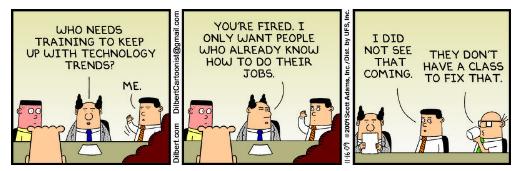

This would be funny if it was not really happening.

The responsibility for knowledge and know-how is being placed on the learner and not necessarily on the company anymore. I believe there are some huge implications to this trend:

  • The gap between the people who have the ability to be lifelong learners, and those who cannot get out of the more formal feed-me learning mode, will grow wider. Income will follow the ones who can learn on their own not the ones who have the most degrees or letters after their name.
  • Providing certificates for people who are learning all the time through the programs they take, from self-paced to webinars, virtual classes to conferences, will be a necessity in a world in which people want to prove what they learned. “Those outside of companies with skill-building curriculae can’t obtain legitimacy in those skillsets without being an employee. The more people are culling unassociated resources and experiences to learn specific skills, the more urgent it is for there to be a place for them to record their efforts and success, to study with peers, and to present their learning portfolios to future employers or partners in a meaningful way.” Fast Company
  • Independent learning is dependent on technology for reach and currency. Countries with the best, fastest most up-to-date online learning technologies will become the leaders in this hyper-competitive marketplace.
  • The formal school system is a disaster of epic proportions. If you disagree spend some time looking up the statistics on things like
    • drop-out rates from 2000 until today
    • average reading levels at graduation for those who get through the system
    • illiteracy rates from 1900 until today
    • comparisons of math and science test scores with other countries.

When you cross-reference these system failures with other countries you discover a startling fact. The countries that are ahead of us are the ones with the best on-your-own education systems. It’s not the formal school system that is giving them the lead but the system that enables their citizens to learn and continue learning on their own.

  • Teaching-to-the-test is a dumb idea. It does not produce people who can master learning on-your-own. Instead the outcome is a person who can memorize and forget and not really learn anything except how to take a test and move from one grade to another. The teaching-to-the-test approach does no one any favors. At best, it is a band-aid on a broken system. At worst, it is responsible for the dumbing-down of America.
  • The current educational model is ancient. Based on the Industrial Age necessity of churning out good soldiers (literally where it started) it was never designed to produce independent critical learners who were capable of learning on their own or with one another.
  • Teaching people to learn is far more important than teaching them a subject. Mastery never came out of a class anyway, and blended learning that married informal and formal modes of learning always trumped formal-only learning.
  • Khan Academy is one of the more brilliant uses of learning technology that seamlessly blends learning on-your-own with being helped to master a concept with a mentor or facilitator. The flipping of the schoolwork and homework into a more effective model of learning is a revolution in education. It can be used from Pre-K to Lifelong learning.

So the upshot is pretty simple. We need to revamp the educational system to produce great learners. It’s totally possible for several compelling reasons:

  1. People are born, to one degree or another, with the innate capability to be brilliant learners. Study infants in their first 5 years as they master walking, running, eating, talking, and so much more. Thank goodness school does not start during this period of exploration, discovery, trying, failing and succeeding. It’s only when we place them into the formal school system that they learn to be stupid.
  2. There already are great new approaches that are succeeding. I mentioned Khan Academy. There are others. So there is no longer any excuse for not replacing the outdated failed dysfunctional model of education with a new, better, brighter and more functional model of learning.

No reason that is except for a mountain of resistance: entrenched stakeholders in the old system; the politics of hold-the-line; stubborn inertia; “teachers” unions; teachers themselves; bureaucrats and their selfish bureaucracies; Boreds of Education; lots of people who hold the old dear and the fear the new; well-intentioned people without a desire to really see the system change … and more.

But despair not, change will come to the educational system, it will just take time. Planks Principle about the way science changes is worth repeating here. In his autobiography, Planck remarks that a “new scientific truth does not triumph by convincing its opponents and making them see the light, but rather because its opponents eventually die, and a new generation grows up that is familiar with it.”

It’s no wonder that a visionary like Sal Kahn literally started his brilliant game-changing program in a closet …
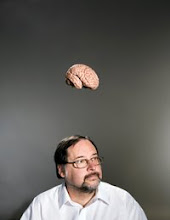
Brain Rules for Classes


One of the biggest reasons people like learning online, especially late at night,  is that it’s a great way to get to sleep.

Just joking. Not. The following interview was originally written as Brain Rules for Meetings. As I read it, I was struck by the realization that it applies even more so as Brain Rules for Classes. It is right to the point about the ways that we need to be Great Instructors in our classes (which after all is and done are not essentially different than a meeting). What I find amazing is how many Teachers – Instructors – Lecturers do not follow the rules.

For those of you pressed for time, here’s a quick summary of the 3 key rules or “Brain Gadgets” that guarantee a really good class presentation:

  1. Start with the meaning of what you’re talking about, not the details. Details are b o r i n g, meaning is everything
  2. You have 10 minutes before the brain checks out … that means a powerful start EVERY 10 minutes if you want to hold their attention
  3. Key in on the 6 Big Questions everyone asks in any meeting or class that you need to answer … especially Question 5 and 6. I won’t even try and sum those up, so read on ….
Molecular biologist John Medina, speaker and author of the best-selling book Brain Rules: 12 Principles for Surviving and Thriving at Work, Home, and School, didn’t set out to become a media star. But he got so fed up with encountering myths about the brain – that you use only 10 percent of it, for example, or that there are right- and left- brain personalities – that he once threw a magazine across a seat on an airplane. (The flight, he notes, wasn’t full.) “So I decided to write Brain Rules,” Medina said, “as an attempt to say, ‘Look, here’s what we do know, here’s what we don’t know, here are a few things you can try that might have an application in the business world – and the meetings world as well.'”

Not that Brain Rules will tell you how the brain operates. “We don’t know squat about how the brain works,” said Medina, who has focused on brain research for nearly three decades. He added: “I don’t know how you know how to pick up a glass of water and drink it. But we do know the conditions that [the brain] operates best in, even if we don’t know all the ins and outs of that operation.”

Which of the 12 Brain Rules has the most impact on meetings?

Well, probably, the biggest one would have to be about attentional states. This rule is very simple: People don’t pay attention to boring things. So if you really want to have a lousy meeting, make sure it’s boring. If you want to have a lousy classroom, make sure it’s boring. And if you want to vaccinate against the types of things that really do bore the mind, we have some understanding of that.

So how do you design a good meeting?

Here are the top three “brain gadgets” that probably have a bearing on the question. First, the human brain processes meaning before it processes detail. Many people, when they put meetings together, actually don’t even think about the meaning of what it is they’re saying. They just go right to the detail. If you go to the detail, you’ve got yourself a bored audience. Congratulations.

Second, in terms of attentional states, we’re not sure if this is brain science or not, but certainly in the behavioral literature, you’ve got 10 minutes with an audience before you will absolutely bore them. And you’ve got 30 seconds before they start asking the question, “Am I going to pay attention to you or not?” The instant you open your mouth, you are on the verge of having your audience check out. And since most people have been in meetings – 90 percent of which have bored them silly – they already have an immune response against you, particularly if you’ve got a PowerPoint slide up there.

How do you then hold attention?

This is what you have to do in 10 minutes. You have to pulse what I just said – the meaning before detail – into it. I call it a hook. At nine minutes and 59 seconds, you’ve got to give your audience a break from what it is that you’ve been saying and pulse to them once again the meaning of what you’re saying.

What is the third “brain gadget”?

The brain cycles through six questions very, very quickly. Question No. 1 is “Will it eat me?” We pay tons of attention to threat. The second question is “Can I eat it?” I don’t know if you have ever watched a cooking show and have loved what they are cooking, but you pay tons of attention if you think there’s going to be an energy resource. Question No. 3 is highly Darwinian. The whole reason why you want to live in the first place is to project your genes to the next generation – that means sex. So Question No. 3 is “Can I mate with it?” And Question No. 4 is “Will it mate with me?”

It turns out we pay tons of attention to – it actually isn’t sex per se, it’s reproductive opportunity. [It is also] hooked up to the pleasure centers of your brain – the exact same centers you use when you laugh at something. Oddly enough, I think that’s one of the reasons why humor can work. If you can pop a joke or at least tell an interesting story, it’s actually inciting those areas of the brain that are otherwise devoted to sex. You don’t become aroused by listening to a joke. I’m saying those areas of the brain can be co-opted. You can utilize them, and a good speaker knows how to do that.

What are Questions 5 and 6?

“Have I seen it before?” and “Have I never seen it before?” We are terrific pattern matchers. There is an element of surprise that comes when patterns don’t match, but the reason why that happens is because we are trying to match patterns all the time.

Is there a Brain Rule that addresses whether you should try to control the use of laptops and phones during a meeting session?

I have this rule response, based on data, and then I have a visceral response, also based on data. In other words, I’m about ready to tell you a contradiction. Are you ready?

Yes, I am.

Alrighty. I do believe what you can show is that there are attentional blinks. The brain actually is a beautiful multitasker, but the attentional spotlight, which you use to pay attention to things, [is not]. You can’t listen to a speaker and type what they are saying at the same time.

What you can show in the laboratory is that you get staccato-like attentional blinks. Just like you come up for air: You look at the speaker, then when you’re writing, you cannot hear what the speaker is saying. Then you come up for air and hear the speaker again. So you’re flipping back and forth between those two, and your ability to be engaged to hear what a speaker is saying is necessarily fragmented.
At the same time, if your speaker is boring, you could have checked out anyway. So you see, in many ways it depends upon the speaker.

How so?

If the speaker is really compelling and is clear and is emotion- ally competent, and has gone through those six questions, letting you come up for air every 10 minutes, I’ve actually watched audiences put their laptops away just to pay attention.

I have a style that is purposely a little speedier. And the reason why is that it produces a tension that says, “I need to pay attention closely to him or I’m going to lose what he’s saying.” I don’t make it so fast that it’s unintelligible – at least I hope I don’t. But I do make it fast, and occasionally I see comments that say, “Great speaker, but you know, you were too freaking fast.”

This interview originally appeared in the Professional Convention Management Association (PCMA) magazine

Crossing the Analog \ / Digital Gap


I’ve written several posts about the evolution of education, especially from the analog past to the digital present and future.

My own experience between the two was real a wake-up call. I bought a new car a many thousands of miles ago and had a lot of music I wanted to hear from my cassette tapes (analog). The new car could only play cassettes and not discs. That was okay until I went over to Borders (remember them?) to buy some new cassettes (remember them?).

Surprise! No more cassettes only discs … Bill Gates was right, the pace of change is changing.

Longer story shortened,  I was listening to the old cassettes until I found a way to transmit the music from my iPod (digital) through my car’s stereo speakers.


Back to Crossfy. I’ve been wondering since then who was going to be smart enough to build a bridge from the ‘old’ analog – which will be around for quite awhile yet – to the new digital.

And here it is …

“Think of all the possibilities” …  Crossfy is an Brazilian company that has figured out how to connect the offline and online worlds, build a bridge between space and cyberspace. Well known in the Brazilian startup community, its CEO Amure Pinho is also the founder of Sync Mobile Based in Rio de Janeiro, a startup initially focused on developing apps and other mobile solutions.

The Crossfy technology identifies printed ads and images to give access to associated digital content, from text and audio to video. It  connects the offline to the online world, via a mobile phone.

As Amure Pinho explains:

“The integration between print and digital media will revolutionize the way we consume newspaper content. For instance, think of all the possibilities around the upcoming Olympic Games in London. For the first time, Brazil’s main TV channel won’t broadcast the largest sports event of the year. This gives us space to deliver a new experience on top of print media. Who knows, this could even help print media to be stronger than TV over that period.”

Imagine you’re reading a textbook, and there’s a great piece about [   fill in the blank  ], and you hold your phone (or iPad) over the book and SHAZAM you get your choice of

  • a video of a recorded interview with the writer
  • directions from here to there if you’re nearby
  • a documentary that relates to the subject
  • photo album of people who went there.

… and more.

I know it would be a curated link, and not as much fun as surfing around, then again how many textbooks make you want to learn all there is to learn about a subject? I don’t know about you, but anything that brings the printed page ‘alive’ for many students is a great option for people trying to transfer information to others, not to mention their instructors (facilitators … more on that later).

Happiness Makes You Smarter? :( It’s True! :)


TED Talks are like the TV show The Voice. They are The Voice of Great Minds. Everyone who speaks  at TED wins.  Here’s another great TED talk that might, if you really listen, change your life …

In many of my most recent posts I alluded to the idea that “average’ was not a goal. Shawn Achor takes it several steps further and talks about how we’ve managed to turn average into the goal. He also explains why happiness is a better goal and clearly shows you the relationship between happiness and education … and everything else.

Always Said The Brain Rules!


I always knew that it’s all in my head, that my brain ruled and not my heart. It’s taken years of work in the Neurosciences to get to the point where they are realizing that they hardly know anything at all about the way the brain really works. John Medina, author of Brain Rules, is my favorite researcher because he’s honest about the science and at the same time very funny. If you ever get a chance to hear him speak take the time and go.

I always learn something useful about my brain when I read or see John. Since my brain controls my life the lessons are always valuable. For example, in this interview, I learned that the Listener (aka Audience) has no choice but to ask The First 6 Questions as I talk. They are so hardwired into our brains that we don’t even know we’re asking them. There were a lot of other great tips about public speaking, which is essentially what anyone does when they transfer knowledge or know-how to a group.

I often wondered what made John such a great speaker and now I know. He reveals his secrets here,  in this great interview with the Guru of Public Speaking himself. If you want to grab your audience when your speaking you would be well advised to take what John has to say to heart …  er make that brain.

Read More

The State of the Education Union


Several things President Obama said in his State of the Union address stayed with me long after the channels covering the speech cut back to their reality shows. First he asked schools to stop teaching to the test, an allusion to the No Child Left Behind program. Then talked about rewarding excellence .

Having consulted with one of the major companies that develop that test, I have a firsthand understanding of what No Child Left Behind is all about and how the tests are developed. I was struck by the thought that in this country, when we teach to the test, two things happen.

First, when we do test we are not asking for a very high bar. Too high a bar and too many would fail. Too low a bar and too many would pass. The test question for all of us is which group determines where we set the bar, and what committee decides what’s just right?

Second, as we have seen, when we teach to the test learning becomes a competitive sport. It’s crazy at this point in the evolving history of Thomas Friedman’s flat world to be competing against each other, student against student, teacher against teacher, class against class, school against school and district against district. For what prize? To not fail the Annual Yearly Progress report and continue teaching for another year? To score on or slightly above the mean?  To be average?

In China, one of our real competitors, there is no expression for “Fool me once shame on you, fool me twice shame on me.” The closest equivalent is “Fool me once shame on me.”  The schools in China work together to help their students reach excellence, to be amazing and know awesomeness. They set the bar so high that everyone is better for trying to reach it.

We need teachers who will raise the bar. Teachers who will help students reach as high as possible. Getting rid of tenure for teachers who entered the profession without any passion or excitement or a love of teaching, who should never have entered a classroom in the first place is a good thing.  And letting go of those who, if they ever had it, have forgotten it, who are simply tired and ready to move on, is also a good thing. We are not the competition in this new Idea Economy. And this is surely one case where just showing up is much less than 90% of the job.

Part Two: Anyone, Anytime, and Anyplace


For starters, since it always helps to know where you are before you decide where you’re going, let’s first take a quick 30,000 foot look at the three economic paradigms, from the Agricultural to the Idea Economy.

Once you see where we’ve been, and understand the business models, methods, theories and approaches that were designed for the Agricultural and Industrial Economies, you will hopefully see why business models everywhere needs to change, why learning experiences need to change, and why the decentralized learning experience is so crucial to success in the this type of economy.

Economic paradigms are at the very heart of the way we live and have lived. They are a critical part of the Social Contract. They directly – albeit usually unnoticed – affect your life in every imaginable way. And the educational systems and programs are either in concert with the current economic paradigm, or they quickly become irrelevant.

The Agricultural Economy

Economists usually separate the last 300 or so years into three economic paradigms. They started when there was a break from things made on a small scale, when the things made and sold by artists, craftsmen, masters, blacksmiths, wheelwrights, family farmers, merchants of handmade goods, etc. were replaced by things that were mass produced and mass consumed. The key point is that mass production is the cornerstone of all modern economic paradigms.

First it was food that was mass produced. So the first economic paradigm was the Agricultural Revolution.

For the first time in history, many people had enough to eat. They stopped worrying about food, did not farm their own crops nor raise and slaughter their own livestock. The mass production of food marks a turning point in history. It gave people something they never had as hunter-gatherers: free time. The ability to move about and travel, even live in new places. Leave the farms and come to what became the first cities.

Owning land became the key to wealth, since land used to grow food was the key to the Agricultural Economy. Land Barons were born. The landed gentry were created. Kings gave land as the highest boon for services rendered. Kings were kings because they owned all the land which is why they could give some of it away. Private property was born. My land was fenced off from your land. New nations opened up huge tracts of land because they knew that making that land productive was the key to prosperity. Rich agricultural lands were fought over and conquered, farmed and fought over again.

We managed muscles because farming was a hard, back breaking job, even for the oxen and horses.

The few existing and emerging educational models was still carefully controlled, managed and centralized. Very few people knew a little and most people knew only what they needed for survival. Reading and writing farmed no land and produced no food. Men were trained to be manly and women to be womanly according to the mores of the time. There was no need for mass education.

The Industrial Economy

Next up was the Industrial Economy. I believe it started with the printing press in the mid-15th century. I also believe it created a period of transition – much like the Incunabula – that has occurred every time there is a new economic paradigm.

The incunabula was a period in which the church still controlled the written word and, until the printing press was invented, ‘books’ were in limited supply. The idea of providing the masses with unfiltered ideas was heretical. So the church decided that it would use the printing press for God’s work, and take the illuminated manuscripts from the scriptorium in the monasteries, where all bibles were created, and print out the words and send these first ‘forms’ back to the scriptorium for illumination.

So the monks took the forms and added colorful pictures of devils and angels, ivy and floral scroll-work, visual ‘job aids’ for learning about right and wrong and what happened to you if you strayed from the path of righteousness. The pictures were important because most people alive then could not read. These first printing press books are called incunabula. They represent a paradigm shift that ultimately affected everything – your work, your play, your family, your thoughts, your life.

Once the Industrial Economy really started to steam ahead, again it was all about mass production, only this time it was the mass production of things. We managed hands.

The first things to become ‘industrialized’ were farming tools – cotton gin, land tillers, tractors, and more. A clean bridge from one economy to the next. Other things began to become mass produced as well. Cars. Trains. Ships. Typewriters, a personal printing press when you added carbon copies (the origin of cc).  Stuff people believed they needed and bought out of the Sears catalog. You didn’t need to read just look at the pictures and send in the money. We not only became consumers of food but simply consumers.

The capitalist world was all about moving capital around to further the production of things (including the industrialized production of food) in order to create wealth. The wealth of nations, as recorded by Adam Smith, was built upon an educational system that led to a culture and political system supporting the mass production and mass consumption of things.

Owning the means of production was the key to wealth. The great wealthy dynasties of the industrialized world were created at this point in time. If you look at America, you see Ford, DuPont, Getty, Rockefeller, and Kennedy ad infinitum, owning the means of production and becoming the kings of this era.

It also meant we needed to make sure the culture of mass consumers was healthy and working. According to John Taylor Gatto, public schools were created for this very purpose. We did not want a critically thinking, independent population focused on anything other than acquiring things. Work to spend. Spend more and work harder. Make the rich richer while you enrich your life with things. Towards the end of this economic paradigm, we invented the credit card, one of the greatest boons to mass consumption imaginable.

Since we had all the food we could want, and all the things we ever hoped for and couldn’t really afford, most Western countries were ready to move on into the next economic paradigm. But not everyone around the world was in lockstep. Many countries were slower to adopt and adapt and it turned out to be a good thing. Those countries has the disadvantage (?) of being stuck in the Agricultural Economy as we, for example, industrialized. We used to call them names. Third World, Underdeveloped, Developing, etc.. Until they realized that they could skip over 100 years of expensive, sweaty and generally nasty industrialization, and go right to the Idea Economy. To automate their new factories. To use cellphones and skip all the wires and poles. And most importantly to drive their new educational models.

The Idea Economy

The Idea Economy was born sometime in the late 20th century since economic paradigms are not given birth on a specific time or in a specific place. In 1959 Peter Drucker  was prescient enough to see what was coming and named the people who labored in this new economic paradigm Knowledge Workers. What they mass produced was Knowledge. New ideas. Innovations. Know-how. They spent their days thinking, writing, communicating, meeting, disseminating, rethinking, researching, creating, innovating, designing, reading, listening to the ideas of others, sharing, collaborating. Later they added emailing, instant messaging, tweeting, texting, wikiing, blogging, commenting, tweeting, etc. We managed minds.
Read More

Part One: The Decentralization of Everything


Part One: Bringing Order Out of Chaos …

What you are reading was born as a simple post about elearning, and ended up taking on a life of its own…

I wanted to write about why it is of critical importance at this point in the history of human evolution that learning is becoming available to almost anyone, anytime and anywhere.

I actually had a philosophical “chicken-and- egg” debate with my self late last night about whether history somehow consciously provides what is needed to take the next step, or do we rummage about in the attic of history and find what we need to keep evolving? I’ll leave the question for my two favorite Radiolab philosophers Jad Abumrad and Robert Krulwich.

Here’s the point. If we are to continue to evolve from the treetops to the Savannah to wherever we are headed in the futures, we need to find a creative and innovative way to transfer knowledge and know-how. There’s just too many of us who need learning, and not enough people to do the teaching.

Here’s great story that illustrates the point. It’s from one of my earlier posts.

Daphne Koller is a computer science professor at Stanford, and a MacArthur “Genius” Fellow. She has been working for years to make online education more engaging and interactive.

“On the long term, I think the potential for this to revolutionize education is just tremendous,” Koller says. “There are millions of people around the world that have access only to the poorest quality of education or sometimes nothing at all.”

Technology could change that by making it possible to teach classes with 100,000 students as easily and as cheaply as a class with just 100. And if you look around the world, demand for education in places like South Africa is enormous.

Almost two weeks ago, at the University of Johannesburg, more than 20 people were injured and one woman was killed trying register for a limited number of openings. Thousands had camped out overnight hoping to snag one of the few available places and when the gates opened, there was a stampede.

Koller hopes that in the future, technology will help prevent these kinds of tragedies.

Up until this writing I was overwhelmed by the number of choices for learning technology in particular, and technology repurposed for learning in general. Chaos makes me nervous. So I have this need to find a pattern that provides order.

As often happens in my mind the pattern emerged while I was dreaming.

I saw my hand write the word “Decentralization” with white chalk on a blackboard. When I awoke, I wrote the word at the top of this post, realizing that everything was being driven by decentralization.

So before I take on writing about the decentralization of education I thought it would be a good idea to write a Part One about decentralization itself.

Read More

A Brave New World of Learning


The following is from NPR and I wanted to share it to make a point. Learning is becoming decentralized. Instead of going to Stanford, Stanford came to over 160,000 students worldwide and they learned about Artificial Intelligence. Really learned it in a way that allowed for knowledge and know-how to be transferred, tested and even provide feedback to the professors to improve their course.

It’s no longer a brave new world of learning. It’s just the way it is and will be.

Stanford Engineering’s Online Introduction To Artificial Intelligence is made up of videos that teach lessons by drawing them out with pen and paper.

Last year, Stanford University computer science professor Sebastian Thrun — also known as the fellow who helped build Google’s self-driving car — got together with a small group of Stanford colleagues and they impulsively decided to open their classes to the world.

They would allow anyone, anywhere to attend online, take quizzes, ask questions and even get grades for free. They made the announcement with almost no fanfare by sending out a single email to a professional group.

“Within hours, we had 5,000 students signed up,” Thrun says. “That was on a Saturday morning. On Sunday night, we had 10,000 students. And Monday morning, Stanford — who we didn’t really inform — learned about this and we had a number of meetings.”

You can only imagine what those meetings must have been like, with professors telling the school they wanted to teach free, graded online classes for which students could receive a certificate of completion. And, oh by the way, tens of thousands have already signed up to participate.

For decades, technology has promised to remake education — and it may finally be about to deliver. Apple’s moving into the textbook market, startups and nonprofits are re-imaging what K-12 education could look like, and now some in Silicon Valley are eager for technology and the Internet to transform education’s more elite institutions.

Thrun’s colleague Andrew Ng taught a free, online machine learning class that ultimately attracted more than 100,000 students. When I ask Ng how Stanford’s administration reacted to their proposition, he’s silent for a second. “Oh boy,” he says, “I think there was a strong sense that we were all suddenly in a brave new world.”

Ng says there were long conversations about whether or not to give online students a certificate bearing the university’s name. But Stanford balked and ultimately the school settled on giving students a letter of accomplishment from the professors that did not mention the university’s name.

“We are still having conversations about that,” says James Plummer, dean of Stanford’s School of Engineering. “I think it will actually be a long time — maybe never — when actual Stanford degrees would be given for fully online work by anyone who wishes to register for the courses.”

‘Uncharted Territory’

Thrun’s online class on artificial intelligence or A.I., which he co-taught with Google’s Peter Norvig, eventually drew more than 160,000 students who received detailed grades and a class ranking.

“We reached many more students, Peter and I, with this one class than all other A.I. professors combined reached in the last year,” Thrun says.

Thrun believes a class that size creates a valuable credential — even if Stanford doesn’t recognize it. Students hailed from 190 different countries, including Australia, China, Ukraine and the U.S. They included high school students, women with disabilities, teachers and retirees — and they were all taking the same class Stanford students took, grades and all. But the online participants didn’t get credit.

“I think we all realized we were in uncharted territory,” Thrun says. “As we move forward, it is my real goal to invent an education platform that has high quality to it, [that] prevents cheating, that really enables students to go through it to be empowered to find better jobs.”

Widespread Impact

Stanford does award degrees for online work, but only to students who get through the admissions process and pay sometimes $40,000 or $50,000 for a master’s degree. Technology could push prices down.

Dean Plummer believes low-cost, high-quality online education will have a profound impact in high education, even at institutions as august as Stanford. He doesn’t think it will diminish demand for undergraduate degrees or Ph.D.s, but he says the impact on master’s programs could be profound.

“What it will look like in 10 years or 20 years or 30 years — your guess is as good as mine,” he says. “But I think the impact will be large and it will be widespread.”

Online education and distance learning have been going on at Stanford and other schools for years, but Plummer believes the technology has reached an inflection point.

Videos stored online let students build course work into their schedules anywhere in the world. Embedded quizzes let students monitor their own progress and give professors much richer data to improve their teaching.

Ng noticed that 5,000 students made the identical mistake in an online quiz. Within minutes, teachers were able to respond and clarify the issue that had led a large fraction of the class down a dead-end path.

Global Benefits

Daphne Koller is a computer science professor at Stanford, and a MacArthur “Genius” Fellow. She has been working for years to make online education more engaging and interactive.

“On the long term, I think the potential for this to revolutionize education is just tremendous,” Koller says. “There are millions of people around the world that have access only to the poorest quality of education or sometimes nothing at all.”

Technology could change that by making it possible to teach classes with 100,000 students as easily and as cheaply as a class with just 100. And if you look around the world, demand for education in places like South Africa is enormous.

Almost two weeks ago, at the University of Johannesburg, more than 20 people were injured and one woman was killed trying register for a limited number of openings. Thousands had camped out overnight hoping to snag one of the few available places and when the gates opened, there was a stampede.

Koller hopes that in the future, technology will help prevent these kinds of tragedies.

Trying ‘Bold New Things’

Over the past six months, Thrun has spent roughly $200,000 of his own money and lined up venture capital to create Udacity, a new online institution of higher learning independent of Stanford. “We are committed to free online education for everybody.”

Udacity is announcing two new classes on Monday. One will teach students to build their own search engine and the other how to program a self-driving car. Eventually, the founders hope to offer a full slate of classes in computer science.

Thrun says Stanford’s mission is to attract the top 1 percent of students from all over in the world and bring them to campus, but Udacity’s mission is different. He’s striving for free, quality education for all, anywhere.

Koller agrees, but she says Stanford and its professors will adapt.

“How it all is going to pan out is something that I don’t think anyone has a very clear idea of,” she says. “But what I think is clear is that this change is coming and it’s coming whether we like it or not. So I think the right strategy is to embrace that change.”

Over the years, Stanford has launched dozens of disruptive technologies into the world, but now administrators and professors seem to agree that the school may be about to disrupt itself. This semester Stanford will put 17 interactive courses online for free.

“Stanford has always been a place where we were will to try bold new things,” Plummer says. “Even if we don’t know what the consequences would be.”

Minority Report for Learning


(YAWN) … that’s my summary of the most recent CES show that seemed to have more iPhone and iPad cases on display than any really new or innovative technology. I’m always looking for “high tech stuff’ that we can use for learning. This year was not a great year with one exception that knocked me out … maybe it was a standout because everything else was so not innovative, but I think it really would have been exciting even in a great year for new products. It was especially hot since the plans to go into production this year are real.

Take a look …

[youtube+http://youtu.be/m5rlTrdF5Cs]

So you’re probably wondering why I think it’s such a potentially great product for learning?

Use your imagination … since the enormous growth of elearning online and in a virtual classrooms, place one in your kitchen and learn how to cook great scrambled eggs or manage a families diet. Put one in the kids room and let them go learning crazy.

The more learning we can do on the Internet, Skillshare being just one terrific example, the more Samsung’s ‘Smart Window’ will become a mirror for the mind.