Read Across America Day Today
I spent more happy hours here than I can recall …

It’s the reading room of the New York Public Library with Leo and Leona (the great gatekeeper lions) at the entrance.I just wanted to remind you that today, March 1st, is Read Across America Day.
Here are the details: http://www.huffingtonpost.com/2013/03/01/table-talk-read-across-america-day_n_2792313.html.
It makes a huge difference in a child’s when you read to them. They learn to enjoy books and love learning for the rest of their lives.
How to Really Measure Schools
I have my own approach which is close enough that I liked the PISA model. It’s more longitudinal and without computer would be virtually impossible to measure. It looks at how well a school is doing to prepare students to be better humans in general and smarter, more creative, collaborative and innovative employees in particular. It’s not about tests but about people.
Really Learning To Do Something New
I was recently challenged by a reader to define what I mean when I use the words “learn” or “learning”.
Here it is:
I’ll use the game of golf.
If you want to learn to play golf, you can go to a seminar, read a book about the history and etiquette of golf, watch a videotape of great golfing moments, and then you can say you know something about golf.
But have you really learned to play golf?
You can then buy and enjoy a great e-golf game, find a golf pro, take lessons, take a simulated swing on a simulated golf course, practice putting, slice and dice balls at the driving range all weekend.
After all this, you think you can do it, but have you really learned to play golf?
From your first tee shot on your first hole, it takes hours of adopting and adapting, alone and in a foursome, in all sorts of weather and conditions. You discover what you know and can do, swing all the clubs, ask all sorts of questions, fail and succeed, practice and practice some more, before you have really learned to play golf. Latest estimate I read for becoming really good at the game is 10,000 hours of practice, practice and more practice.
Real learning, then, is the state of being able to adopt and adapt what you learned, what you know and what you can do under a constantly varying set of new and different circumstances.
Just for the sake of learning, who knows what the word “GOLF” stands for?

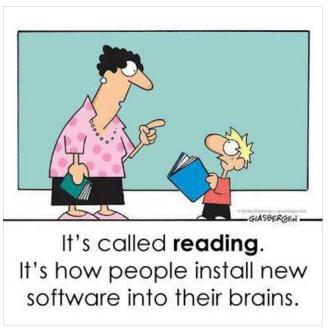
Programming Your Brain
How-To Adult Learning
This show was developed in 2010 for an NGO in South Africa has been used all over the place since then. It contains some Nuggets of Truthiness that most people developing learning programs for adults Anywhere and Everywhere would be well advised to learn. Amazing how we miss the basics in our quest for faster, cheaper, mobile … .
Why?

Dripping Wet
This story starts with me in the shower …
Dripping wet, drops of water on my relatively impervious skin, I grab a towel and begin to dry off. That’s when it happens.
“Why am I using a towel to dry off?” I wondered.
I looked at the towel. Little pieces of towel sticking up everywhere. “Little towelettes” I thought.
So why, I wondered does this work? Then I realized … transference. The little towelettes were grabbing the drops of water from my skin and moving them to the towel. Now I knew what the ratings for towels meant. The more little towelettes, the better the transfer. I had just learned the simple answer to why I was using a towel.
Real Learning Starts with “Why?”
In the second half of the 5th century BC, Socrates developed a new method of searching for answers. Sounds silly now but it was codified by Plato as The Socratic Method and involved one question – Why? At some point it developed into the “The 20 Why Questions” and is a very simple to game to play. If you dare to ask the first question, and continue with another “Why?” for every answer, you will find yourself going to Google and Beyond. By the way, the answer is never “Because I said so.” and playing dumb or lazy equals “I have no idea why.”
Simple knowledge goes to about Question Number Two on the Socratic – Plato Scale. If you get to Question Number Four you must be scientist. Einstein, who seemingly spoke to The Creator during what has become known as Einstein’s “Miracle Year”, asked “Why do things have mass?”
The answer was probably the most famous physics formula ever written in white chalk on a dusty blackboard.
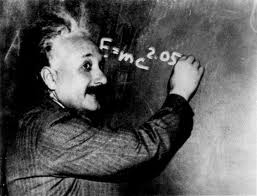
The answer to that why was probably somewhere up near Question Number 20 on the Socratic – Plato Scale. Yet if you study the origins of the theory you start to realize that there were many “Why?” questions and answers that led up to what is still an amazing leap of human imagination.
Learning is Not Educating
And that’s what this is all about – learning results from asking “Why?”. Learning is not education where the answers are already known and are graded as correct or incorrect. Learning is as simple as asking “Why?” every time you think you have the answer. It’s hard brain work.
And that’s why the question “Why?” is hardly ever heard in classrooms in schools, corporations, congress or almost anywhere else. Asking the “Why?” question is not displaying how smart you are with the correct answer; it makes most people feel stupid to ask “Why?”; In some situations it’s even consider impolite or impolitic. Yet that “Why?” is at the root of all critical thinking, and drives innovation, invention, scientific inquiry, and the answers we currently have today to everything we think we know today. It is the real meaning behind the often used quotation by William Butler Yeats “Education is not filling a bucket, but lighting a fire.”
If you think it’s a dumb game to play, try it once. Try the most basic “Why is the sky blue?” and see how high you can climb on the Socratic -Plato Scale. Just keep asking and answering “Why?”.
If you hit Question Number 20 with a good answer, please let me know since I’ve been wondering “Why are we here?” since I was old enough to formulate abstract questions. Maybe The Creator will whisper that secret to you the same way Einstein heard E=MC2.
Learning at the Water Cooler and Everyplace Else

I cannot believe how duped we’ve been to think of learning as an event. That idea is artifact of the Industrial Revolution and a terrible conceit on the part of the educational institutions we developed. Learning starts BEFORE we are born and (for all we actually know) continues AFTER we are dead. We are in a very real sense Continuous Learning Organisms.
Here’s a piece from Annie Murphy Paul’s The Brilliant Blog which is aptly named and , and if you’ve missed, it I recommend putting it on your weekly ‘must read’ list.
“Bersin by Deloitte, a human resources firm, has an interesting report out on the future of learning in organizations. The language in which it’s written is turgid, to put it kindly (“Our new High-Impact Learning Organization Framework® shows organizations have moved from ‘talent-driven learning’ to a focus on ‘continuous capability development’ . . . “), but there are some good insights to be had. Here, translated from corporate-speak, are its main findings and predictions:
“Continuous Learning” and “Capability Development” will likely replace the buzz around “Informal Learning.” Our new High-Impact Learning Organization Framework® shows organizations have moved from “talent-driven learning” to a focus on “continuous capability development.” Driven by these changes, the L&D market grew 12 percent last year, the highest growth rate in more than eight years. The buzzword of “informal learning” is giving way to a whole architecture of L&D programs that are social, mobile, continuous and highly integrated with talent management strategies.”
Cognitive scientist Allan Collins and his coauthors John Seely Brown and Susan Newman in Rethinking Education in the Age of Technology, notes that digital tools are creating a transformation as profound as the one that swept the apprenticeship model of learning into the Industrial Revolution. It is a transformation that is causing many people to rethink the idea of education. “In the apprenticeship era, most of what people learned occurred outside of school,” they note. “Universal schooling led people to identify learning with school, but now the identification of the two is unraveling.”
Finally we are starting to get to the bottom of learning things! I must admit, I’ve been as culpable as anyone feeding the maw of the formal vs. informal learning debate. My head was stuck in an academic box and stayed there even as I moved into a corporate environment. It was the same problem that corporate learners inherited. As we developed formal learning in our workplaces, we simply grabbed what we knew and were comfortable with from the schoolplace. Learning as an event. Formal, scheduled, instructed. We often went so far as to copy the old physical layout of the classroom – seats facing forward, instructor on the stage, quiet until called upon (yikes!) or recognized by a single hand held waving in the air .
What has been called ‘informal’ learning was really nothing more than a way of naming all the interstices, the spaces in between the formal learning events. Well, time to move on. There is no “formal” or “informal” learning. There is only, and always has been, continuous learning. And accepting that changes everything.
It means that the definition, design, development and delivery of learning changes. It alters the way learning is managed and measured. The endless conversation about formal versus informal stops. Naming conventions like “courses” and “programs” and “corporate universities” goes away. We start to see learners in a new way – as individuals moving through a world in which they – we – are always learning something new because there is always something new to learn.
We tried to formalize this natural process, and managed to do a really good job disabling it. We took learning out of any real context, gave the onus of the experience to the instructor who provided a predigested often canned helping of facts, heaped upon a PowerPoint slide, removed any chance for serendipity, social interaction or creativity. Rewarded remembering instead of discovering. Punished failure And we expected people to sit through these massive knowledge dumps and actually learn something.
In a funny way, I was correct years ago when I wrote “At the Water Cooler of Learning“. I think the definition of real learning – the ability to adopt and adapt what we’re taught – is still valid. And I still believe we really do learn most of what we need in between the events that we are told to attend. Yet I was guilty of the same bifurcation of learning into “formal” and “informal” as everyone else. There is no versus, just a flow through the day, learning as you go, remembering what you need to know and know how to do, and forgetting what you knew and knew how to do. It all adds up – from scheduled events to chance water cooler moments – to continuous learning.
So what will this mean to the way you approach learning? As a student? As an instructor or teacher? What will you do differently?
The Inconvenient Truth About Continuous Learning
“In a time of drastic change, it is the learners who inherit the future. The learned find themselves equipped to live in a world that no longer exists.”
Eric Hoffer

Here are the facts:
The vast majority of learning programs still rely on event-driven formal learning models. Formal and informal together are only a small part of the continuous learning experience. LMS and LCMS systems favor events which account for only a small amount of continuous learning.
The conclusion? Continuous Learning is the way we learn and grow, and because of the way we have learned to teach, it is still the least accepted and included way of learning in our schoolplace (primary and secondary) or workplace.
If it is truly the primary way we learn then it is incumbent upon us to begin to incorporate continuous learning into our programs starting in pre-school. How you ask? No longer difficult I answer. I recently wrote about Eddie Obeng who understands that all the rules have changed and that most of the world was “…asleep at midnight when all the rules changed.” We are still operating as if nothing has changed. So as to how we can easily create classrooms that have an online Community of Learners forum for sharing, exploring, discovering, asking and answering. Peer-to-peer and peer-to-mentor. as we move from one grade level to the next we can ‘graduate’ the Community of Learners to become a Community of Practice. Worldwide.
All schools worldwide have parallel ‘grades’ or ‘tranches’ for learning in the K-12 space. The fact is that we live in a digitally-connected global society. For starters there is no longer any reason to put learning into an small event-driven box (aka classroom). Students are already learning continuously and are also forming global Communities of Learners (CoL) and Communities of Practice (CoP). It’s time for the educational systems to get in sync with the students and support what they are doing.
Continuous Learning in the Corporation
The same is true for corporate learning only more so. Many of us have been talking about “informal Learning” for years (feels like forever actually). Well the continuous learner is all about informal learning. Perhaps if we shift the focus from the learning to the learner we can make some progress. Continuous learning in the corporate environment is critical to the increase of the Corporate IQ. And only the smartest companies will win in this new rapidly changing hypercompetitve flatworld. So companies MUST support continuous learning by creating the following:
Communities of Learners (CoL) that are networked together as they take a flipped course (assume companies and L&D organizations will be smart enough to learn that the flipped classroom enables learning far better than the disabling traditional classroom)
Communities of Practice (CoP) that the learners ‘graduate’ into to continue learning on a worldwide basis adding real world experiences into what they know and know how to do as a result of adopting and adapting the learning.
Rewards, certificates, some software that tracks the continuous learners – a Continuous Learning System (CLS)- so the company can see (custom or standard reports) how much learning is going on that today of which they are, for the most part, completely unaware.
What a waste of all that talent and learning! Here’s my experience. I once worked in a big blue-colored company and every year I was told what courses I needed to take. Well it depended on whether I had the time. If I was off being a good little billable employee, the course was a nice to take. Seems like I was always off being billable, and at the end of the year, the list of courses was replaced with another list that again went the way of “I’m too busy making money for the company”. In the meantime I managed to take a number of online seminars, webinars, courses and go to a few conferences where I grabbed a workshop or two. I learned enough to realize I wanted to work in another company with more cutting edge technology and left my former company feeling blue. The company not me since I was all happy. The moral of the story is that the motivated interested curious continuous learner in me trumped the too-busy-being-billable proscribed learner and moved on. And no one in the old company had a clue.
Now here’s another scenario. The old company tracked my continuous learning as much as what they were telling me to learn. And lo and behold they found a new position for me that fit with what I was interested in to take all the learning I had pursued on my own. They benefited and I helped them and me grow in a new area.
So let’s stop all the chatter about “informal learning” since it has no more meaning or relevance. We’ve talked about enough and nothing has happened. Let’s instead focus on the Continuous Learner as the Hero of the story and continuous learning as one of the the Great Differentiators between the individuals who are so motivated that they use their own time to learn and grow, and those that are just taking up office space. Between companies that have a lively and growing corporate brain and an increasing corporate IQ, and the ones that will soon be forgotten.
And you know who you are …
Flipping Corporate Learning
This one is from my friend Jay Cross @ Internet Time. It’s a take on flipping the corporate class that I totally agree with. Flipping the educational process has now been proven to work across the board especially among financially challenged schools. A combination of flipping and going back to the dream we all had with elearning when it was first introduced could ‘flip’ the equation and move the dial in corporate learning from disabling to enabling. Maybe this time I’ll use a more permanent glue to keep my fingers crossed.
Thanks to Jay for your insights as always!
Flipping learning is big in education. It will be big in corporate learning. Let’s not blow it.
How do you flip learning?

Khan Academy is the poster child for flipped learning. Sal Khan has produced more than 3,000 short videos on a variety of topics. Students watch the videos before coming to class. In the classroom, they sort out what they’ve learned and do what used to be called homework. Millions of students are learning this way. Recently, Stanford professors offered a couple of courses in this fashion and were surprised when a third of a million people enrolled.
Flipping makes a ton a sense. The learner can watch the mini-lectures when it’s convenient to do so. The learner controls the pace by pausing, replaying, or fast-forwarding. In all likelihood, the presentation by the enthusiastic Salmaan Khan or a popular Stanford prof is going to be more engaging than your local school teacher or grad student teaching assistant. The video can provide content in small, digestible pieces. Once it’s in the can, the video can be replayed again and again. And of course, video delivered online scales without an increase in cost.
More important for learning outcomes, the time spent in class can be put to more productive use. Learners convene to get answers to questions, discuss examples, put what they’ve learned in context, debate, explore, and extend their knowledge. Instead of passively listening to an instructor, they actively engage the material. Instructors, freed of the need to mouth the words of lessons, focus on helping learners understand things and coaching individuals. These activities can take place online, and people can learn from one another in virtual communities and support groups.
Flipping Stanford
In a Science Times essay, “Death Knell for the Lecture: Technology as a Passport to Personalized Education,” Daphne Koller described how Stanford University has flipped traditional courses:
At Stanford, we recently placed three computer science courses online, using a similar format. Remarkably, in the first four weeks, 300,000 students registered for these courses, with millions of video views and hundreds of thousands of submitted assignments.
What can we learn from these successes? First, we see that video content is engaging to students — many of whom grew up on YouTube — and easy for instructors to produce.
Second, presenting content in short, bite-size chunks, rather than monolithic hourlong lectures, is better suited to students’ attention spans, and provides the flexibility to tailor instruction to individual students. Those with less preparation can dwell longer on background material without feeling uncomfortable about how they might be perceived by classmates or the instructor.
Conversely, students with an aptitude for the topic can move ahead rapidly, avoiding boredom and disengagement. In short, everyone has access to a personalized experience that resembles individual tutoring.
Watching passively is not enough. Engagement through exercises and assessments is a critical component of learning. These exercises are designed not just to evaluate the student’s learning, but also, more important, to enhance understanding by prompting recall and placing ideas in context.
Moreover, testing allows students to move ahead when they master a concept, rather than when they have spent a stipulated amount of time staring at the teacher who is explaining it.
An article in Wired, The Stanford Educational Experiment Could Change Higher Learning Forever, describes the wildly popular course on artificial intelligence taught by Stanford professors Sebastian Thrun and Peter Norvig:
Does it make any sense that school is generally a place where people come together to sit and listen to the person at the front of the room? It generally doesn’t make the most sense to get a group of people together to sit and stare. What if instead, educators spent class time doing and homework time for the watching of lessons/lectures. The other benefit of this is that these can be viewed and reviewed anytime/anywhere. The result is a lively bustling classroom where students can spend their time learning, talking, doing.

I fear that flipping learning in corporations may meet the same nasty fate as eLearning.
In the early days, 1999-2000, many of us believed that eLearning was the forefront of a renaissance in learning. Not only could people learn at their own pace, whenever they wanted, they’d also be able to ask questions, learn with peers, join communities, access job aids, contact mentors, and create personal learning paths. Workers could attend virtual classes without leaving the workplace. Software would create personalized learning experiences by assembling custom configurations of learning objects.
The eLearning dream didn’t last long. Companies proved more interested in reducing instructor head-count and facilities costs than in improving learning outcomes. Training departments put PowerPoint presentations on their intranets and acted as if people could learn from them. Vendors put deadly-dull page-turner courses online and called it eLearning.
When times were tough, training departments slashed budgets by replacing face-to-face instruction with online reading. They failed to follow through with the discussions, practice, social processing, and reinforcement that makes lessons stick. It didn’t work. Most eLearning is ineffective drudgery.
That’s my nightmare about flipping learning in the corporation, that organizations will once again confuse exposure to content with learning. It’s great to replace lectures with video clips — IF you retain the opportunity for people to ask questions, interact with the material, practice what they’ve learned, collaborate with others, and periodically refresh their memories. This takes a sound learning ecosystem, a workscape.
Dan Pink thinks we should flip not only schooling but also publishing, the movie business, human resources, and office space. I agree. Business has changed. There’s hardly any business model left that couldn’t benefit from a flip. Break the processes into pieces and see if there’s not a better way to put them back together.
 David Grebow KnowledgeStar