Are You Analog or Digital?

Faster than a speeding blog post.
More powerful than a retweeted tweet
Able to leap small Internet Service Providers in a single bound.

Look! Anywhere in Cyberspace!
It’s a message. It’s a meeting. It’s VMman!

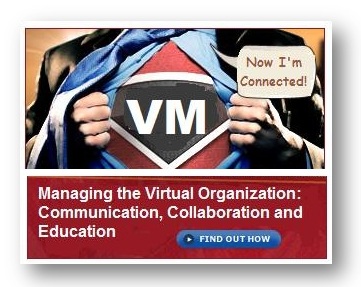
Yes, it’s VMman – Virtual Manager – strange visitor from another generation who came to Earth with powers and abilities far beyond those of mortal f2f managers. VMman – who can change the course of mighty projects, bend program budgets with his virtual hands, and who, disguised as a mild mannered manager for a great multinational corporation, fights the never ending battle for better collaboration, communication and education to enable the American Way.

I recently finished a project that the client called “Mission Critical”. The program taught ‘analog’ managers how to be great virtual managers.

It was important because today all managers are managing virtual teams regardless of the location of the chair upon which they sit. Some do it far more effectively than others.

The older ‘analog’ managers were unwillingly thrust into the role of virtual manager. They were definitely virtual immigrants when it came to using the virtual tools at hand. For example, I heard things like “Hi! I’m calling to make sure you received my email message”.

And if you think there’s nothing wrong with that then you are an analog manager.

The ones known as the Digital Natives, the Gen X, Y and Z folks,  took to being Virtual Managers like ducks to digital water. They were the ones knew their message got to you. Since many of the Senior Managers are analog, it was incumbent upon them to learn how to be all digital all the time. That was the program we created.

I think we got closer than anyone else. I heard of one analog manager who got it and was sending pictures and emails of her trip to a factory that was being built in another country. One analog manager started a Project Blog. I even received a txt from a very senior manager that was all upper case since he was “…HAVING TOO HARD A TIME READING THE SMALL PRINT.”

I guess even in cyberspace size matters.

Learning About learning


I found this surfing through cyberspace when I was looking for information on current learning research. I liked it because it distilled a lot of information into a neat 10-minute video. It also introduced me to a great new blog –aconventional – which I can add to my RSS and get my weekly personal digest.

So here’s the video and check out the blog posts. Smart, funny and spot-on.

Learning Defined?


Here’s two from me now it’s your turn …

The Oxford English Dictionary defines knowledge as (i) expertise and skills acquired by a person through experience or education or (ii) the awareness or familiarity gained by experience of a fact or situation.

Another definition is “learning is the ability to adopt and adapt what you know and can do in an ever-changing set of circumstances.”

If You Teach Adults …


… then you need to watch this every day until you have memorized the content. Forget Learning 3.0, I am always amazed at how many people are in the business of transferring knowledge to adults who do not even know the basics, the very foundation, upon which they should be standing.

Let alone being able to spell Andragogy … So please watch and learn. Maybe then you’ll be better able to help other adults learn …

Twilight Zone Music Please


You’re in a conference room filled with your team…

Suddenly they start to disappear, one by one until they are all gone … gone to the four corners of the world … in different places and time zones … they’ve been zapped by the Virtual Vortex and it’s now you’re job to manage them …

Where do you begin? … How do you communicate and keep in touch, educate and collaborate when there’s no one there?  … how can you make a team out of people who are spread out all over the place? …

You need to learn to use the Power of the Virtual Management …it’s far greater than you ever imagined, and perhaps even better than being there, like the good old days when everyone on your team was there … only there’s no ‘there’ anymore … it’s now everywhere.

Old Days of Being There New Ways of Being Everywhere
Choose people because they are there Choose the best team in the world – literally
Spend time setting up face-to-face meetings Save time meeting virtually
Finding a conference room and scheduling one Conference rooms in virtual space are always open
Communicating whenever you can meet Meeting whenever you need to communicate
Slowly gathering the troops to get their schedules so you can set-up a team meeting in that conference room Quickly finding openings in everyone’s schedule and setting up a virtual meeting across space and time
Setting up a classroom with all the parts and pieces and scheduling and wait listing involved Putting the learning online and letting people access it anytime and anywhere
… And don’t forget the lab for that course … labs need to be set-up every time there’s a course to teach A virtual lab has been found to be more effective and easier to use … create it once, use many times

Total Recall


I have given up just about anything related to play for a most enjoyable pursuit. I voraciously read, annotate, try to apply and often day and night dream about how the brain works and learns.

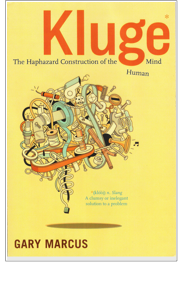
One of the better books – defined by the level of science and research as well as it’s readability-  is a book by Gary Marcus, Kluge ..


Dr Marcus is the Director of the NYU Center for Child Language. His research, published in leading journals such as Science, Nature, Cognition, and Psychological Science, focuses on the evolution and development of the human mind. This is one of his best books to date.

If you ever wanted to find out more about why the brain works in a certain way  and how it evolved and was hardwired, Kluge is a great starting point.

Here’s a piece Gary wrote for the New York Times about forgetting and remembering. Enjoy!

Read More

Welcome to Learning 3.0


(Please HELP! I’ve been looking for a GREAT representative image that captures Learning 3.0 and becomes iconic for the next wave of learning experiences … I’m hoping that you can help me find one. Thanks)

I usually ignore the labels…

Lately I’m beginning to see that they serve  a purpose. They delineate the evolutionary stages of our profession. They also coincide with the evolution of technology that to date has brought us to Social Media and Social Networking.

Let me take a crack at defining the ones I’ve heard so far.

Learning 1.0: The emphasis was on the blending of the Industrial Economy learning methods (Kirkpatrick, Gagne et al.) that were essentially non-scientific observations with  the newly emerging computer tools such as elearning on disc. We were still the Gatekeepers of Knowledge (or at least we thought we were). Programs were developed from theories and intuition and “training” was basically a craft. Students were students, the classroom was the default environment, and you were a meaning taker (sponge) as Ruth Clark so aptly called it.

We were beginning to be enamored with technology for learning and attended conference called “TechLearn”. We could finally put the teacher in the box.

Learning 2.0: The emphasis was on the tools and technology that had rapidly evolved and could now deliver learning programs to more people anytime and anywhere. We still acted like the Gatekeepers, and we learned a lot about the new (and newer) technology and tools (Authorware software programs, LMS, Virtual Instruction, et al.) to put the teacher (us) in the box. We delivered training on CD’s, over slow computers, creatively and artfully blended technology and people.  We were still in the bookish mindset, creating what were referred to as “page turners” on screen.

Programs were still based on a best guess, supported by assessments, pre-existing theories and/or committee agreements about what the people needed to learn. Period.

Learning 3.0: The latest evolution that places the emphasis back on people and takes us out of the role of Gatekeeper. Blame it on the newest technology that puts the learner in the driver’s seat. Now ‘the people’ decided what they need to learn and, guess what, if we cannot come up with it then they will go wherever they need to learn what they want to know and know how to do. If we stay in the Learning 1.0 or 2.0 mode we’re toast, we have become irrelevant.

Our job is to take the role of Enabler, Mentor, Tutor etc. We can no longer manage knowledge. All we can hope to do is manage the environment in which knowledge can be “…created, discovered, captured, shared, distilled, validated, transferred, adopted, adapted and applied.” [Chris Collison and Geoff Parcell, “Learning to Fly” January 2005, Capstone]. Scientific research into how the brain works and how we really learn, has replaced sociological and psychological observation that generated the theories about learning.

Learning 3.0 is another BIG change. And it comes too soon, way too soon for many in our industry. They have made a name for themselves during the previous phases. Can they change and evolve?

Meaning takers now become meaning makers. Collaboration is the essential key to learning. Learning and Social Media and Social Networking are all mashing up. Having a group working together to learn with and from one another is the quest. And it is a quest.

We need to drop all the stuff we learned during the previous phases. We need to adopt new roles as Mentors and Guide and even Entertainers and Storytellers.

All the stuff about informal and blended and everything else that’s “teacher-centric” or “content-centric” needs to be abandoned. It all needs to be focused as “Learner-centric”. And that means Wiki, Web Portals, Connecting people in the class … and anything else that does the following:

  • Builds that learning experience upon the solid foundation of science and the most current scientific research about the ways the brain learns, remembers, forgets, adopts and adapts. We need to learn to enable rather than disable the learning process with which we are all endowed from birth
  • Creates and delivers a compelling way of transferring the knowledge, transforming it into a learning experience
  • Be emotional, entertaining, full of stories, anecdotes, and anything else that touches the hearts and minds of the people experiencing the program. Put an end to death by PowerPoint
  • Takes full advantage of all the technology tools&toys we have now and will have in the future and uses them really well. This means well trained Virtual Instructors / Mentors / Guides who really know what their about.
  • Connects the people before, during and after that learning experience so they can learn from one another and continue to learn from one another

Okay, so you heard it here first. What do you think about Learning 3.0?

A Tool for Learning 3.0


How many times when you’ve been watching a movie have you just wanted to reach out and poke an annoying character? Maybe help a fleeing victim by making them run just a little bit faster? A new interactive experience by production company Tool of North America uses the capabilities of the iPad to allow viewers to do just that as they interact with–and seemingly change the outcome of–live-action video. Part video game, part immersive entertainment, Touching Stories is available today as a free, downloadable app, and we’ve got an exclusive behind-the-scenes video that gives a peek into the process of making it.

Tool, who create ads and interactive work for brands like MTV and Bud Light, had been tossing around ideas for creating such an experience for the iPhone, but as soon as the iPad was announced they realized the device was made for their concept, says Tool’s digital executive producer Dustin Callif. “Immediately as visual storytellers we got excited because the iPad is such a better device for consuming media than the iPhone–I mean just look at the difference in size with the screen,” he says. “We’ve been looking for the right opportunity to really create customized stories.”

Five of Tool’s directors–Geordie Stephens, Jason Zada and Erich Joiner, Sean Ehringer and Tom Routson–shot four films with interactive points that call for touching, shaking or turning the iPad built into the plots. A partnership with Domani Studios provided the technology to connect the film process with the iPad’s multi-touch and accelerometer features, as well as the ability to load videos or visit Web pages. The result goes far beyond special effects–the team rebuilt each film’s story within the context of the iPad experience.

Last week, Tool used the convergence of advertising’s top players at the Cannes Lions festival to create major buzz around Touching Stories: They delivered iPads pre-loaded with the apps to at least 10 chief creative officers at blue-chip agencies. A smart move, since the experience feels like it’s made for delivering a brand’s hands-on experience to consumers. But the implications for more narrative filmmaking are also important–how will this technology change the face of storytelling?

This week, we’ll have an in-depth look at each film and see how Tool worked closely with Domani Studios to collaborate on this new experience. If you want to try it for yourself, Touching Stories is available in the App Store today. Be careful, though, if you mess with the fate of those characters: Sometimes they strike back.

From Fast Company

How to Make Corporate Training Rock


By: Dan Heath & Chip Heath

How one team transformed a training binder into must-see TV.

WORLD’S SLEAZIEST BOSS BearingPoint’s ethics videos deftly mimic The Office’s mockumentary style, even starring a Michael Scott-esque leader.


Russ Berland’s first assignment at BearingPoint was a doozy. He was asked to redesign the company’s ethics-and-compliance training program. If simply reading the phrase “compliance training” sapped a little of your will to live, perhaps you can empathize with Berland.

Most companies — including yours, probably — have an ethics program, and often the “program” looks uncannily like a three-ring binder. It may be sitting on your bookshelf right now, between What Color Is Your Parachute? and the 2003 Metro Area phone book. It’s filled with mimeographed, knuckle-rapping prose, just like the code of conduct Berland inherited, which, he said, appeared to have been repurposed from a law firm.

Yet compliance training was critical at BearingPoint, a management and technology consulting firm, because the company’s employees often spent more time on client sites than at home. So Berland, the chief compliance officer, had to influence the behavior of employees who were scattered across the country, operating in organizational cultures very different from BearingPoint’s. (BearingPoint filed for bankruptcy earlier this year, due to an excessive debt burden unrelated to an ethics issue.)

Berland and his colleagues began to interview some of the company’s associates, asking them about real-world “gray areas”: What situations make you feel squishy? What have you seen happen in the field that gave you pause? Soon, they’d uncovered stories of ethical quandaries and anxious situations and strained relationships. It was exactly the sort of drama that was absent from the three-ring binder.

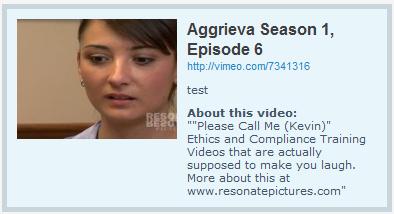
Then came their epiphany: Let’s bring this drama to life. They hatched the idea to film a fictional series, modeled on The Office, that would highlight the activities of a single IT consulting engagement team. The team would work for a fictional company called Aggrieva, which was designed to be the evil doppelgänger of BearingPoint. (Motto: “Aggrieva says yes when everyone else says no.”)

Berland hired filmmaker Marc Havener to direct the series, and they shot an entire season of 10 short episodes in a weekend. The episodes deal with touchy areas such as bosses hitting on subordinates, teams misrepresenting their expertise, and managers trying to pass along inappropriate expenses to the client. In other words, comedy gold.

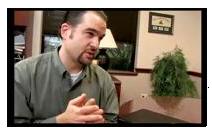
Here’s a scene where Kevin, the lovably oily boss, has proposed throwing a grandiose surprise party for Ricardo, a client, as a way to curry favor. Vanessa, a levelheaded analyst on Kevin’s team, objects:

VANESSA: Sir, how are we going to pay for this?

KEVIN: We’ll just work it into the bill somewhere.

VANESSA: We can’t bill a client for a birthday party.

KEVIN: [Exasperated] Okay, you know what? Fine. I tried. You know what, Vanessa? I want you to look Ricardo in the face and tell him that we don’t care enough to throw a party for him.

VANESSA: Wasn’t this party supposed to be a surprise? Why do I have to tell Ricardo that the party is off if he never even knew about it in the first place?

KEVIN: Well, now it’s “Surprise! There’s no party!” Tell him that.

The episodes were an immediate sensation. The emails poured in: “This is the best training I’ve ever had.” “I think that episode was based on my team.” “I’m cackling like a madman,” and so forth. Soon, the characters and situations became part of the company’s vocabulary. Many employees admitted to Berland that they had “worked for a Kevin.”

New episodes debuted each Monday, but employees were so ravenous for the next episode that they started tracking them down on the company’s staging server where the videos were posted on the preceding Friday. Thousands of employees watched the videos before they were released.

Note: When your company’s employees are madly searching for your compliance videos, you’ve done something right.

Great Way to Learn


It may seem like I’m sidestepping the issue of learning, but I learned SO much from the way this was done that I had to include it as an example of “way to go”.