There is a lot of advice, information and great books (I personally have always referred to my old marked-up copy of Roger Schank’s Tell Me a Story) about the art of storytelling. We always find a way to use them in our programs, since I think they are among the most powerful and hardwired ways to teach. Stories are important tools for learning for a lot of reasons, this one from Roger Schank’s book in particular:
“We would like to imagine that we learn from the stories of others, but we really only do so when the stories we hear relate to beliefs that we feel rather unsure of, ones that we are flirting with at the moment, so to speak. When we are wondering, consciously or unconsciously, about the truth, about how to act or understand some aspect of the world, then the evidence provided by others can be of some use.” (P.78)
The NPR short video is all about how to capture and keep the learner’s – or listener’s – attention. The focus is on rhythm and how to ‘breath’ your story.
If you use stories in your learning experiences, it’s worth your time.
These are the 10 most important lessons I learned in 2010.
What’s on your list?
1.The brain is hardwired by evolution for learning.
2. We spend a lot of time and money disabling the hardwired learning process.
3. Learning is a social experience – We learn the best when we learn with a group of people who also need to learn what we need to learn.
4. Online learning is inherently an anti-social experience.
5. Social Media (SoMe) and Social Networking (SoNe) can help enrich and enable the online learning experience .
6. Learning in a business environment in the 21st Century needs to focus on know-how more than knowledge.
7. We need to flip online learning – especially virtual classes – upside down so they focus on performance, instead of a passing score.
8. Need to know (cognitive information) is best transferred using asynchronous learning technology.
9. Need to know-how (behavioral information) is best transferred using synchronous and social learning technology.
10. We ignore most of what we have learned about how we learn. We let habit rule, instead of adopting and adapting what we now know about enabling the learning process.
I’ve had these words to the wise pinned above my desk for awhile. I can’t remember where they were discovered. I’m not even sure who “Schuster” is. I just know he is a very wise human being.
I wanted to share them since I think they have a lot to do with learning. And time. That seems to be my definition of wisdom. Learning about life that lasts more than one lifetime for more than one person. Perhaps that’s why I like cliches so much. They capture wisdom in a few easy-to-remember words. Apple juice made from the Tree of Knowledge.
Hopefully there’s a space above your desk for these words.
May 2011 be an AMAZING year for you, filled with laughter, learning and love.
Become the world’s supreme expert in something – Schuster advises to “begin at once, at this precise moment to choose some subject, some concept, some great name or idea or event in history on which you can eventually make yourself the world’s supreme expert.”
He urges us to start a crash program immediately using the three R’s of modern education, reading, research and reflection – with the goal of establishing yourself as “one who has the most knowledge, the deepest insight and the most audacious willingness to break new ground by defining your terms and actually examining all the alternatives and consequences.”
Master the art and technique not merely of rapid reading, but creative reading and creative research – Schuster says it’s important to “learn how to use a library and how to build a home library of your own.”
He reflects how “back in 1913, high school graduates were singing the old refrain: “No more pencils, no more books, no more teacher’s saucy looks.” He points out that they were throwing away their books and saving their diplomas. He urges us to do the opposite, “Forget your diploma, or throw it away, but save your books and use them day and night.”
Learn the supreme art of getting sixty seconds out of a minute, sixty minutes out of an hour, twenty four out of a day – He reminds us that we have as much time as everyone else our age. He says to “Save it, hoard it, plug up all the leaks. If necessary, stand on the street corner, cap in hand like a mendicant, and beg all the passers-by for the seconds and minutes and hours and days they waste.”
Master the art of preparation – Do your homework (especially after your formal education). Remember the words of French chemist Louis Pasteur (1822 – 1895) who said “Chance favors the prepared mind.”
Begin now to learn the art and science of preventative medicine – In other words, take care of yourself. Exercise and eat healthy. He says we should prepare now to out-perform and outlive our doctors. He says Ralph Waldo Emerson said it best: “Give me health and a day, and I will make the pomp of emperors ridiculous.”
Work hard, think big, and always have a dream beginning with a detailed blueprint and plan for your agenda, your priorities, your first things first – Schuster encourages us to put a firm foundation under our “castles in Spain, in the form of these step-by-step, play-by-play specifics and make your dream come true.”
Remember the following three questions: “If I am not for myself, who will be? If I am not for others, what am ‘I’? And if not now, when?” These three questions were first asked by renowned Jewish religious leader Hillel the Elder.
Work hard and opportunities will come – Schuster advises us to remember the words of noted American journalist H.L. Mencken (1880 – 1956) who said, “Most people don’t recognize opportunity when it comes along, because usually it is disguised as hard work.”
Don’t try to please everyone – Schuster counsels us to always keep in mind the maxim of U.S. editor and journalist (and the first recipient of the Pulitzer Prize for reporting), Herbert Bayard Swope (1882-1958) who said, “I can’t give you any formula for success, but I can give you a sure formula for failure – try to please everybody.”
Always remember, the time to be happy is now – The place to be happy is here. The way to be happy is to make others so.
Remember what people really want – Schuster’s last point is extremely applicable to writers who promote products and services. He says to “never forget that people never buy things or services … they buy solutions, for their problems. Your job is to help them find solutions.”
According to a recent statement by Bing, Microsoft’s search engine answer to Google, search is no longer about looking for knowledge about something. It’s about getting something done. It’s all about know-how.
According to a recent Fast Company article, “The idea behind features like this, say Bing executives, is that search is no longer simply about looking for information. It’s about getting things done: Booking reservations, buying plane tickets, researching consumer products. And Microsoft is trying to help its users get those things done as quickly as possible. It’s trying, simply put, to make search results less like a list of links and more like an app.”
So before we say goodbye to 2010, let’s say “Adieu” to The Knowledge Age and shake hands with The Know-How Era!
So what’s the problem? Well it’s kind of simple. All the tools and technology we have for learning is all still focused on knowledge, learning about something NOT learning how to do something. There’s very little built into these learning tools – from LMS to Virtual Live Classrooms – that enable practice, practice and more practice.
Everything that neuroscience and psychology, and any of the fields related to learning how we learn, all understand that to learn how to do something involves the following key elements;
Time
Practice
Failure (In a safe environment)
More Practice
And More Practice.
Learning how to actually do something means that we have adopted what we know and can do and learned enough to adapt it in a variety of real world situations. That’s what being an Expert instead of a Beginner really means.
Here’s a great and recent example: When Captain Chesley Sullenberger – called just “Sully” – rescued those 155 people on board his plane, landing it safely and improbably in the Hudson River, everyone agreed Sully was a hero. Everyone that is except Captain Sully. In his mind, he was just doing what he spent 30 years training how to do. On his own, he would often take simulator training that focused on emergencies, water landing among them.
So he was all about learning how to do something.
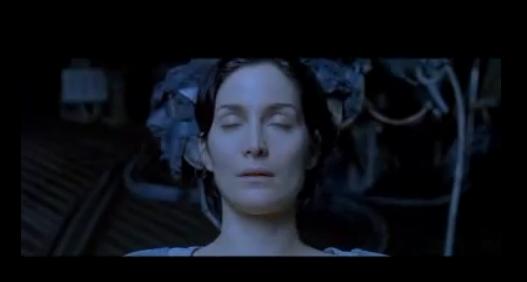
It calls to my mind that scene from The Matrix in which Trinity is on the roof with Morpheus and Neo. She gets programmed to expertly fly a helicopter in a matter of seconds by “jacking-in” to the database of know-how. These days acquiring that level of know-how would take years.
You can watch that scene here if you need to recall the technology. It’s very cool and I look forward to the day …
The question is how to shorten the time on that continuum between jacking-in seconds and the years of actual simulated and actual flying. And that gets us back to the initial question. If the current learning tools and technology are ‘artifacts’ from the Knowledge Age when we were all learning about something, what tools and technology can we adapt or create to really enable learning how-to do something? How do we truncate the time-to-performance between the Beginner and the Expert?
I have some ideas but I’d really like to hear yours first.
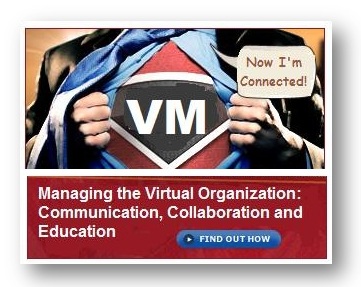
Faster than a speeding blog post. More powerful than a retweeted tweet Able to leap small Internet Service Providers in a single bound.
Look! Anywhere in Cyberspace! It’s a message. It’s a meeting. It’s VMman!
Yes, it’s VMman – Virtual Manager – strange visitor from another generation who came to Earth with powers and abilities far beyond those of mortal f2f managers. VMman – who can change the course of mighty projects, bend program budgets with his virtual hands, and who, disguised as a mild mannered manager for a great multinational corporation, fights the never ending battle for better collaboration, communication and education to enable the American Way.
I recently finished a project that the client called “Mission Critical”. The program taught ‘analog’ managers how to be great virtual managers.
It was important because today all managers are managing virtual teams regardless of the location of the chair upon which they sit. Some do it far more effectively than others.
The older ‘analog’ managers were unwillingly thrust into the role of virtual manager. They were definitely virtual immigrants when it came to using the virtual tools at hand. For example, I heard things like “Hi! I’m calling to make sure you received my email message”.
And if you think there’s nothing wrong with that then you are an analog manager.
The ones known as the Digital Natives, the Gen X, Y and Z folks, took to being Virtual Managers like ducks to digital water. They were the ones knew their message got to you. Since many of the Senior Managers are analog, it was incumbent upon them to learn how to be all digital all the time. That was the program we created.
I think we got closer than anyone else. I heard of one analog manager who got it and was sending pictures and emails of her trip to a factory that was being built in another country. One analog manager started a Project Blog. I even received a txt from a very senior manager that was all upper case since he was “…HAVING TOO HARD A TIME READING THE SMALL PRINT.”
I found this surfing through cyberspace when I was looking for information on current learning research. I liked it because it distilled a lot of information into a neat 10-minute video. It also introduced me to a great new blog –aconventional – which I can add to my RSS and get my weekly personal digest.
So here’s the video and check out the blog posts. Smart, funny and spot-on.
… then you need to watch this every day until you have memorized the content. Forget Learning 3.0, I am always amazed at how many people are in the business of transferring knowledge to adults who do not even know the basics, the very foundation, upon which they should be standing.
Let alone being able to spell Andragogy … So please watch and learn. Maybe then you’ll be better able to help other adults learn …
You’re in a conference room filled with your team…
Suddenly they start to disappear, one by one until they are all gone … gone to the four corners of the world … in different places and time zones … they’ve been zapped by the Virtual Vortex and it’s now you’re job to manage them …
Where do you begin? … How do you communicate and keep in touch, educate and collaborate when there’s no one there? … how can you make a team out of people who are spread out all over the place? …
You need to learn to use the Power of the Virtual Management …it’s far greater than you ever imagined, and perhaps even better than being there, like the good old days when everyone on your team was there … only there’s no ‘there’ anymore … it’s now everywhere.
Old Days of Being There
New Ways of Being Everywhere
Choose people because they are there
Choose the best team in the world – literally
Spend time setting up face-to-face meetings
Save time meeting virtually
Finding a conference room and scheduling one
Conference rooms in virtual space are always open
Communicating whenever you can meet
Meeting whenever you need to communicate
Slowly gathering the troops to get their schedules so you can set-up a team meeting in that conference room
Quickly finding openings in everyone’s schedule and setting up a virtual meeting across space and time
Setting up a classroom with all the parts and pieces and scheduling and wait listing involved
Putting the learning online and letting people access it anytime and anywhere
… And don’t forget the lab for that course … labs need to be set-up every time there’s a course to teach
A virtual lab has been found to be more effective and easier to use … create it once, use many times
I have given up just about anything related to play for a most enjoyable pursuit. I voraciously read, annotate, try to apply and often day and night dream about how the brain works and learns.
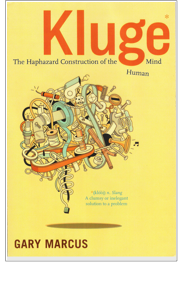
One of the better books – defined by the level of science and research as well as it’s readability- is a book by Gary Marcus, Kluge ..
Dr Marcus is the Director of the NYU Center for Child Language. His research, published in leading journals such as Science, Nature, Cognition, and Psychological Science, focuses on the evolution and development of the human mind. This is one of his best books to date.
If you ever wanted to find out more about why the brain works in a certain way and how it evolved and was hardwired, Kluge is a great starting point.
Here’s a piece Gary wrote for the New York Times about forgetting and remembering. Enjoy!



 David Grebow KnowledgeStar