Case Study: Flipped Classrooms Work for Financially Challenged Students

flipp

I’ve been advocating for the flipped classroom since I first read Daniel Pink’s article in the UK Telegraph 3 plus years ago. Since then some amazing changes have been happening (see previous post). This case study grabbed my attention for several reasons. It is written by the Greg Green, the Principal at Clintondale High School in Clinton Township, Michigan. It talks about how he flipped what he terms “… a financially challenged school near Detroit”. The flipped version of the school way out-performed the standard model that was failing in almost every respect. And he wraps it up with the following statement:”Instead of placing blame on each other, we need to recognize the solution, which has been right in front of us the whole time. It’s time to change education forever.”
Thank you Greg Green, my new Education Hero of the Week! You showed us that money is not the problem, teachers are not the problem, unions are not the problem, and the kids are certainly not the problem.
The problem is the lack of vision and ability of people running the schools to change the educational model from the traditional disabling approach to one that is truly enabling for all. The answer really has been in front of us for several years now. Time for the people who control the schools and administer the districts to learn the lesson.

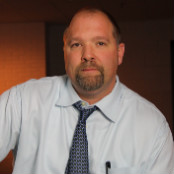
Courtesy Troy Steinby Greg Green,

Greg Green is the principal at Clintondale High School in Clinton Township, Michigan.

I’m a principal at Clintondale High, a financially challenged school near Detroit. I’m in charge of doing my best to make sure that Clintondale students get the best education possible when they walk through our doors.

There are constant hurdles to making this happen. We are a school of choice, so not all students come in with the same skill levels in reading, math, science or other subjects. Almost 75% of our students receive free or reduced-price lunch because of today’s economic climate, and a large part of our student population commutes from Detroit, which often times takes an hour or longer, especially if the bus is late.

Every year, our failure rates have been through the roof.  The students weren’t paying attention, they weren’t doing their homework, they were being disruptive, or they weren’t coming to school at all. Sadly, these issues are not that uncommon, particularly in this economic climate, where the percentage of students who fall into the poverty category is increasing by the day.

It’s no surprise that these issues are happening in our schools. Everyone from politicians to parents admit that our educational system isn’t working, and we’re all screaming for change.  But no one gives advice on what changes are needed to improve education. The time has come to realize that the problem isn’t simply lack of effort or money, but the misalignment of our school structure.

To watch this happen every day, where it is your responsibility to try to provide the very best you can for the students, is beyond frustrating. It’s heartbreaking.

Our staff agreed that our failure rates were not good. But how do you go about addressing these issues with no money, no additional resources and no clear solution from the experts who already know the system is broken?

How do you get your staff on board with change you want to implement, but no one else has ever tried it on a mass scale? How do you get your students excited about learning when they’ve never shown much interest before?

You flip it. Here’s how it works:

At Clintondale High School, our education model wasn’t working, and the people suffering most were students. We recognized that a change was needed and applied for a grant from TechSmith, a local company that makes screen and lecture recording software. They provided us with some technology licenses and helped us create a flipped class structure, which we first implemented in the ninth grade and eventually put into action for the entire school.

Our flipped school model is quite simple. Teachers record their lectures using screen-capture software (we use Camtasia) and post these lecture videos to a variety of outlets, including our school website, and YouTube. Students watch these videos outside of class on their smartphone, in the school computer lab (which now has extended hours), at home or even in my office if they need to. Now, when students come to class, they’ve already learned about the material and can spend class time working on math problems, writing about the Civil War or working on a science project, with the help of their teacher whenever they need it. This model allows students to seek one-on-one help from their teacher when they have a question, and learn material in an environment that is conducive to their education. To change the learning environment even further, we’ve used Google Groups to enable students to easily communicate outside of class, participate in large discussions related to their schoolwork and learn from each other.

In addition to flipping the classroom, we wanted to give our students the opportunity to learn about each subject or topic from someone who is a recognized expert in each area. So we decided to team with other schools across the country and world. Now, some of our calculus students are able to watch video lectures from a math teacher in a private school in Virginia, and our students learning about the Holocaust can watch videos made by a teacher in Israel who just brought her class to Auschwitz. This type of learning network will enable us to close the gap of inequality that schools are subjected to because of their financial standing, and provide all students, no matter what district they’re from, with information from the best teacher or expert in any field.

At Clintondale High School, we have been using this education model for the past 18 months. During this time, our attendance rate has increased, our discipline rate decreased, and, most importantly, our failure rate – the number of students failing each class – has gone down significantly.  When we first implemented this model in the ninth grade, our student failure rate dropped by 33% in one year.

In English, the failure rate went from 52% to 19%; in math, 44% to 13%; in science, 41% to 19%; and in social studies, 28% to 9%. In September of 2011, the entire school began using the flipped instruction model, and already the impact is significant. During the first semester of the year, the overall failure rate at the school dropped to 10%. We’ve also seen notable improvement on statewide test scores, proving that students’ understanding of the material is better under this model.

Our schools have long been structured so that students attend class to receive information, and then go home to practice and process this information. When many students go home after school, they don’t have the resources necessary to understand, and sometimes don’t complete their homework. Many families are not able to provide the expertise and technology needed to help with their children’s homework, so when we send kids home at the end of each day, we’re putting them into environments that are not capable of supporting their learning needs.

By reversing our instructional procedures so that students do their homework at school, we can appropriately align our learning support and resources for all of our students, and eliminate the inequality that currently plagues our schools. When students do homework at school, they can receive a meal and access to technology (during a declining economy), and an overwhelming amount of support and expertise. When students do their homework at school, we can ensure that they will be able to learn in a supportive environment that’s conducive to their education and well-being.  For the first time in history, we can provide a level playing field for students in all neighborhoods, no matter what their financial situation is.

As we continue to expand and improve the flipped school model, it’s important for educators to come together and work with each other toward a common goal of fixing our education system through teamwork and collaboration, so all students can have access to the best information and materials. Instead of placing blame on each other, we need to recognize the solution, which has been right in front of us the whole time.

It’s time to change education forever.

[NOTE: Part of an online article first printed January 18, 2012 –  http://schoolsofthought.blogs.cnn.com/2012/01/18/my-view-flipped-classrooms-give-every-student-a-chance-to-succeed/]


Brain Dead Spaces


Copy of JohnMedina_Portrait_WebVersion

“There is no greater anti-brain environment than the

classroom and cubicle.” 

Since most of us spend most of our time in them, it’s amazing we learn anything or get anything done,

Check out John Medina’s new multimedia interactive website on brain and learning here.

Read Across America Day Today


I spent more happy hours here than I can recall …

Image

It’s the reading room of the New York Public Library with Leo and Leona (the great gatekeeper lions) at the entrance.I just wanted to remind you that today, March 1st, is Read Across America Day. 

Here are the details: http://www.huffingtonpost.com/2013/03/01/table-talk-read-across-america-day_n_2792313.html.

It makes a huge difference in a child’s when you read to them. They learn to enjoy books and love learning for the rest of their lives. 


Really Learning To Do Something New


I was recently challenged by a reader to define what I mean when I use the words “learn” or “learning”.

Here it is:

 I’ll use the game of golf.

If you want to learn to play golf, you can go to a seminar, read a book about the history and etiquette of golf, watch a videotape of great golfing moments, and then you can say you know something about golf.

But have you really learned to play golf?

You can then buy and enjoy a great e-golf game, find a golf pro, take lessons, take a simulated swing on a simulated golf course, practice putting, slice and dice balls at the driving range all weekend.

After all this, you think you can do it, but have you really learned to play golf?

From your first tee shot on your first hole, it takes hours of adopting and adapting, alone and in a foursome, in all sorts of weather and conditions. You discover what you know and can do, swing all the clubs, ask all sorts of questions, fail and succeed, practice and practice some more, before you have really learned to play golf. Latest estimate I read for becoming really good at the game is 10,000 hours of practice, practice and more practice.

Real learning, then, is the state of being able to adopt and adapt what you learned, what you know and what you can do under a constantly varying set of new and different circumstances.

Just for the sake of learning, who knows what the word “GOLF” stands for?

Image

Programming Your Brain


Programming Your Brain

How-To Adult Learning


This show was developed in 2010 for an NGO in South Africa has been used all over the place since then. It contains some Nuggets of Truthiness that most people developing learning programs for adults Anywhere and Everywhere would be well advised to learn. Amazing how we miss the basics in our quest for faster, cheaper, mobile … .

Why?


images (2)

Dripping Wet

This story starts with me in the shower …

Dripping wet, drops of water on my relatively impervious skin, I grab a towel and begin to dry off. That’s when it happens.

“Why am I using a towel to dry off?” I wondered.

I looked at the towel. Little pieces of towel sticking up everywhere. “Little towelettes” I thought.

So why, I wondered does this work? Then I realized … transference. The little towelettes were grabbing the drops of water from my skin and moving them to the towel. Now I knew what the ratings for towels meant. The more little towelettes, the better the transfer. I had just learned the simple answer to why I was using a towel.

Real Learning Starts with “Why?”

In the second half of the 5th century BC, Socrates developed a new method of searching for answers. Sounds silly now but it was codified by Plato as The Socratic Method and involved one question – Why? At some point it developed into the “The 20 Why Questions” and is a very simple to game to play. If you dare to ask the first question, and continue with another “Why?” for every answer, you will find yourself going to Google and Beyond. By the way, the answer is never “Because I said so.” and playing dumb or lazy equals “I have no idea why.”

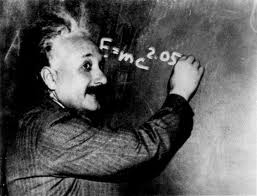
Simple knowledge goes to about Question Number Two on the Socratic – Plato Scale. If you get to Question Number Four you must be scientist. Einstein, who seemingly spoke to The Creator during what has become known as Einstein’s “Miracle Year”, asked “Why do things have mass?”

The answer was probably the most famous physics formula ever written in white chalk on a dusty blackboard.

images (1)

The answer to that why was probably somewhere up near Question Number 20 on the Socratic – Plato Scale. Yet if you study the origins of the theory you start to realize that there were many “Why?” questions and answers that led up to what is still an amazing leap of human imagination.

Learning is Not Educating

And that’s what this is all about – learning results from asking “Why?”. Learning is not education where the answers are already known and are graded as correct or incorrect. Learning is as simple as asking “Why?” every time you think you have the answer. It’s hard brain work.

And that’s why the question “Why?” is hardly ever heard in classrooms in schools, corporations, congress or almost anywhere else. Asking the “Why?” question is not displaying how smart you are with the correct answer; it makes most people feel stupid to ask “Why?”; In some situations it’s even consider impolite or impolitic. Yet that “Why?” is at the root of all critical thinking, and drives innovation, invention, scientific inquiry, and the answers we currently have today to everything we think we know today. It is the real meaning behind the often used quotation by William Butler Yeats “Education is not filling a bucket, but lighting a fire.”

If you think it’s a dumb game to play, try it once. Try the most basic “Why is the sky blue?” and see how high you can climb on the Socratic -Plato Scale. Just keep asking and answering “Why?”.

If you hit Question Number 20 with a good answer, please let me know since I’ve been wondering “Why are we here?” since I was old enough to formulate abstract questions. Maybe The Creator will whisper that secret to you the same way Einstein heard E=MC2.

Learning at the Water Cooler and Everyplace Else


Water Cooler

I cannot believe how duped we’ve been to think of learning as an event. That idea is artifact of the Industrial Revolution and a terrible conceit on the part of the educational institutions we developed. Learning starts BEFORE we are born and (for all we actually know) continues AFTER we are dead. We are in a very real sense Continuous Learning Organisms.

Here’s a piece from Annie Murphy Paul’s The Brilliant Blog which is aptly named and , and if you’ve missed, it I recommend putting it on your weekly ‘must read’ list.

“Bersin by Deloitte, a human resources firm, has an interesting report out on the future of learning in organizations. The language in which it’s written is turgid, to put it kindly (“Our new High-Impact Learning Organization Framework® shows organizations have moved from ‘talent-driven learning’ to a focus on ‘continuous capability development’ . . . “), but there are some good insights to be had. Here, translated from corporate-speak, are its main findings and predictions:

“Continuous Learning” and “Capability Development” will likely replace the buzz around “Informal Learning.” Our new High-Impact Learning Organization Framework® shows organizations have moved from “talent-driven learning” to a focus on “continuous capability development.” Driven by these changes, the L&D market grew 12 percent last year, the highest growth rate in more than eight years. The buzzword of “informal learning” is giving way to a whole architecture of L&D programs that are social, mobile, continuous and highly integrated with talent management strategies.”

Cognitive scientist Allan Collins and his coauthors John Seely Brown and Susan Newman in Rethinking Education in the Age of Technology, notes that digital tools are creating a transformation as profound as the one that swept the apprenticeship model of learning into the Industrial Revolution. It is a transformation that is causing many people to rethink the idea of education. “In the apprenticeship era, most of what people learned occurred outside of school,” they note. “Universal schooling led people to identify learning with school, but now the identification of the two is unraveling.”

Finally we are starting to get to the bottom of learning things! I must admit, I’ve been as culpable as anyone feeding the maw of the formal vs. informal learning debate. My head was stuck in an academic box and stayed there even as I moved into a corporate environment. It was the same problem that corporate learners inherited. As we developed formal learning in our workplaces, we simply grabbed what we knew and were comfortable with from the schoolplace. Learning as an event. Formal, scheduled, instructed. We often went so far as to copy the old physical layout of the classroom – seats facing forward, instructor on the stage, quiet until called upon (yikes!) or recognized by a single hand held waving in the air .

What has been called ‘informal’ learning was really nothing more than a way of naming all the interstices,  the spaces in between the formal learning events. Well, time to move on. There is no “formal” or “informal” learning. There is only, and always has been, continuous learning. And accepting that changes everything.

It means that the definition, design, development and delivery of learning changes. It alters the way learning is managed and measured. The endless conversation about formal versus informal stops. Naming conventions like “courses” and “programs” and “corporate universities” goes away. We start to see learners in a new way – as individuals moving through a world in which they – we – are always learning something new because there is always something new to learn.

We tried to formalize this natural process, and managed to do a really good job disabling it. We took learning out of any real context, gave the onus of the experience to the instructor who provided a predigested often canned helping of facts, heaped upon a PowerPoint slide, removed any chance for serendipity, social interaction or creativity. Rewarded remembering instead of discovering. Punished failure  And we expected people to sit through these massive knowledge dumps and actually learn something.

In a funny way, I was correct years ago when I wrote “At the Water Cooler of Learning“. I think the definition of real learning – the ability to adopt and adapt what we’re taught – is still valid. And I still believe we really do learn most of what we need in between the events that we are told to attend. Yet I was guilty of the same bifurcation of learning into “formal” and “informal” as everyone else. There is no versus, just a flow through the day, learning as you go, remembering what you need to know and know how to do, and forgetting what you knew and knew how to do. It all adds up – from scheduled events to chance water cooler moments – to continuous learning.

So what will this mean to the way you approach learning? As a student? As an instructor or teacher? What will you do differently?